
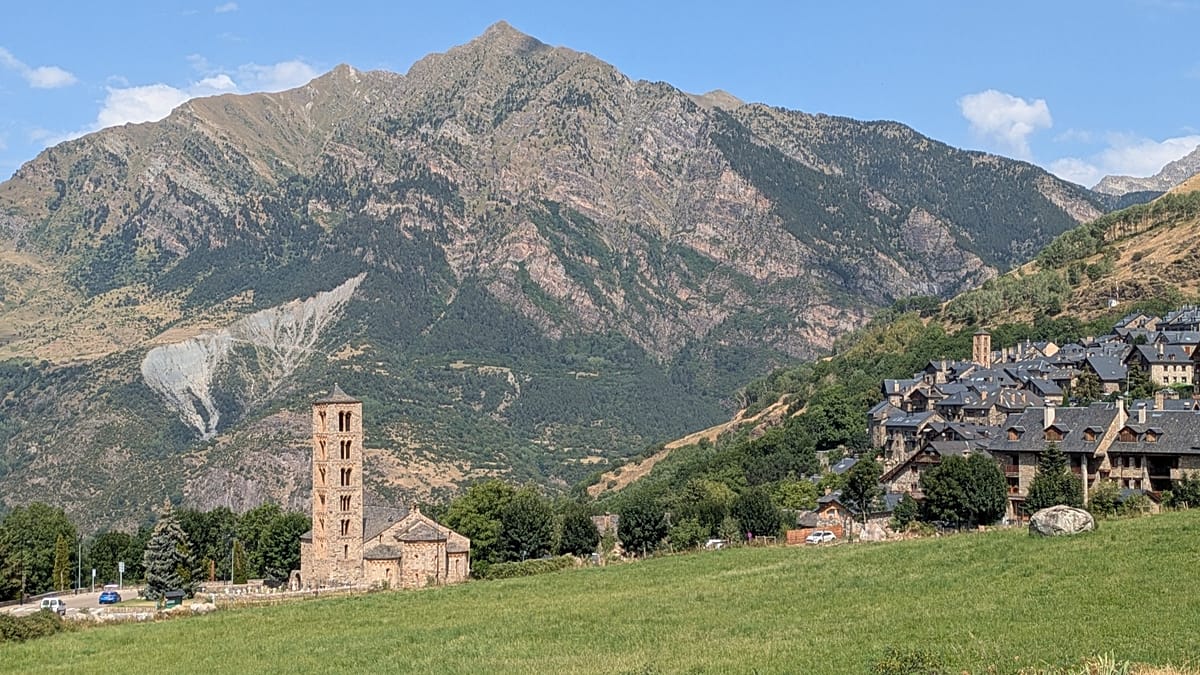
Here’s a confession – this is actually “take two” of this specific travel tale. ADVERTISEMENT ADVERTISEMENT Originally, I had started writing about how a relaxing week-long outdoorsy holiday in Spain had evolved into a mega summer road trip starting in Barcelona, spending a few days in scenic mountain villages and then taking an “eclipsed-sized detour” to San Sebastian. And back again. Then I realised, just like my itinerary planning and driving skills, that it was all getting a bit too chaotic and veering away from what I really wanted to talk about: and that is the Spanish Pyrenees. Had I continued venturing towards the road trip storyline, you would have read a lot about spending hours behind the wheel as we criss-crossed our way through Catalonia, Aragon, Navarre, and the Basque Country – where we ended up to watch the eclipse on 12 August. Not a bad tale, but that’s one for another day, maybe. While Barcelona and San Sebastian are brilliant cities with so much to see and do, it’s only right that the focus here is on slow travel in a lovely part of Spain that I had never been to before. So, without any more talk of roadworks, dodgy satnavs and drastic searches for petrol stations, here’s how we explored a small section of the Spanish Pyrenees. A coolcation with great views Having flown into Barcelona from London, where it was already warm enough, we had feared that a last-minute trip to Spain in mid-August may have been slightly rash considering the rising temperatures across Europe that week. However, in the Vall de Boí the weather was just perfect. Warm during the day, cool at night, with a few storms thrown in here and there for good measure. It is the mountains after all. After a 297km, near four-hour drive to the Boí valley from Barcelona (sorry, but it’s worth adding in the journey details for context), we found ourselves in Taüll, a small village located on the edge of the Aigüestortes i Estany de Sant Maurici National Park – the only national park in Catalonia. Known for its two UNESCO-listed Romanesque churches, Taüll was to be our base for the trip. Sitting at an altitude of around 1,500 metres, it’s an ideal spot for a summer coolcation and you can enjoy scenic walks to nearby villages – up the valley to Pla de l'Ermita or down the hill to Boí. On the walk back down from Pla de l'Ermita you’ll get some great views of Taüll from above. And if hiking or walking isn’t really your thing, then there’s a few restaurants for relaxed al fresco lunches and dinners. In Taüll, we stayed in a one-bed rental above a selection of eateries – Llesqueria l'Empriu, Tribulosi, and Restaurant El Fai – which all serve local dishes and drinks. The walking is what we were here for though and the views are what make the journey really worth it. In Taüll itself, a must-do is the Santeta Viewpoint. You can walk from the Church of St. Climent through the village to the Church of Santa Maria, where a short 15-minute trail starts to the viewpoint. From here you’ll get panoramic views of the valley below and the villages of Boí and Erill la Vall. There’s plenty more to explore around Taüll, particularly if you want to stay active. The national park has hiking trails past lakes and waterfalls, while the Boí Taüll resort offers adventure activities like e-biking and ziplining during summer and skiing in winter. Further down the valley, around El Pont de Suert, you can enjoy rafting and kayaking. From Vall de Boí to Val d’Aran If you have a car and want to explore the wider area then we’d certainly recommend doing a few day trips to some nearby towns and villages. Around an hour’s drive from Taüll, Val d’Aran offers mountain scenery, glacial lakes and some of the region’s prettiest villages. One of its standout walks is the Circ de Colomèrs, a spectacular glacial basin containing almost 50 lakes. The popular seven-lake circuit covers 5.7 kilometres and takes around five hours, with quite a few short climbs included. Elsewhere, you can explore the town of Arties, known for its Romanesque church, historic houses and lively restaurants, or head higher into the mountains to Bagergue, the highest village in Val d’Aran at 1,419 metres. Both are among the valley’s most picturesque villages, though we really loved Bagergue. Here you can wander around its cobbled streets and see traditional stone houses. There are some nice restaurants that serve local cuisine and there’s also a cheesemaker and museum to visit, too. And further afield to Aínsa… One road trip that we should discuss is the journey from Taüll to Aínsa – which is around 95 kilometres and two hours by car. Although it’s a fair drive, you do get some scenic Pyrenean views and the end destination is just lovely. On our long list of places to see while in Spain, Aínsa is a medieval town in the Aragonese Pyrenees. It has a beautifully preserved old town and the cobbled Plaza Mayor is lined with restaurants, cafés and small shops. Another attraction here is Aínsa Castle, which has an elevated walkway along the top of its walls and offers sweeping views of the surrounding mountains. Slow down and stay a little longer Barcelona and San Sebastian are undoubtedly two of Spain’s great city break destinations, but this trip proved that there’s plenty worth exploring in between. In the Pyrenees, slowing down is pretty much the order of the day. Rather than racing between attractions, you can spend your time walking between villages, stopping for lunch on a sunny terrace or heading into the mountains for a trek. If you have the time to venture away from the cities and explore at a slower pace, this corner of Spain is definitely worth the journey.
Slow travel in the Spanish Pyrenees: Exploring Taüll, Vall de Boí and Val d’Aran
Full Article
Original Source
Read the full article at Euronews →KhanList aggregates and links to publicly available news content. We do not host full articles from third-party sources. Always verify important information with original sources.