
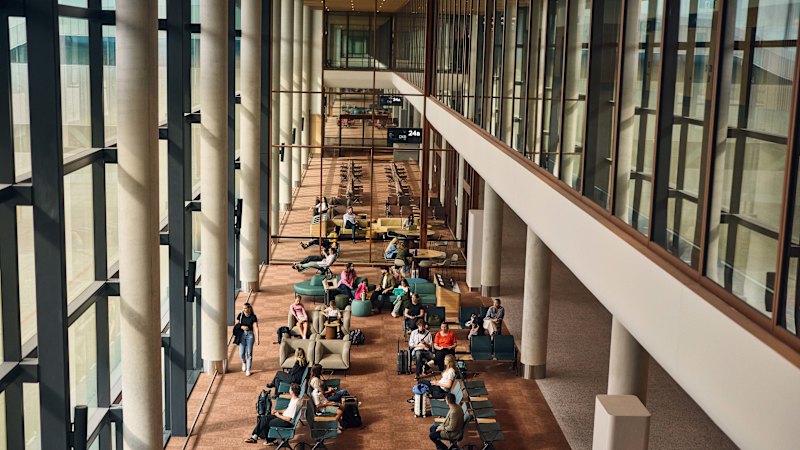
October 24, 2026 — 3:00pmOnce Western Sydney International Airport opens on Sunday, the true strength of demand for flights from Australia’s newest airport will start to show. But success won’t happen overnight, aviation experts say.The curfew-free airport is expected to benefit from Sydney Kingsford Smith Airport’s limits on capacity. But its growth may be held back by passengers’ unwillingness to try the new hub some 50 kilometres away from Sydney’s CBD, as well as airlines’ reluctance to fly there.How busy will it get? An artist’s render of Western Sydney International (Nancy-Bird Walton) Airport.Australia’s first newly built airport in more than half a century is launching at a time of spiralling costs for airlines amid surging fuel prices due to the war in the Middle East, and the kind of global uncertainty that makes market predictions difficult.But playing in its favour are Sydney Airport’s well-known issues with capacity, which are often worsened by its air traffic control staffing issues, inclement coastal weather conditions and a strict curfew, which prevents night take-offs and landings.With those conflicting factors, it’s perhaps not surprising that only seven airlines have committed to fly out of WSI so far, averaging about six return flights a day, domestic and international routes combined.Sydney Airport, by contrast, is at near capacity with about 400 return flights a day across almost 60 airlines.‘Many big cities globally have two or more commercial airports. It was absolutely necessary here as well.’Former IATA business strategist Tony LaverghettaQatar Airways finally committed to flying to WSI this week, though not before late 2027. With crude oil at more than $US100 a barrel, airlines can’t afford to fly uneconomical routes. High costs and a shortfall of new airframes have limited the availability of planes and pilots.Perhaps for this reason, Qantas will run only four return flights per week to Brisbane and four flights per week to Melbourne when it starts to fly from WSI on March 28, 2027, using 95-seat QantasLink Embraer E190 aircraft. Air New Zealand will fly three times weekly to WSI from Auckland.After that, it depends on how well things go. Senior aviation consultant Ian Guy says that if airlines make more money off their routes at WSI than elsewhere, they’ll stick with it. But if the routes are unprofitable, after a season or a couple of years they’ll to pull the flights.‘Slow burn’A look overseas offers examples of the dynamics starting to play out at WSI. Secondary airports operating far from the city centres they nominally serve, tend to attract low-cost airlines that effectively “plant a flag” to watch the demand, says Guy, who is a director at Melbourne-based Tango 5 aviation consultancy. A carrier can then quickly scale up if demand supports it.Qantas-owned Jetstar has made the biggest commitment to WSI so far. Jetstar will fly up to 24 return services a week from Western Sydney, with up to 14 to Melbourne, daily services to the Gold Coast, and three a week to Brisbane.Vietnam-based low-cost carrier Vietjet will start flying two return services a week to Ho Chi Minh City in January. The airline’s stablemate Vietjet Thailand is expected to begin flying four times a week to Bangkok in November 2027.In addition to Air New Zealand’s commitment, Singapore Airlines will have one daily return flight from WSI to Singapore Changi.Behind the scenes, subsidies for operational fees are also a factor. A $16 million Western Sydney International Take-Off Fund backed jointly by the airport and the NSW state government has been designed to help woo airlines to the new airport.Yet what happens after the initial sweetener is a different matter, Guy says, and it’s possible that “once that subsidy falls away, the route doesn’t have the same economics and so it stops existing.”Ellis Taylor, Asia editor for aviation analytics company Cirium, expects the new airport uptake would be “a bit of a slower burn” but WSI’s ability to operate late at night and early in the morning adds “an interesting dynamic”.‘More than just the poor man’s Sydney Airport’WSI is “more than just the poor man’s Sydney Airport,” Taylor says, comparing its premise with when Jetstar began flying from Avalon in 2004. “It’s not really sort of seen as an alternative to the main airport as yet. It’s more about opening up an additional demand point,” she says. And once that is done, the airport’s viability in the larger aviation market will be tested.Yet, in other ways, WSI and Avalon could not be more different. While WSI is built on the expectation of expanding commercial flights to Sydney’s west, Avalon was built in the 1950s for use by military planes and only turned into a commercial airport in the 1990s.A view from the new airport’s top floor, where international passengers will arrive.Sitthixay DitthavongMelbourne Tullamarine, Victoria’s primary airport, has plenty of capacity, hosts more than 40 airlines (including, from this month, Finnair) and operates without a curfew. Avalon is operating against an unconstrained competitor. In turn, it has sought to specialise and tap the growing logistics and freight sectors to link Victoria to export markets in the Middle East.The proximity of airports often shape where airlines base themselves. In London, Heathrow is the premium airport, serving alongside smaller airports Gatwick, Stansted and Luton, which function as hubs for low-cost carriers such as easyJet, Ryanair, and Wizz Air.“If you really looked at the density of their flight operations...they have each picked particular airports to focus on,” says Guy.A UK-based network planner with knowledge of the Australian market believes WSI will be a success, as it adds real international capacity to the city.“It relieves Sydney’s peak-slot scarcity and it’s curfew-free, so carriers can build in the late-night and early morning departures that make European connections work” – a big advantage over Kingsford Smith, she points out.Western Sydney is also “a big, multicultural catchment with strong VFR [visiting friends and relatives] demand and family ties abroad”.WSI will target the leisure and visiting friends and relatives market, which is cheaper, volume-led, she says, “while Kingsford Smith holds the premium end”.The VFR market has its own dynamic. People typically take fewer trips, but travel in bigger groups. They tend to fly on less expensive fares, too, and have more luggage. This could be a positive for WSI’s launch, as passengers are likely to travel by car and won’t be dissuaded by WSI’s nascent ground transportation.Escalators and stairs link a bag-drop area to departures on the first level.Sitthixay DitthavongVFR represents a significant plank of the aviation market in Australia. NSW Premier Chris Minns has been courting India as a major source of visitors to the state. But demographics don’t mean an automatic embrace from homeland airlines.In a media presentation early this month by Air India head of global sales Manish Puri played down the possibility of serving WSI for now, saying that while the “options of opening new stations always remain… initially, our intention is to densify our current network” with more frequencies.About 60 per cent of Air India traffic to and from Australia is VFR, Puri says, and while VFR will remain a “strong point” for the airline, Air India wants to move more into meeting demand for travel to Europe.The addition of WSI to Australia’s network of airports could spur other changes too.Perth-based senior aviation consultant Bill Meeke says the combination of the curfew at Sydney Airport and the three-hour time zone difference with Western Australia during daylight saving means that “the daily window of access for flights from Perth is very narrow for much of the year”. Curfew-free flights at WSI could change that.As the new airport finds its place in the national aviation grid, it may spur other opportunities. It’s possible an overseas carrier would make WSI a stopover between a domestic airport and an international destination to pick up enough passengers to make its flight profitable. There could be a route like Cairns-Western Sydney-Hong Kong, for example, where passengers from two domestic points are used to fill the plane.Once WSI kicks into gear and proves a business success for the first airlines, it could become a meaningful competitor to Sydney Airport and force the city’s long-established hub to lift its game, says Guy.Unable to add a lot more airlines, Sydney Airport will then have to help carriers up-gauge their aircraft, accommodating larger-capacity, bigger planes, he says.But that’s in the future. “I suspect at the moment they’re not overly worried.”Tony Laverghetta, a former International Air Transport Association business strategist, says it will take time, but eventually WSI “will become a solid option for travellers”, especially when its new metro line opens.“Many big cities globally have two or more commercial airports,” Laverghetta says, pointing to London, New York, Milan and Paris. “It was absolutely necessary here as well.”The Market Recap newsletter is a wrap of the day’s trading. Get it each weekday afternoon.From our partners
‘Slow burn’: Western Sydney Airport’s real challenge awaits after launch
Full Article
Original Source
Read the full article at Smh →KhanList aggregates and links to publicly available news content. We do not host full articles from third-party sources. Always verify important information with original sources.