
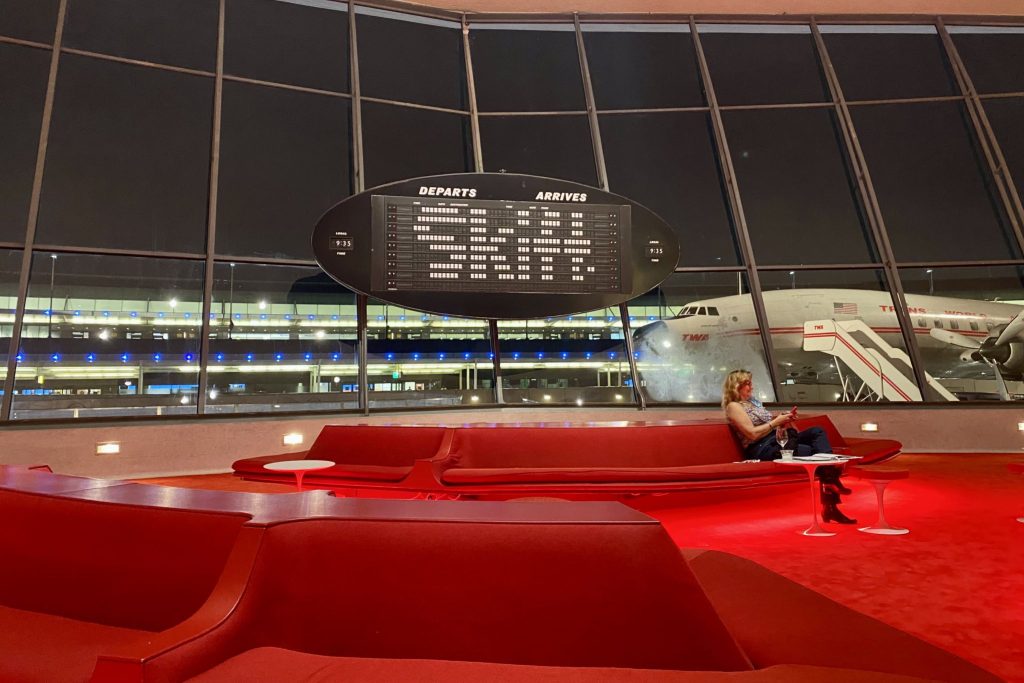
TWA Hotel at JFK International Airport, New York · Nov 12, 2026 Skift Aviation Forum 2026 · Pre-Read Jet fuel prices are still rising, and just about every variable affecting air travel is in flux — aircraft supply, air traffic volume, global partnerships, input costs. Decisions made today will determine who succeeds in aviation. Passenger demand and airline revenues seem to be holding at a macro level. For now. Jet fuel prices continue to rise, aircraft remain scarce, and labor and airport costs keep rising. Meanwhile, global air traffic has been unpredictable throughout 2026, with wide regional differences. Airlines at all levels of the market are shifting toward premium offerings to offset these headwinds and keep their revenues afloat. They’re redesigning cabins, loyalty programs, networks, ancillaries, and customer experiences. Skift Research describes the premium push as a normalizing trend: it’s now a baseline offering underpinning revenue expectations, rather than a stopgap strategy. [1] The decisions industry leaders have to make today center on how to yield a competitive advantage within this industry-wide shift. The decisions underpinning every conversation at the 2026 Skift Aviation Forum will provide foundational evidence for these answers. Premium cabins generated 24% of global airline passenger revenue in 2024, or about $188 billion. For many carriers, premium is becoming the primary engine of revenue expansion, helping offset margin pressures elsewhere in the business. [1] Skift Aviation Forum: TWA Hotel at JFK International Airport, New York, November 12, 2026 Group tickets $1,195 (2+) · Solo tickets $1,295 · Airline Weekly subscribers $500 with code SAF26AW. events@skift.com Register now The agenda The Five Decisions Decision 01Can Airlines Absorb Fuel Costs Without Passing Them to the Customer?→ Decision 02How Far Should Airlines Push the Premium Shift?→ Decision 03Where Should Airlines Add Capacity?→ Decision 04What Makes Loyalty to an Airline Strong Enough to Survive AI’s Efficiency?→ Decision 05Which Operational Investments Are Worth Committing to Now?→ Can Airlines Absorb Fuel Costs Without Passing Them to the Customer? Fuel has become the industry’s biggest near-term margin test. Airlines entered the year with strong passenger revenue and high load factors, but the economics changed quickly as jet fuel prices climbed. The impact is not uniform. Some airlines have more pricing power, stronger premium demand, better hedging positions, or networks that can absorb a shock more easily. Others compete in markets where travelers are more price-sensitive or where adding a fuel surcharge risks pushing demand to a rival. The decision is how much of the fuel increase airlines can absorb before fares have to rise. IATA expected the airline industry’s net profit to halve in 2026, a forecast made months before jet fuel prices peaked above $200 a barrel in October. [2] [3] The Decisions Being Made Right Now How much of the fuel increase can airlines absorb before margins become unacceptable? Which markets have enough pricing power to support higher fares? When does a fuel shock justify cutting capacity or exiting a route? How should premium demand affect decisions about fare increases? What signals show that passengers are beginning to resist higher prices? What to Discuss in the Room How global airline CEOs and finance leaders decide when to absorb fuel costs and when to raise fares. How network and commercial executives identify routes where higher fuel costs no longer support the economics. What low-cost and full-service airline leaders see differently about the passenger’s ability to absorb higher prices. How revenue-management executives use demand and pricing signals to decide how much of a fuel shock can be passed through. How Far Should Airlines Push the Premium Shift? Airlines have spent the past several years reallocating space toward travelers who generate more revenue per seat. It’s not just major international carriers, either. Low-cost airlines have nearly doubled premium capacity since 2019. Demand has kept up so far. More than 70% of travelers surveyed by Skift Research said they would consider paying for a premium cabin. [1] The decision is how much further to push. Premium now affects cabin configuration, route planning, revenue management, airport strategy, and loyalty. Airlines need to know where demand still supports expansion and where the market is beginning to crowd. U.S. domestic premium-seat capacity has grown 33% since 2020, roughly twice the 16% growth in economy seats. Premium revenues are significantly outpacing overall revenue growth and driving disproportionate value within airline revenue streams. [1] The Decisions Being Made Right Now Which routes can support additional premium capacity without diluting yield? How should airlines price the gap between economy, premium economy, and business class? How much cabin space should move toward higher-yield travelers? Which competitive markets justify the highest product and schedule investment? What would indicate that the premium cycle is beginning to weaken? What to Discuss in the Room How network planners are allocating capacity around high-yield demand. What low-cost and hybrid airline executives are learning as they develop premium strategies. How revenue-management and loyalty leaders measure the total value of a premium customer. What airline strategy and research executives are watching to identify potential oversupply. Where Should Airlines Add Capacity? The global traffic story has fractured by region. Middle East passenger traffic is expected to contract by 11.4% in 2026 amid airspace closures and reduced transfer demand, while Africa and Asia-Pacific will benefit from the shift. [4] Global load factors are reaching record levels because capacity remains constrained even as demand slows. The decision is how to create the strongest return if capacity becomes more scarce. Slower global growth raises the cost of getting that call wrong. Global air traffic growth is expected to slow to 2.1% in 2026 from 5.3% in 2025, while capacity increase is expected to be even lower at 1.6%. [4] The Decisions Being Made Right Now Which markets deserve incremental capacity as global traffic growth slows? When does a smaller aircraft create better network economics than waiting for a larger narrowbody? Which routes should an airline cut rather than defend? How does consolidation change the opportunities left for smaller carriers? Which regional demand shifts are durable enough to affect fleet and network plans? What to Discuss in the Room How airline executives, investors, and strategists assess opportunities in a more concentrated market. How low-cost airline commercial executives are finding growth while parts of the sector retrench. What aircraft manufacturers and fleet planners see as the tradeoff between availability, gauge, and unit cost. What network-planning and aircraft-marketing leaders see changing as traffic moves between regions. What Makes Loyalty to an Airline Strong Enough to Survive AI’s Efficiency? For many travelers, the ease of knowing they’ll get some miles and a few perks outweighs the headache of price comparison. AI changes this calculation, even for those who consider themselves somewhat loyal. Shopping tools can compare fares and products across airlines immediately. A traveler carrying points or status can still be presented with a better-priced or better-matched option somewhere else. The decision for airlines is what loyalty has to deliver beyond points. Service, recognition, card economics, access, flexibility, and personalization can all strengthen the relationship. To avoid commoditization, airlines need to prove to travelers at every level of their programs that they can offer differentiated value. The shift to premium is buoying revenue numbers, but AI platforms may not-so-quietly siphon off loyalty value from otherwise brand-agnostic travelers. The Decisions Being Made Right Now Which loyalty benefits still change traveler behavior? How should airlines measure a customer’s lifetime value alongside the yield of an individual seat? When do co-branded card economics start affecting network and product decisions? What can a loyalty program offer that an AI shopping tool cannot commoditize? How much personalization should move into pricing, servicing, and offers? What to Discuss in the Room How airline loyalty executives are redefining what members value. What airline commercial and credit-card leaders see in the relationship between loyalty economics and network decisions. How revenue-management and technology executives could incorporate customer value into pricing decisions. What customer-experience leaders believe must remain human as AI moves into shopping and service. Which Operational Investments Are Worth Committing to Now? The industry has to make long-term commitments while near-term conditions remain volatile. Those investments have to make some assumptions about how the industry will operate years from now. The decision is which bets deserve capital allocation. Growth alone is no longer enough justification. Airlines, airports, and manufacturers need a clear view of what each investment changes — capacity, economics, reliability, service, or competitive position. Global airline passenger revenue is expected to approach $883 billion in 2027, but annual growth is projected to slow to about 3%. [5] The Decisions Being Made Right Now Which aircraft and infrastructure investments still make sense under slower traffic growth? Where should airports prioritize people, process, and technology before new physical capacity? Which parts of shopping and service should AI handle directly? Which emerging aviation technologies have the clearest commercial path? What to Discuss in the Room How airport CEOs and operations executives decide which infrastructure investments materially improve the journey. What aircraft manufacturing leaders see in production capacity, fleet demand, and the next generation of aircraft. How airline customer and operations executives divide responsibility between automation and human service. What aviation investors and former airline operators consider commercially credible among newer technologies and business models. What You Will Leave With The airline industry’s next set of decisions centers on where to commit. Airlines need to decide how much further to push premium, where capacity belongs, which rising costs customers can absorb, what keeps loyalty valuable, and which long-term investments deserve capital now. Each decision comes back to the same constraint: airlines cannot pursue every opportunity at once. Skift Aviation Forum is focused on helping industry leaders identify where the economics still justify the strategy. Register now Sources [1]Skift Research, The Premium Shift: How Airlines Are Rebuilding Around High-Yield Demand, July 2026 [2]IATA June Outlook, 2026, cited by Skift Research, State of Travel 2026, p. 128 [3]IATA Jet Fuel Price Monitor [4]IATA June Outlook, 2026, cited by Skift Research, State of Travel 2026, p. 129 [5]Skift Research, State of Travel 2026, p. 127
Skift Aviation Forum 2026: Five Decisions in the Room
Full Article
Original Source
Read the full article at Skift →KhanList aggregates and links to publicly available news content. We do not host full articles from third-party sources. Always verify important information with original sources.