
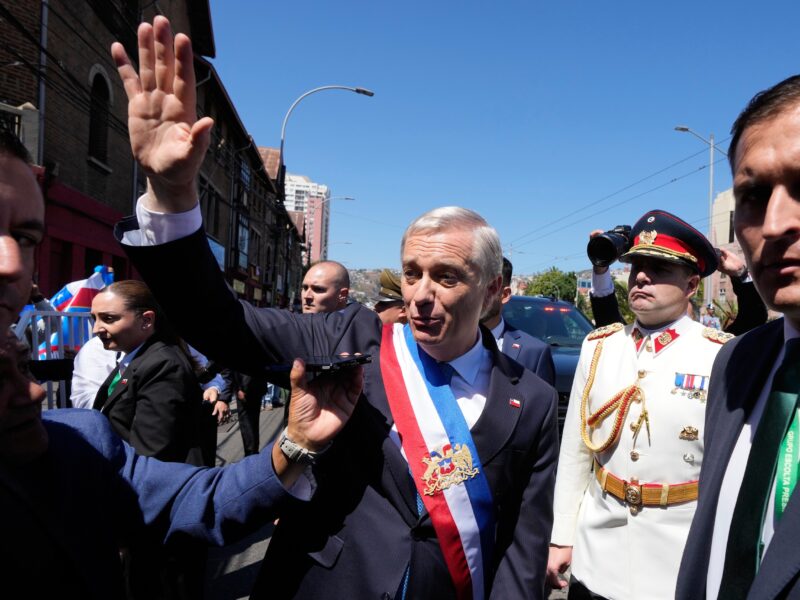
SANTIAGO, Chile (CN) — La Vega, Chile’s largest produce market, was busy on a Monday morning as workers opened their stalls and early customers moved between vendors selling fruits, vegetables and fish.Thousands of vendors work there year-round, supplying one of the country’s main food markets. For more than 130 years, La Vega has drawn restaurant owners, families and shoppers looking for low prices. But in recent years, crime — particularly robberies — has become part of the daily concerns in the surrounding neighborhood.Six months into the presidency of far-right populist José Antonio Kast, La Vega offers a view of the challenges facing a government elected on promises to improve security and revive the economy.Elena Cruz, a woman in her 80s, sat outside a tarp-covered stall she has owned for five years, where two employees sell vegetables and fruit. For decades, her husband, now 95, supported their family while she raised their children. He is now ill, and Cruz has spent years caring for him while managing the small business that helps support them.But, she said, business has become more difficult.“There’s no money on the streets,” Cruz said. “I see mothers buying two or three potatoes, while some years ago they’d take kilos of them.” Cruz said she did not vote for Kast in December but still hoped conditions would improve. Instead, she said, “things are going from bad to worse.”The economic picture has given voters little immediate relief. Unemployment reached 9.5%, with the number of unemployed people up 10.4% from a year earlier, according to Chile’s National Statistics Institute, while consumer prices rose by 4.1% over the past year.Kast’s public support has also weakened. His approval stood at 31% in the latest Criteria poll, while 55% disapproved of his government.The president, who campaigned on reversing policies of his predecessor, progressive Gabriel Boric, and addressing Chile’s economic and security concerns, has acknowledged the challenge on jobs.“We haven’t been able to fix the unemployment,” he said in a recent radio interview, adding that his government would seek partnerships with the private sector to increase hiring in the coming months.For people like Cruz, however, economic pressures are already tangible.Iris Castro, 33, earns about $800 a month cleaning houses and spends more than three-quarters of her income on rent for herself and her 2-year-old daughter. “Everything is just getting more and more expensive,” she said.Castro voted for Kast but said she would not vote for him again if conditions remain unchanged. Her concerns extend beyond the economy to another issue that dominated the election: security.As she did her grocery shopping in La Vega, Castro glanced around and pointed to police officers standing near the stalls. “A few months ago, this was no man’s land,” she said. “There’s more control now, but it still isn’t enough.”More than 60% of Chileans identified public safety as one of their main concerns during last year’s election. Although crime levels in Chile remained low compared with those of many other Latin American countries, concerns about violence and organized crime became central to the political debate.Gonzalo Parra, head of the political science program at the University of Chile, said criminal activity in the country has changed since the pandemic as part of a broader regional trend.Criminal organizations have expanded across Latin America, particularly in South America, and Chile has become increasingly attractive as a market for their entry into the financial system, Parra said.“That makes it appealing,” he said, adding that Chile has also become an unconventional route for drug trafficking to Australia and Asia.Kast campaigned against illegal immigration, particularly from Venezuela, and have linked newcomers to violent crime while criticizing the migration policies of previous governments.But Parra said the government’s response to security has so far amounted largely to a continuation of policies adopted by previous administrations. “He said he had a plan, but his first six months haven’t shown that,” Parra said.The government has instead increased the police presence in the streets, which Parra described as an attempt to project strength. “Most of it has been a continuation from past administrations,” he said.The government has also moved toward broader institutional changes. It introduced a bill to amend Chile’s Constitution and adopt tougher security measures, including expanded executive powers over security and the possibility of declaring a state of emergency for up to 120 days, with the possibility of renewal without full congressional approval.“It’s what governments in Venezuela, Nicaragua and El Salvador have used to erode political accountability,” Parra said, echoing concerns raised by human rights advocates about the potential consequences of giving the executive broader security powers.The government’s security agenda is also connected to a broader shift in Chile’s foreign policy, according to Gilberto Aranda, a political scientist and international affairs scholar. He said Kast has sought closer alignment with U.S. President Donald Trump through participation in the Shield of the Americas — a coalition started by the Trump administration to target drug cartels and other international crime rings — but that alignment has not produced the relationship Kast expected.“Kast entered thinking that if he joined the Shield of the Americas he would have a full relationship with the U.S., and that he would be among the favorites," Aranda said. “And it was not like that.”Aranda said Washington is increasingly seeking clearer geopolitical alignments in Latin America as it tries to limit China’s influence. That presents a challenge for Chile, whose economy remains deeply connected to Asian markets.For decades, Chile has pursued an open trade policy, maintaining commercial relationships with countries across the political spectrum. Kast’s government now faces a more difficult geopolitical environment in which trade and strategic alliances are increasingly intertwined.“The affinity that Kast cultivated very early with Trump, there is a feeling that it has not paid off as expected,” Aranda said.Lucía Cholakian Herrera is a Courthouse News correspondent covering Latin America based in Buenos Aires. She reported from Santiago, Chile.Subscribe to our free newslettersOur weekly newsletter Closing Arguments offers the latest about ongoing trials, major litigation and rulings in courthouses around the U.S. and the world, while the monthly Under the Lights dishes the legal dirt from Hollywood, sports, Big Tech and the arts.Additional Reads
Six months into far-right presidency, Chileans wait for results
Full Article
Original Source
Read the full article at Courthousenews →KhanList aggregates and links to publicly available news content. We do not host full articles from third-party sources. Always verify important information with original sources.