
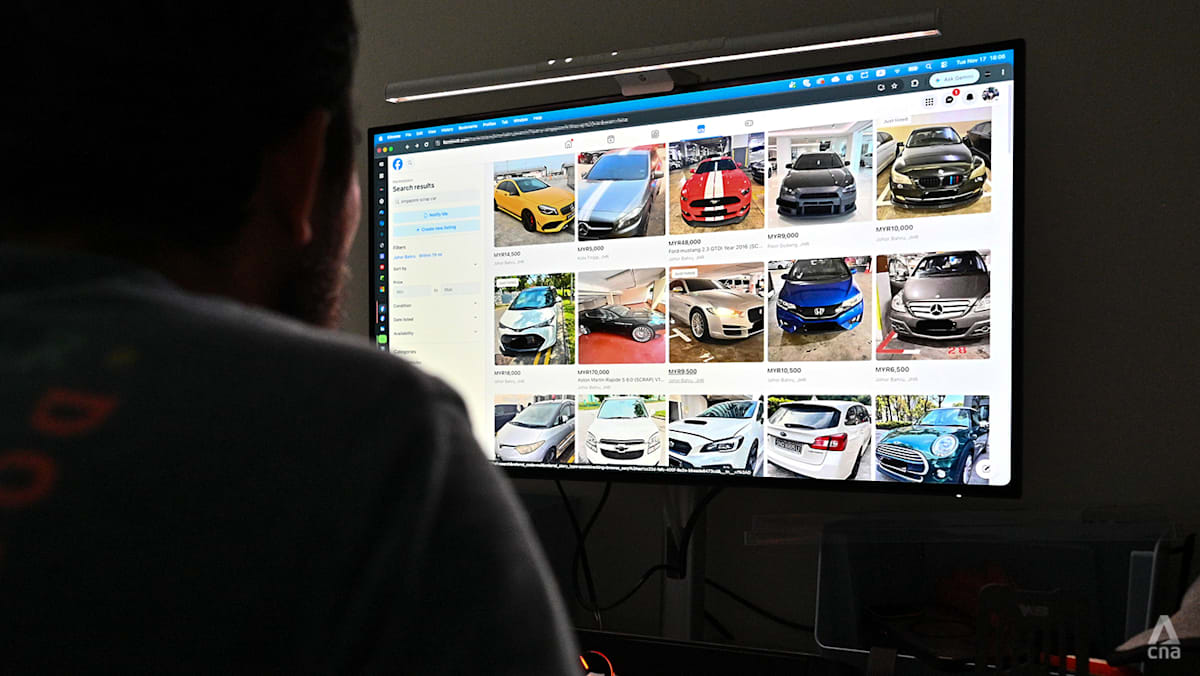
JOHOR BAHRU: A BMW Coupe for just RM25,000 (US$6,070), roughly a third of what it would cost in Malaysia's secondhand car market.This was among the eye-catching deals being advertised online by traders in Johor Bahru, where even luxury European cars can be found for a fraction of the prices commanded by legally registered vehicles.But there's a catch: These cars have been deregistered in Singapore and cannot simply be driven on public roads without meeting the relevant registration requirements.CNA found hundreds of online advertisements offering such vehicles for sale across platforms such as Facebook, Telegram and WeChat.The listings feature everything from Japanese brands such as Toyota and Honda to luxury European marques including BMW, Mercedes-Benz and Land Rover.Most vehicles were advertised to be between 10 and 20 years old, with asking prices ranging from about RM5,000 to RM100,000.On Monday (Nov 23) alone, advertisements included a 10-year-old Toyota Vellfire going for RM33,000, a 15-year-old Mercedes-Benz for RM10,000 and a 15-year-old Mini Cooper for RM5,500. A screenshot of a social media listing advertising a Singapore-deregistered vehicle for sale in Johor Bahru, Malaysia. While some sellers explicitly stated that the cars are meant to be stripped for spare parts, CNA found that others were willing to sell intact vehicles for road use.And despite their deregistered status, some sellers acknowledged that customers had bought these cars to drive on Malaysian and even Singapore roads.Some also described how vehicles could be disguised as being legally registered through car cloning, a practice involving the use of another vehicle's registration identity. These include its number plates and, in some cases, falsified documents or identification details."This is a risk which is borne by buyers. We can direct … to specific workshops who can help with the cloning but we do not condone this," said one seller who oversees a Facebook page advertising Singapore-deregistered cars."The risk of getting caught is high both in Singapore and Malaysia, but some are willing to take this risk because the prices are so cheap," added the seller, who declined to be identified. Singapore-registered scrap cars, typically sold for spare parts, are advertised on social media at low prices in Johor Bahru, Malaysia. Some appear to be in good condition. (Photo: CNA/Zamzahuri Abas) The findings raise questions about whether a legitimate cross-border trade in used vehicles and spare parts is being exploited to put deregistered cars back on public roads.They also cast a spotlight on the potential risks to other motorists, particularly when accidents occur and victims are left seeking compensation.On Oct 29, a fatal accident involving a blue Audi in Tampines - located in the eastern part of Singapore - killed a 24-year-old motorcyclist and his pregnant wife, also 24, who was riding pillion. The Audi's driver was subsequently charged with several offences, including dangerous driving causing death, using a deregistered vehicle, displaying a false licence plate and driving without insurance.The accident sparked online speculation that the Audi had previously been advertised for sale by a Johor-based dealer, after social media users pointed to photographs of a similar-looking car listed in August.However, there is no verified evidence linking the vehicle involved in the Tampines accident to those listings or establishing that it had been exported to Malaysia before returning to Singapore.CNA has sought clarification from Singapore's Land Transport Authority (LTA) and police on the vehicle's history.Transport economist Walter Theseira warned that illegally-driven deregistered vehicles could leave accident victims with limited avenues to recover compensation."The basic problem is these vehicles are uninsured so it means that any liability resulting from accidents will likely be borne by the victims," said the Singapore University of Social Sciences academic."Technically, of course, it's still the driver who is liable, but odds are that many such vehicles will be driven by persons who are engaged in criminal activities, and are likely to have little legal assets that can be used to compensate victims." FROM SCRAP TO THE STREETS: HOW THE TRADE WORKSFor many Singapore motorists, deregistration marks the end of a car's legal life on the road.A Certificate of Entitlement (COE) typically lasts 10 years and can be renewed for another five or 10 years, depending on the vehicle category.If the COE is not renewed, the vehicle must be deregistered and disposed of in accordance with LTA's requirements.Owners can have their vehicles scrapped at an LTA-appointed scrapyard or export them overseas. Some are stored at export processing zones pending shipment.Exporting an intact deregistered vehicle is not inherently illegal. Neither is dismantling it overseas for usable parts, experts told CNA.But the distinction becomes important when a vehicle exported for dismantling is subsequently offered to an individual for driving.Malaysian automotive industry analyst Hezeri Samsuri told CNA that many Singapore-deregistered cars are exported with the stated purpose of being stripped for spare parts, which can then be used to repair vehicles in Malaysia.The cars can be particularly attractive because many remain in relatively good condition despite having reached the end of their COE period. File photo of dismantled vehicles at a used auto parts shop in Johor Bahru. Some of the vehicles were imported from overseas for their spare parts. (Photo: CNA/Zamzahuri Abas) Theseira said the quality of their components makes them valuable to Malaysia's automotive repair industry.While it is possible for an eligible imported Singapore car to be legally registered for Malaysian road use, doing so requires the necessary import approvals, inspections and registration documents.Malaysia's standard Open Approved Permit scheme for used or reconditioned cars generally applies to vehicles between one and five years old, said Hezeri, who is managing editor of automobile publication Careta Media. That creates a significant hurdle for many Singapore-deregistered vehicles being advertised in Johor, which are considerably older. BARGAIN PRICES, HIGH RISKS: WHAT SELLERS TOLD CNACNA's enquiries with sellers in Johor revealed how some of these vehicles are marketed to buyers who intend to drive rather than dismantle them.Some claimed they could refer interested customers to workshops offering vehicle-cloning services, while others described arrangements for buyers to collect intact cars and drive them away.Several sellers asked prospective buyers for a deposit of roughly 10 per cent of the advertised price before arranging a viewing or test drive.One seller advertising Singapore scrap cars on WeChat described how customers typically took possession of the vehicles."They usually drive off with the car (and not use a tow truck). We do the exchange at night usually where there are fewer cars on the roads to minimise the chance of facing accidents," the seller said.Another seller, who said his team operated out of Taman Daya in Johor Bahru, acknowledged that motorists using such vehicles risked being caught if the cars were involved in accidents or traffic offences. The Taman Daya suburb is about a 20 minute drive from Johor Bahru's Customs, Immigration and Quarantine (CIQ) complex. He believed the risk was considerably higher in Singapore, citing electronic road pricing and parking systems that could expose inconsistencies in a vehicle's registration details. An ERP alert that will appear as part of a trial of ERP 2's location-based charging. The feature will roll out to the public on Jan 1, 2027. (Photo: CNA/Syamil Sapari) Other sellers said the majority of their customers were based in Malaysia.One Facebook seller, whose page carried about six vehicle listings a day, claimed that many customers purchased the cars as cheap second vehicles for everyday use."They usually use these cars in villages where the likelihood of enforcement is lower. Just for simple everyday chores like sending kids to school and for groceries," he said.The accounts by the sellers suggest that some buyers see the savings as worth the risk of getting caught.Such vehicles also risk being exposed when a traffic offence, parking summons or accident is linked to the legitimate vehicle whose identity has been copied.Sellers added that there are buyers who purchase these scrapped cars but choose not to clone it and merely drive it around Johor. Theseira noted that Singapore-registered cars are a familiar sight in Johor Bahru, which attracts large numbers of Singaporean visitors."A Singapore-plated car doesn't attract much attention in Johor Bahru," he said. ILLEGAL USE ON THE RISE, ON BOTH SIDES OF THE CAUSEWAYSingapore has recorded a sharp rise in cases involving the illegal use of deregistered vehicles.According to figures released by LTA, there were 75 reported cases in 2024, rising to 245 last year.On Nov 20, the authority said 566 deregistered vehicles had been impounded so far in 2026, reflecting what it described as both a higher prevalence of offences and stepped-up detection and enforcement.The 2026 figure refers to vehicles impounded and is not directly comparable with the reported case figures for previous years.It remains unclear how many of these vehicles had been exported to Johor, purchased there and subsequently brought back into Singapore illegally.But authorities have documented instances of deregistered vehicles crossing the border.In May, LTA announced charges against three men in separate cases involving deregistered vehicles.Among them was a 62-year-old Singaporean who allegedly used a deregistered vehicle to cross Woodlands Checkpoint on numerous occasions between 2024 and 2025.A 63-year-old Singapore permanent resident was also charged in a separate case involving a deregistered vehicle that had allegedly crossed Singapore's land checkpoints repeatedly over the same period. A worker sweeps the floor with the congested Causeway and an “I Love Johor” billboard in the background on May 20, 2026. (Photo: CNA/Zamzahuri Abas) Across the Causeway, Malaysian authorities have also uncovered syndicates dealing in stolen and cloned vehicles.In March, Malaysian police arrested 12 suspects and seized 12 vehicles worth an estimated RM1.1 million during an operation targeting a vehicle theft and cloning syndicate operating across several states.Eight of the vehicles had allegedly been cloned, while four were reported stolen from Singapore.In Johor alone, the Road Transport Department (JPJ) seized 2,075 vehicles for various serious road-traffic offences in 2025.The figure does not specifically identify cloned vehicles or deregistered Singapore cars, making it difficult to determine the scale of this particular trade.A JPJ Johor spokesperson told CNA that the department was aware of businesses selling deregistered Singapore vehicles in the state and was investigating whether illegal sales had taken place. TOUGHER LAWS, BUT ARE THERE STILL ENFORCEMENT GAPS?Both Singapore and Malaysia have moved to strengthen penalties and enforcement against the illegal use of deregistered or falsely registered vehicles.In Singapore, tougher penalties for keeping or using unregistered or deregistered vehicles took effect on Feb 27.Under the penalties, first-time offenders may be fined up to S$20,000 (US$15,500), jailed for a maximum of two years, or both. Previously, they faced a fine of up to S$2,000, a jail term of up to three months, or both. Penalties are doubled for repeat offenders.In October, parliament also passed legislation to tighten the disposal and export of deregistered vehicles.Among the measures is a new Authorised Exporter Scheme, which will require deregistered vehicles intended for export to be handled by LTA-authorised exporters.The reforms also provide for a shorter disposal period of 14 days, down from one month, and new offences targeting those who knowingly or recklessly supply deregistered vehicles for illegal use on Singapore roads.The Authorised Exporter Scheme is not yet operational, with LTA targeting implementation in the fourth quarter of 2027. File photo of dismantled vehicles at a used auto parts shop in Johor Bahru. Some of the vehicles were imported from overseas for their spare parts. (Photo: CNA/Zamzahuri Abas) Malaysia has also strengthened penalties for vehicle-record falsification offences under amendments to its Road Transport Act that took effect on Oct 16.Certain offences involving falsified vehicle records or identities now carry fines of up to RM200,000, imprisonment of up to 10 years, or both.Anthony Loke - whose official capacity as transport minister remains in limbo after he submitted his resignation letter - had previously identified cloned vehicles as one of the problems the tougher penalties were intended to address.But experts say tougher punishments alone may not be enough to disrupt the trade.Theseira suggested tighter regulation of businesses that produce and install vehicle registration plates, including a system of government-approved plate makers."There is no regulation in Singapore governing 'approval' of licence plate makers," he said. "So it means that really, a lot of parties down the chain can potentially abet the car cloning process without being specifically regulated."Another potential safeguard is technology.Cartrack, a telematics company specialising in vehicle tracking and fleet management, told CNA that tracking deregistered vehicles through the disposal and export process would be technically possible, although it would come with significant limitations."Tracking devices can be removed or disconnected, particularly by individuals deliberately attempting to avoid detection. There is also the question of who should be responsible for monitoring a vehicle once it has been deregistered, and for how long," said Carmen Calisto, co-chief executive of Cartrack Asia.Meanwhile, Hezeri suggested that Malaysia could tighten the import process by requiring vehicles brought in specifically for dismantling to be broken down before crossing the border.Such a requirement, he said, could help reduce opportunities for complete vehicles destined for scrapping to be resold for road use.But he acknowledged that enforcement measures would be unlikely to eliminate the problem entirely."It seems that the cheap prices are just too difficult to ignore and people (will continue) to exploit loopholes," he said.
Singapore-scrapped cars resold in JB: Are they illegally returning onto roads?
Full Article
Original Source
Read the full article at Channelnewsasia →KhanList aggregates and links to publicly available news content. We do not host full articles from third-party sources. Always verify important information with original sources.