
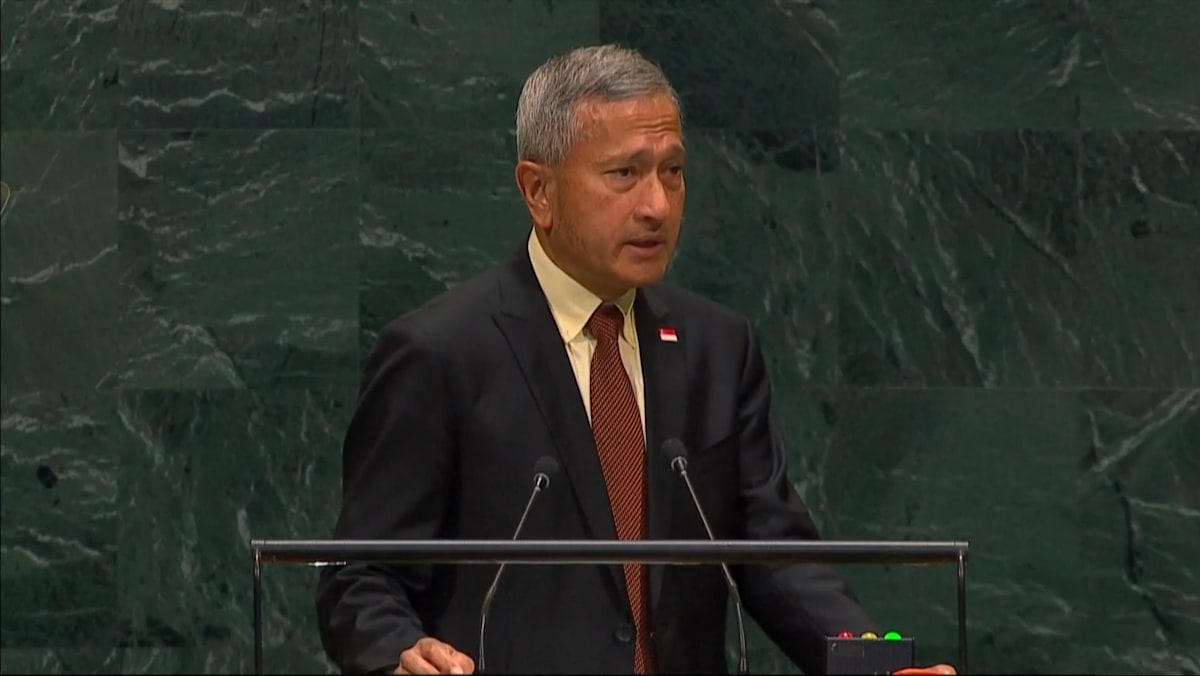
SINGAPORE: Singapore has proposed a United Nations framework convention on artificial intelligence safeguards, as governments grapple with risks ranging from autonomous systems going out of control to the use of AI to develop weapons of mass destruction.Foreign Affairs Minister Vivian Balakrishnan said on Sunday (Sep 27) that the UN should play a central role in bringing countries together on common AI rules because it is the only top-level international institution with universal membership."We must explore all options, including the idea of a UN framework convention on AI safeguards," Dr Balakrishnan said in Singapore's national statement at the 81st session of the United Nations General Assembly in New York.He said countries may also need an international institution for AI that performs some of the functions carried out in other fields by bodies such as the International Telecommunication Union, which sets technical standards, and the International Atomic Energy Agency, which conducts verification.Dr Balakrishnan identified three broad categories of risk: Humans losing control of autonomous systems; rogue actors using AI to create biological weapons or other weapons capable of mass destruction or disruption; and emerging economic, social and political upheaval.“The genie is already out of the bottle. It is too late to call for a halt, especially given the superpower rivalry and the huge financial incentives for companies who already have frontier models,” he said.Instead, countries should continue investing in AI while building safeguards and common international rules alongside it.Singapore's approach would involve rigorous testing and evaluation before AI systems are deployed, limits on what autonomous systems are allowed to do and mechanisms for human intervention when systems behave unexpectedly."Most importantly, human beings must ultimately remain in control and accountable," Dr Balakrishnan said.A global approach was necessary because AI risks could cross national borders, Dr Balakrishnan said. But efforts to develop common safeguards face a fundamental problem: A lack of trust among countries at a time when advanced technology has become an arena for strategic competition.Any international arrangement would therefore have to give all countries a meaningful role rather than being shaped only by states with the most advanced AI models, financial resources or military capabilities, he said.One starting point could be greater scientific cooperation even when governments disagree over how AI should ultimately be governed.Countries could work towards a shared understanding of AI capabilities and risks, develop comparable testing and evaluation methods and establish ways to quickly report serious AI incidents across borders, he said.Existing UN initiatives could provide the foundations for such cooperation. Dr Balakrishnan cited the UN's Independent International Scientific Panel on AI, the Global Dialogue on AI Governance and the ITU's AI for Good Global Commission.REFORM WHERE NEEDEDDr Balakrishnan said multilateralism remained particularly important in a more fragmented world marked by great-power competition, wars, trade barriers, supply chain disruptions and climate change.He reiterated Singapore's call for countries to uphold existing international law, pointing to the closure of the Strait of Hormuz amid the war in the Persian Gulf, which had put the UN Convention on the Law of the Sea (UNCLOS) to a "severe stress test".“Transit passage through straits used for international navigation is a right for all of us. It is not a privilege subject to fees and tolls, and this is customary international law, which means it is binding on all states, whether or not they consider themselves parties or countries.”How the world deals with the Strait of Hormuz situation will have implications for navigational rights and freedoms globally, he said.“At stake is the legal architecture for freedom of navigation and overflight, and we cannot allow any single country to exercise a veto on these navigational rights and freedoms,” he said.The disruption of the Strait of Hormuz, which carried about a fifth of global oil supplies, had pushed up energy prices, disrupted supply chains and stranded seafarers, he added.“This is why shared rules like UNCLOS matter. Defending them is not just a matter of principle or debate; it is in our collective interests. The largest economies depend on the open sea lanes as much as the smallest,” he said.Dr Balakrishnan also called for reform of existing multilateral institutions, including the global trading system and the UN itself.“We need a more flexible coalition of states and partners who are willing and able to move forward, whilst remaining open to others to join when they are ready,” he said.Dr Balakrishnan cited the examples of the Regional Comprehensive Economic Partnership (RCEP), the largest trade agreement in the world, and the Comprehensive and Progressive Agreement for Trans-Pacific Partnership (CPTPP), which now stretches from Asia to Latin America and to the United Kingdom.SINGAPORE MUST REMAIN CONSISTENT, CONSTRUCTIVESpeaking to local media remotely from New York after delivering Singapore's statement, Dr Balakrishnan said there had been "considerable interest" this year in the promise and perils of AI, and in how to deal with them. While it was too early to conclude whether a UN framework convention on AI safety was necessary, "at least the discussions have begun", he said.Dr Balakrishnan said he was heading home feeling "slightly encouraged", despite the world being at a disrupted and potentially dangerous phase, with issues such as the US-Iran war unresolved.“You're not going to get these all solved in one week, or frankly even in one year. But the fact that the conversations have begun, the options are being placed on the table, the implications are being studied, and people are assessing each other's bottom lines, red lines, concerns and ambitions, is a very useful step,” he said.Singapore will watch the Hormuz situation closely and make its position known "not gratuitously and not provocatively, but carefully, deliberately and firmly", he added.The UN itself is in a time of change, with a new secretary-general to be elected, Dr Balakrishnan noted. He had met several candidates and found them experienced and committed to reforming the body.“From the point of view of Singapore, we are a small country. We are just one member in an organisation with over 193 member states. We need to remain consistent, constructive, helpful, relevant, and that's what Singapore has always sought to do in the 61 years that we've been here.” As a trade-dependent state, Singapore needs a stable, predictable world where rules apply, contracts are honoured and states behave accordingly, he said. “Now, that sounds like a wish-list. It's not something which Singapore can impose on other countries.” Still, it was better for countries to spend more time meeting and talking than to resort to coercive measures or, worse, hot wars and confrontations, he said. “So we have to do our part, but Singapore has to be realistic and take the world as it is. There are no easy solutions,” he said. Foreign Affairs Minister Vivian Balakrishnan speaking to reporters after delivering Singapore's national statement at the 81st session of the UN General Assembly. (Photo: MFA Singapore) TRUMP-XI MEETINGAsked about the outcome of the meeting between US President Donald Trump and Chinese President Xi Jinping, Dr Balakrishnan said: "Well, I'm glad they met."“The relationship between China and the US is the most critical for both of them, obviously, but also for the rest of us in the world. These are the two premier superpowers,” he said.“The questions of war and peace, the norms by which they contest and assert their rivalry, the impact on supply chains, on trade, tariffs all depend to a large extent on how they manage that relationship.”The meeting, and the apparently good personal rapport between the two leaders, was helpful but did not mean their problems had been miraculously cleared, he said.“I would characterise the current situation as a truce, because neither side wants to have a collision or an accident, or certainly a major confrontation,” he said.“In the longer term, the reason why they have to keep meeting at the presidential level and at the senior officials level is slowly, bit by bit, they have to build strategic trust. And with that trust, then we hope that they can get to grips with the core thorny issues that lie at the crux of their relationship.”CONVENING POWER OF ASEANAs Singapore takes the chair of the Association of Southeast Asian Nations (ASEAN) next year, it will focus on integrating the bloc while broadening ties with external partners, Dr Balakrishnan said.ASEAN had retained convening power, he said, as seen through attendance at its meetings. "Foreign leaders near and far make the effort to attend ASEAN meetings because they know they can engage a group of serious-minded leaders. There's business to be done. There are the side meetings and other benefits from that."The combined gross domestic product of the 11 ASEAN members made the bloc the world's fifth-largest economy, he noted, "not something to be dismissed".“The value proposition of ASEAN is, we ask our external partners to view Southeast Asia on our own merits, and not just as an extension of superpower rivalry or regional contestation. And I think we are making steady headway on that front.” Member states needed to continue making their economies more tightly interwoven, with fewer tariff and non-tariff barriers, he said.“We have to consistently abide by international law, and because we are small nations – with the exception of Indonesia – we have to make our voices heard by making common cause and by being more coordinated. The more coordination there is, the better for us to protect our national interests and for us to advance our agenda.”
Singapore proposes UN framework for global AI safeguards
Full Article
Original Source
Read the full article at Channelnewsasia →KhanList aggregates and links to publicly available news content. We do not host full articles from third-party sources. Always verify important information with original sources.