
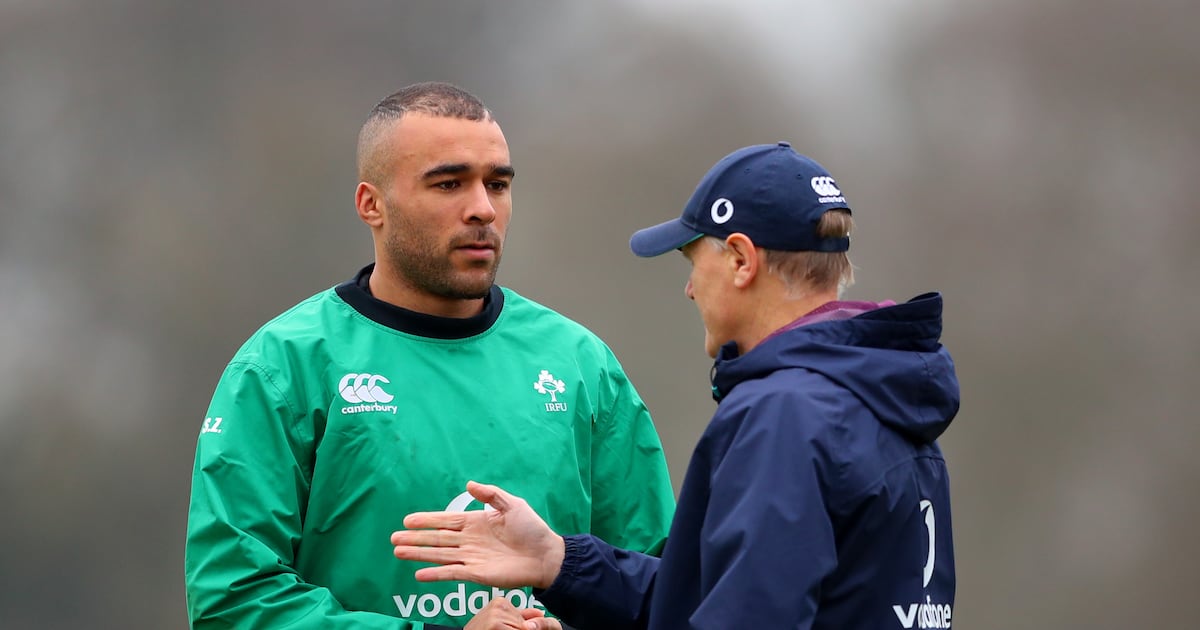
Ireland’s head coach nailed the build-up to the clash with the All Blacks in 2016; if he’d always been like that, I’d never have gone to FranceSimon Zebo with then Ireland Joe Schmidt at a training session in February 2017. Photograph: James Crombie/Inpho Axel’s spirit was with us in Chicago in November 2016. I’ve often described it as my favourite week ever in an Irish jersey and it wasn’t just purely because of the result. It was the whole week.I think Joe was brilliant that week and if you could bottle that Joe from Chicago for my whole career, I’d never have left for France. Well, not as soon as I did anyway. There was a huge novelty around travelling to the USA and playing our first fixture of the November series in Chicago against the All Blacks, in Soldier Field, the home stadium of the Chicago Bears, which was insane when you put it all together. At the time, there hadn’t been a fixture remotely like this in the history of Irish rugby. There were eight Munster players in the squad. Pete, John Ryan and Donnacha Ryan, Earlsy, Billy Holland, Conor, CJ Stander and myself. That whole week was quite relaxed because the long-haul flight was on the Monday, so Tuesday was just a recovery day, and then when we were on the pitch it was very light on the feet. We enjoyed each other’s company and while training was still important, it was that little bit lighter and less stressful than most Test weeks. There was less detail around our attacking plays and how we were going to approach the game. I thought Joe balanced the workload very well, taking the pressure off the team while treating the match as the huge opportunity that it was for us.We had plenty of time to explore Chicago, to eat in nice restaurants and do fun things. We had the deep-base pizza that Chicago is famous for and went to cafes while walking up and down the Golden Mile. On a day off, some of the lads went to the Chicago Bulls training facility. We stayed in Trump Tower and whatever you think about him, that hotel is spectacular. The match itself almost snuck up on us. Not that we didn’t think about it. There were constant reminders. Pockets of us ran into pockets of the All Blacks several times, either walking around Chicago or after ending up in the same cafes. I bumped into Tawera Kerr-Barlow and we saw Malakai Fekitoa, TJ Perenara, Julian Savea and a few others. We were crossing paths or saluting them walking down the street or seeing them in the Nike shop. The excitement was building all week and on the Wednesday night thousands of fans spilled on to the streets after the Cubs beat the Cleveland Indians in a dramatic and deciding seventh game to win the World Series for the first time in 103 years. When an estimated five million people took part in the victory parade on the Friday, we were able to watch it from the roof of the Trump Tower, which is a hundred storeys high. Probably the best view in Chicago. The following day, we had our chance to make history by beating the All Blacks for the first time in 111 years.READ MOREIreland face the Haka in a figure of eight, in memory of Anthony Foley, in Chicago in 2016. Photograph: Billy Stickland/Inpho I think it was Joe who suggested we face the haka by forming a figure of eight. That was incredibly powerful. We rehearsed it once and Joe made a point of having the Munster boys at the front, to underline our links with Axel. When the crowd realised what we were doing, their response sent a tingle up the spine. It was one of the best atmospheres I ever played in and forming that figure of eight had a huge impact on Irish sport as a whole. It created an iconic image and was a brilliant way of paying tribute to Axel. I would say that Joe has a lot of class and he is a brilliant coach and he nailed that week. It was a touching moment and it fired us up. TJ Perenara led their alternative haka, the Kapa o Pango, which was incredible, but I think we were more inspired by their haka than they were.We really went after that game with an attacking mindset from the first minute to last. We built a lead and even when they came back at us with three tries in the second-half, we weren’t afraid to throw the ball to the wider channels. I thought we played with more freedom, and that reflected the week we’d had. Joe didn’t have his paws on us as much – I mean that in the nicest possible way! He had a brilliant game plan and it was a little less restricted, a little looser. We were set up to be ambitious off set-pieces and, of course, he had detected kinks in the All Blacks’ armour that we could exploit, such as channels farther out or space in the back field.Simon Zebo celebrates with Johnny Sexton after scoring a try for Ireland against New Zealand in Chicago in 2016. Photograph: Andrew Cornaga/Photosport/Inpho From the pack’s lineout maul, Conor and Johnny gave me a run-in on the blindside to put us 30-8 ahead with our fourth try, but six minutes from the end our lead was down to 33-29. Joey Carbery had turned 21 on the Monday and he replaced Johnny before the hour on his debut. From a scrum in our own half, he passed to Jared Payne. He ripped a pass to me on the edge and I kicked deep into their 22. There was a lot of space for Julian Savea to cover because we knew he was slow off the blocks to get across and cover kicks. He didn’t have a great appetite for it and if I was able to hit grass and keep the ball in play, it would be trouble for them. So, when Fekitoa picked up and passed to him, Savea was smashed into touch-in-goal by Mur and Andrew Trimble. From the 5m scrum, Jamie Heaslip picked quickly when they might have been expecting us to hold the ball at the base. He worked a switch with Robbie Henshaw, who scored with an in-out line. Joey converted and that was it. It felt incredible to be part of the first Irish men’s team to beat the All Blacks. But it was only when we did the lap of honour and saw all the Irish supporters, and saw Paulie alongside Doug Howlett in the stands, that it actually hit home.Join our Irish Times Rugby WhatsApp communityGet the best of our writing in the Irish Times rugby community. Photograph: Henry Simpson/Inpho Join our Irish Times Rugby WhatsApp community and get our best rugby writing sent directly to your messages inbox. From provincial news to coverage of Ireland’s inaugural Nations Championship campaign, you won’t miss an update. Join here: https://chat.whatsapp.com/DaV5S7cDxWF0xDDILjarcwThere were loads of massive moments in that game, but it started with Joe giving us the ambition and license to go after them with that type of riskier play. Everybody was buzzing for the game, which wasn’t always the case because of the amount of stress and nerves that sometimes you could potentially be under. I loved being in Irish camp that week and I clearly wouldn’t say that about all my time with Ireland.I can go through all my caps and pick out plays and moments in games where a team-mate missed a horrendous tackle, one-on-one, and just dived at the floor to pretend he had made an attempt, to make it look like an ankle tap or whatever. But really, he was just diving on the floor. However, if I stayed on my feet and tried to make a tackle, which I have done to every player in my career, and I lost to better offence, I would invariably be singled out in front of the squad at a review. But if it was anyone else? Rob or Felix or Earlsy or whoever, in the review Joe would say: “Oh mate, I know you can do better than that.” And then he’d quickly move on, almost as if it did not happen. That double standard drove me mental, and drove me to dislike Irish camp.Joe Schmidt and Simon Zebo before an Ireland training session in February 2016. Photograph: Morgan Treacy/Inpho I know Johnny and Paulie would swear by him, but those lads never got a bollocking. Paulie was never called out in front of the squad and God forbid he’d call out Johnny because he could do no wrong. Rob Kearney and Seán O’Brien were the same. Yet myself and others might get slaughtered. And it hurt, because I never thought I’d want to avoid wearing a green jersey. I loved to represent my country. I’m a proud son of Blackrock in Cork. I will happily show off my hometown to anyone. I was so proud to play for my country, and especially singing Amhrán na bhFiann.All of this was on my mind when I met with Joe and David Nucifora, the IRFU’s director of performance. I watched and listened as they made the worst attempt to retain a player you could ever imagine.“Oh, mate. So, are you going to sign?”It felt to me like a token gesture. It was a pathetic conversation.Joe and Nucifora didn’t say anything along the lines of “Please, we really need you to stay” or “You’re so important to Munster and look what you’re going to sacrifice”. Nothing like that. It was as cold as ice.“So, you’ve made your decision, mate?”I was like: “Absolutely. I’m going.”In my view, they were just carrying out a box-ticking exercise for the benefit of the media, so that when my departure was announced they could claim they tried to make me stay. I wish I’d had the balls to say that to them there and then. Nothing about that conversation made me remotely inclined to stay. And it wasn’t meant to do so.So, while it was difficult to leave Munster and Ireland, Joe being head coach of Ireland made it very easy to decide that 2018 would be the time in my career when I would maximise my contract value by joining Racing. There, I’d have the chance to play my best rugby with some of the best players in the world and also have the best chance of winning a Champions Cup. I had a good relationship with Andy Farrell, both before and after my three years with Racing. He coached me on the Lions tour and later brought me back into camp when he was Ireland head coach, but different injuries meant a recall could never happen. If he had been head coach all along, however, it could all have been so different. I don’t think I would have left a green jersey, or at least not as early in my career as I did. I was the number-one left winger at the time and I was the likely starting 11 for Ireland in the Six Nations and in the World Cup. Jacob Stockdale was emerging, but he had zero caps and he was the only other Irish left-winger on the horizon. Of course, Earlsy could play on the left wing, but it would be over a year before James Lowe became eligible to play for Ireland.I had started every game in the 2017 Six Nations, so I decided to leave as a starter, not as a squad member or a player in the wider extremities. But it was that bad, I felt I had to go. I would have stayed longer had Andy or someone else been the Ireland head coach and then have gone to Racing or somewhere in France at the age of 29/30/31. I would have gone eventually, but it would have been later. I wouldn’t have left at the age of 28. I missed the 2019 World Cup when I was in my pomp and ripping up trees. I scored 16 tries in my first season with Racing, was nominated for European Player of the Year and was named in the Midi Olympique Team of the Season.Simon Zebo book cover I was ready to be called up for that World Cup and if I had been, I would have said yes in a heartbeat. But of course, the call never came. So, I effectively sacrificed playing in the World Cup because I no longer enjoyed Irish camp. That was a sad state of affairs.♦ Zeebs my autobiography by Simon Zebo written with Gerry Thornley is published by Eriu on 15th October.Simon will be signing copies of his book at Eason on Patrick Street in Cork on Saturday, October 17th at 12pm; at O’Mahony’s Bookshop in Limerick on Saturday, October 31st at 1pm; and at the Ennis Bookshop on Thursday, November 12th at 5.30pm.IN THIS SECTION
Simon Zebo: Joe Schmidt’s double standards drove me mental, made me dislike the Irish camp
Full Article
Original Source
Read the full article at Irishtimes →KhanList aggregates and links to publicly available news content. We do not host full articles from third-party sources. Always verify important information with original sources.