
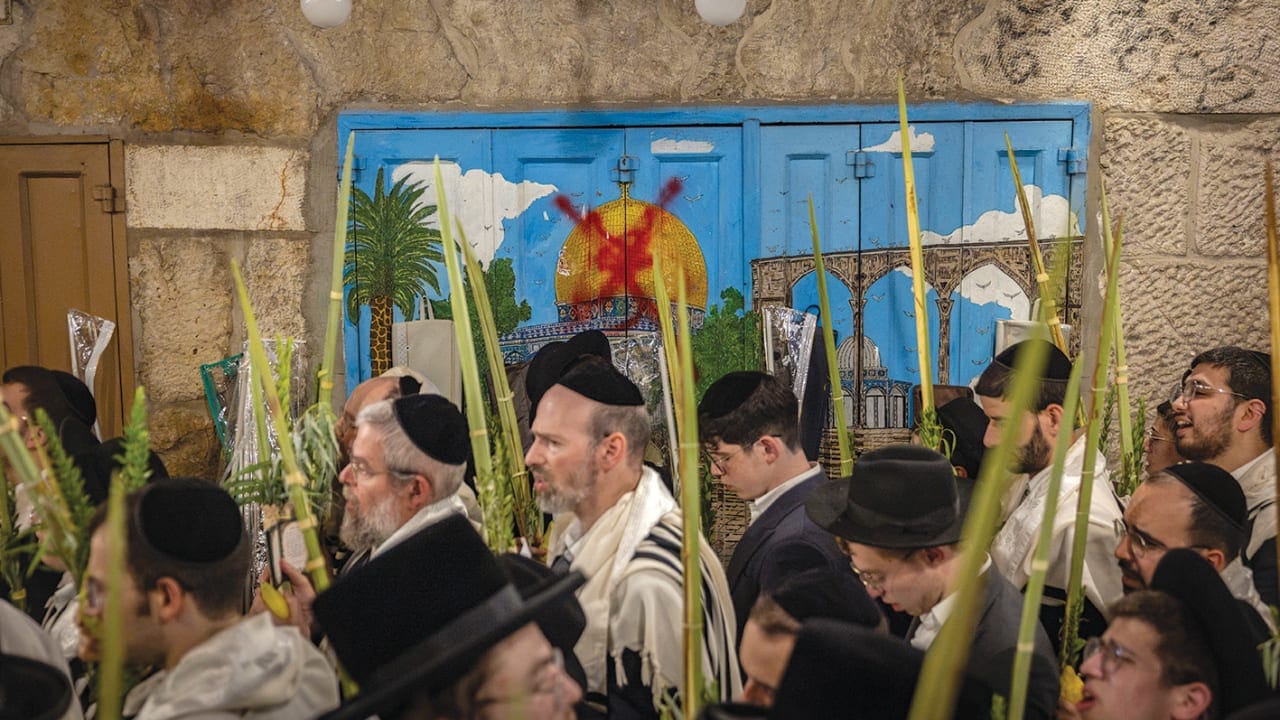
OCTOBER 2, 2026 16:03The haftarah for Shmini Atzeret (I Kings 8:54-66) takes us back nearly three thousand years to the dedication of the First Temple in Jerusalem.The account opens as King Solomon rises “from before the altar of the Lord, from kneeling on his knees, with his hands spread toward heaven” (I Kings 8:54). He turns to the assembled nation and blesses them, thanking God for fulfilling His promises to Israel.The timing is significant. Scripture describes 14 days of celebration in Jerusalem – seven days for the dedication of the Temple, followed by the seven days of Sukkot. The final verse of the haftarah then tells us: “On the eighth day he sent the people away, and they blessed the king, and went to their tents joyful and glad of heart” for all the goodness that God had shown His people (8:66).Jewish tradition identifies that “eighth day” as Shmini Atzeret.So when we read this haftarah, we are reading about Jews gathered on the Temple Mount, praying and rejoicing at the Temple. And this year, those verses have taken on a special resonance.An Orthodox Jewish man faces the Temple Mount, in Jerusalem's Old City, March 12, 2026 (credit: REUTERS/AMMAR AWAD)Jewish prayer on the Temple MountOver the past decade, Jewish prayer on the Temple Mount has become increasingly open and visible. On the first day of Hol Hamoed this year, more than 1,100 Jews ascended the Mount, with footage showing groups praying there openly.Earlier this year, police began permitting approved printed prayer sheets, and in August worshipers were reportedly allowed, in a limited trial, to bring prayer books onto the Mount, although there is still no general permit.The restrictions remain frustrating and at times absurd. But the direction of events is unmistakable: Jewish prayer on the Temple Mount is becoming an increasingly established reality.Sukkot this year provided another example.The Mishna, describing what happened when the first day of Sukkot fell on Shabbat, records that “they would bring their lulavim to the Temple Mount” (Sukkah 4:4). This year, too, the first day of Sukkot fell on Shabbat – precisely the calendrical circumstance described by the Mishna.And while police restrictions on using the Four Species on the Mount have continued, some Israelis nevertheless succeeded in performing the mitzvah there this Sukkot. Reports indicate that sets of the Four Species were clandestinely brought up and then passed from person to person during prayer.And so, nearly 2,000 years after the destruction of the Second Temple, Jews stood on the Temple Mount during Sukkot holding the same Four Species described by the Mishna.Such developments do not mean that everything has changed. There are still serious restrictions on Jewish worship there, and there is also a well-known halachic debate regarding ascent to the Mount. Those who do ascend generally follow rabbinic rulings permitting entry only to specific areas and after the required preparations.But the historical change is nonetheless real.The enormous symbolic weight of the Temple MountFor most of the past two millennia, Jews could only turn toward Jerusalem and pray for the day when Zion would once again become the center of Jewish spiritual life. Even after the establishment of the State of Israel and the reunification of Jerusalem in 1967, open Jewish prayer on the Temple Mount remained largely forbidden.A prayer book on the Temple Mount may seem like a small thing. So might a Jew holding a lulav (palm branch) and etrog (citron) there for a few moments. But after centuries in which such acts were unimaginable, they carry enormous symbolic weight.Our haftarah begins with Solomon rising from prayer on the Temple Mount and ends with the Jewish people departing Jerusalem, “joyful and glad of heart,” with the Temple at the center of that entire scene.For us, the Temple described in the haftarah is still something we await. Three times every day, we pray for the restoration of the Divine service to Jerusalem, and throughout the year we ask God to rebuild His House.The sight of Jews praying on the Mount, and Israelis performing the mitzvah of the Four Species there, is another step in the return of Jewish worship to the place where it stood at the heart of our national life.On Shmini Atzeret, as we hear the haftarah’s account of King Solomon and the Jewish people celebrating at the newly built Temple, those ancient verses take on a new immediacy.May we merit the day when Jews no longer need to hide a prayer book or conceal a lulav in order to pray at Judaism’s holiest site, and when the plea we recite each day is finally fulfilled: “May our eyes behold Your return to Zion in mercy.”Follow us on Google
Shmini Atzeret haftarah: The Temple Mount is no longer silent
Full Article
Original Source
Read the full article at Jpost →KhanList aggregates and links to publicly available news content. We do not host full articles from third-party sources. Always verify important information with original sources.