
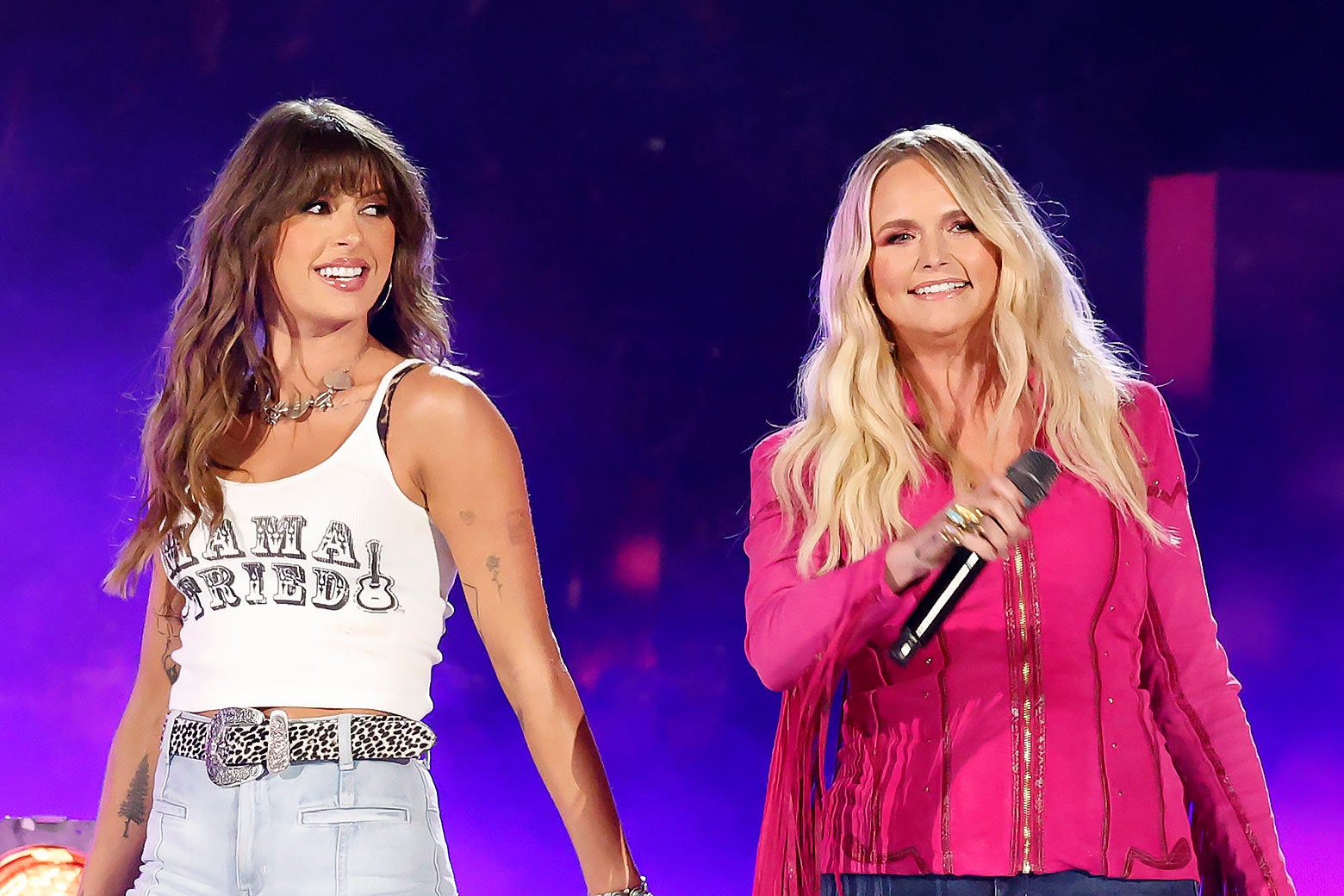
Music America Has Chosen Texas. Will It Finally Choose Miranda Lambert Too? Country women are taking over the pop charts. But is there room for the godmother of them all? Ella Langley and Miranda Lambert at the 2025 Academy of Country Music Awards. Jason Kempin/Getty Images Sign up for the Slatest to get the most insightful analysis, criticism, and advice out there, delivered to your inbox daily. Let’s be clear off the top: It’s OK by me if you haven’t heard the country song “Choosin’ Texas” by Ella Langley, even though it’s now set a record as the single that has spent the greatest number of weeks at the top of the Billboard Hot 100 chart since its inception in 1958. It’s a much sadder case if you’ve never listened to anything by Miranda Lambert. Langley’s mentor and the reigning queen of contemporary country for going on two decades co-wrote and co-produced “Choosin’ Texas” with Langley and a couple of other collaborators, no doubt never imagining that, at least on paper, it would be bigger than anything Lambert herself had ever done. By design or coincidence, her own new album Crisco is, by Lambert’s standards, an unusually formalist and nostalgic pleasure cruise through pop-country styles of the past, overlapping some with the vaguely retro feel of “Choosin’ Texas” itself. It could be pulled along in that juggernaut’s wake or lost in its shadow. Langley and Lambert’s overachieving little tune was first released in October 2025, and though I’d never heard of Langley before, by December I’d fallen for it enough to name it one of my Top 20 songs of last year. But I had no inkling it would be America’s official No. 1 for 24 weeks, more than half of 2026 so far—not in a row, but letting bigger stars’ releases displace it some weeks and then always drifting back up into the catbird seat, as my colleague Chris Molanphy explained back in August. Its latest chart milestone, surpassing the likes of “All I Want for Christmas Is You” and “Old Town Road” in the books, has drawn some people out of the social-media woodwork to declare their bafflement, suspicion, even anger over how it could be so big if they were unaware of it. Then others stood up to question the sincerity of that reaction, which only pissed people off more. Both sides, as Billboard went on to dissect in great detail, simply underestimated how possible it is for various demographics and factions of American society now to live in totally hived-off worlds. It would be a shame, though, if the messiness of this discourse were allowed to fix a permanent stain to Langley and Lambert’s sweetly melancholy two-step of a ditty. Because what’s really notable about “Choosin’ Texas” is how it finally brought a feminine presence to the wave of country crossover that—however unevenly distributed—has been perhaps the most prominent trend in chart pop over the past few years. Country finally saw its audiences turn to streaming in big numbers during and after the pandemic, and it’s allowed listeners to make smashes out of songs and artists that the once dominant conservative gatekeepers of country radio would have marginalized or shut out altogether. In 2024 it was Black country-rap artist Shaboozey, with “A Bar Song (Tipsy),” while Beyoncé, Post Malone, and others were also crossing temporarily from pop into country. This summer, it’s been “Choosin’ Texas” and a couple of other Langley singles, as well as Stella Lefty’s somewhat dubiously country-designated single “Boston.” As a result, some weeks, as critic-journalists Marissa R. Moss and Natalie Weiner have observed in their essential newsletter, the Billboard Hot Country Top 10 has actually seen gender parity. If you’re a pop-dance fan accustomed to the reign of the “pop girlies,” that might not impress you much. But consider that in 2025, according to researcher Jada Watson, airplay for women on country radio had reached an all-time low of 8.08 percent. In 2015 a programmer infamously said women should be nothing but “the tomatoes” in country radio’s salad, but soon they would seem more like a few slivers of carrot. Just as it was in mainstream pop in the days of Lilith Fair, the radio programmers and concert promoters in country still tend to think it’s fatal to business to feature two women back-to-back or on the same bill. Thanks to streaming, though, Langley and her peers, such as Megan Moroney—who, unprecedentedly, had the No. 1 album this summer at the same time Langley had the No. 1 single—as well as Lainey Wilson, Kelsea Ballerini, and others, are testing how much pressure those assumptions can bear. At 42, Lambert is a godmother and guide to this rising generation of country women. The frustrating thing is that this new moment of flexibility didn’t come when she was in her own commercial prime, when in 2011, for example, she went out of her way to form side project Pistol Annies with comparatively unknown songwriters Ashley Monroe and Angaleena Presley, trying to uplift other women, as she’s consistently done in a resistant Nashville. If she’d had the same chance to cross over, Lambert would also make it harder to tar all of country music as an intolerant MAGA monolith. Like the late lamented Dolly Parton, she has been welcoming of her LGBTQ+ fans, in her case partly thanks to the education the small-town Texan received from her gay younger brother. Her record label even sponsored a “Miranda Lambert Crisco Disco Drag Brunch” in Nashville in June, after Lambert last year showed up in Austin at a drag tribute to the 20th anniversary of her debut album Kerosene. The title song of that album established her take-no-shit attitude, soon followed by 2008’s “Gunpowder and Lead,” a song about a woman plotting to kill her abusive husband—when Lambert was growing up, her parents were private investigators who often gave shelter to women stuck in violent relationships. Later, on albums like 2016’s The Weight of These Wings, she would tell her own stories about the breakdown of a marriage, but this time the violence would be coming from the outside, from the invasive tabloid press when she was getting divorced from fellow country star Blake Shelton. NPR country correspondent Jewly Hight got it exactly right in 2019 when she wrote, “Watching Lambert figure out how to be both a serious-minded singer-songwriter and an arena-rocking entertainer, how to close the distance between her version of country artistry and the commercial center, continually readjusting her approach, has made her the most riveting country star of her generation.” Her songs can be sassy and hedonistic, reflective and wry, raucous and rebellious, crushingly poignant, or thoroughly shaken cocktails of all those ingredients. But they are always forthright, original, and self-possessed. An anecdote she told at a writing session about getting pulled over while driving with a pet kangaroo led to the phrase “She’s from Texas, I can tell” becoming the kernel of Langley’s hit. And, good as it is, Lambert’s got plenty of better ones. Lambert’s tastes were formed by Texas singer-songwriters and the holy trinity of country foremothers (Dolly, Loretta, and Tammy) but also by the boom years for country women in the 1990s, led by Shania Twain but followed closely by Martina McBride, LeAnn Rimes, Faith Hill, Mary Chapin Carpenter, Wynonna Judd, and the Dixie Chicks. Yet, just as Lambert’s own career peaked in the 2010s, country radio slammed the door on new female voices, and “bro-country” took center stage. As Lambert told the New York Times’ Popcast this week, “Carrie Underwood and I made it through pretty much a solid, at least, seven years of only guy artists coming out of country music. … We should get a ribbon for surviving that. That was a hard time, honestly.” She added, optimistically, “I’m so thankful that there’s room for a crowd now.” How much space there is for Lambert herself as a face in that crowd today—rather than as a behind-the-scenes writer, producer, and adviser to her successors—is harder to say. Country doesn’t dispense with its elders as quickly and ruthlessly as other pop formats tend to do. She currently has seven nominations for the Country Music Association Awards coming up in November, bringing her career total to 70, including a record 19th nod for female vocalist of the year. She has won 14 CMAs and three Grammys, among many other accolades. The industry and her fans are not about to forget her. But she hasn’t had a Top 10 country hit in five years, and increasingly she’s been making the kinds of slightly offbeat, conceptual albums a later-career creator explores when she’s not expecting much chart traction anyway. Crisco is definitely one of those. Its title playfully portmanteaus the words country and disco into the name of the cooking grease that played a leading part in both the country kitchens and the sex jokes of the 1970s and 1980s. In those years, Studio 54 often rubbed elbows with Urban Cowboy, most famously in Parton and Kenny Rogers’ classic performance of the Barry Gibb–composed “Islands in the Stream.” Lambert and Chris Stapleton took that as the model for the enticing duet they released last year, “A Song to Sing,” and Lambert and new writer-producer collaborator Jesse Frasure had such fun with it they decided to carry on from there. Lambert is far from the first to cotton on to country-disco revivalism. She was preceded most notably by her sometime frenemy, former East Texan neighbor, and recent duet partner (“Horses and Divorces” has been called the “Girl, So Confusing” of country) Kacey Musgraves on 2018’s Grammy-winning Golden Hour. But Crisco also widens its ambit to the whole range of “sophisticated” country-pop strains of the 1950s through the 1980s, including the Nashville Sound associated with the likes of Patsy Cline and Tammy Wynette and mid-’70s “countrypolitan,” the country equivalent of yacht rock (think Glen Campbell and “Rhinestone Cowboy”). Both disco and countrypolitan were marked by orchestral strings, and part of what ties the album together is Lambert’s use of them here for the first time in her recording career. Predictably, Lambert’s duet with Langley, “Snakeskin Boots,” has been shuffled to the top of the album, but to me its electro-spaghetti-western dynamics strike an off note, with a muddled tale of some kind of lawbreaking femme duo dodging the hangman’s noose in … Beverly Hills? (Huh?) Crisco’s title track, coming next, spells out the album concept too literally. It drops 1970s song titles over what sounds like library music labeled “Disco 001,” selling nostalgia in a way Lambert—and most of the rest of the album—is usually too smart to do. I feel similarly about the final two numbers, a rushed and uncharacteristically lazily sung cover of Jim Croce’s “I’ll Have to Say I Love You in a Song” and “Sunset Marquis,” a tribute to some L.A. hotel that means a lot more to Lambert than it does to me, set to music that sounds far too much like the theme to The Love Boat. There’s kitsch, and then there’s being suffocated by a velvet pillow. But through the middle, the album goes from strength to strength. The countrypolitan “Two Things Can Be True,” maybe the best song here, has a sad, waltzing lilt and a theme not far off from that of Langley’s hit: “Baby, you’re saying the words / But you’re gone in your eyes … I know you’re fallin’ for her / But you’re still mine / Two things can be true at the same time.” By contrast, “Cuttin’ Onions” brings out Lambert’s goofy side, recasting the classic country theme of emotional denial (viz. George Jones’ “She Thinks I Still Care”) as kitchen-sink farce. She’s not crying, just meal prepping: “Halfway through that first Vidalia / Thought of a few things I would tell ya,” but she’s too busy with her kitchen knife to fuss. “Unlike you, it never stabbed me in the back.” Full points in the chorus for managing to drawl done with and onions into a convincing-sounding rhyme. She returns to the restless, travel-addicted themes of 2022’s Palomino on “Till the Going’s Gone,” with a groove lifted wholesale from Harry Nilsson’s classic 1967 version of “Everybody’s Talkin’ ” on the Midnight Cowboy soundtrack and the ideal country kicker “That’s why the good Lord made the interstate.” And “Right Where We Left It” brings a perfect blend of Dolly Parton and Donna Summer to an affecting portrait of a couple rediscovering each other after a separation of perhaps years: “Right in between goodbye and a dream that we had / Bringin’ the good times back.” With that, of course, it also doubles as a tribute to the exercise of musical revival in itself, much more subtly than “Crisco.” It feels especially rich to reencounter the Stapleton duet “A Song to Sing” after that. All this time travel is a long step away from the brash country-rock and honky-tonk for which Lambert has usually been best known. I’m not sure if that’s unfortunate just at the point when she’s catching an extra sweep of the spotlight via Langley, or if it’s appropriately in sync with the vibe-centric appeal of “Choosin’ Texas” itself. Ultimately, it’s doesn’t matter much, as Lambert has nothing left to prove, and whatever she had to lose, the industry took long ago. Whoever and whatever is coming after, for her the time has come, as Lambert sings here, when learning to let go becomes the best way of holding on. Texas Country Music Pop
She Co-Wrote the Longest-Running No. 1 of All Time. Now Will She Finally Get Her Due?
Full Article
Original Source
Read the full article at Slate →KhanList aggregates and links to publicly available news content. We do not host full articles from third-party sources. Always verify important information with original sources.