
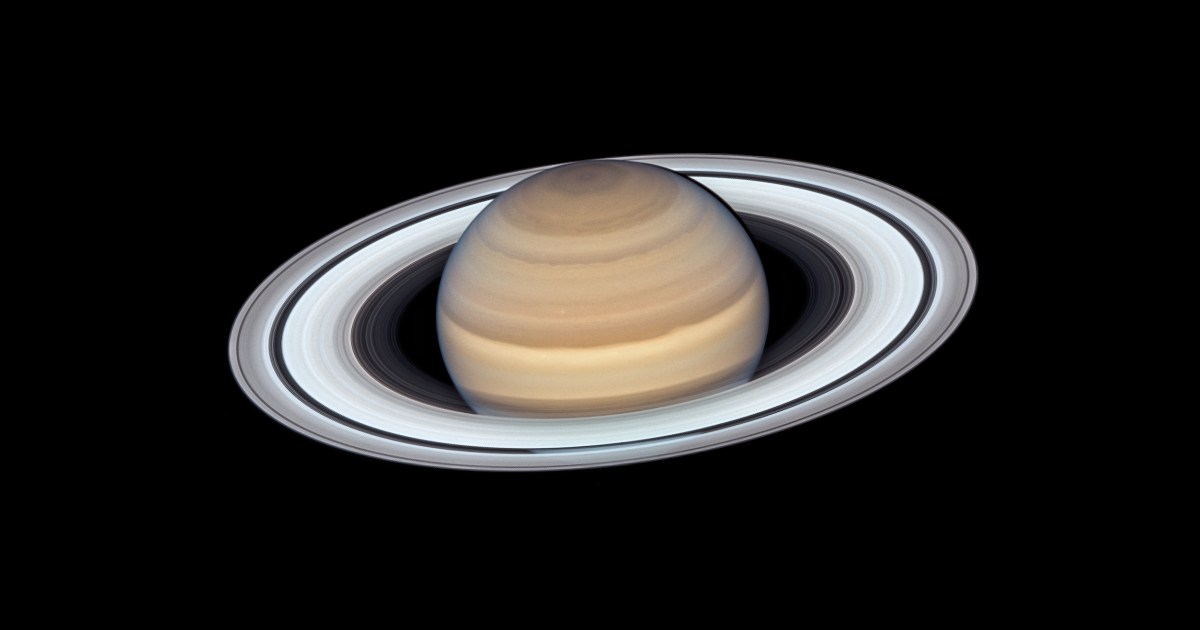
The Hubble Space Telescope snapped this "close-up" pic of Saturn June 20, 2019, when the ringed planet and our own world were just 845 million miles apart. Credit: NASA, ESA, A. Simon (Goddard Space Flight Center), and M.H. Wong (University of California, Berkeley) Three planets provide a feast for your eyes in this month’s evening sky. The star of the show in early October is Venus, which shines brilliantly in the west as the sky starts to darken. The magnitude –4.8 planet easily bests all other night-sky objects except for the Moon. If you follow Venus’ trajectory this month, you’ll see it dipping lower each evening. It becomes hard to see after midmonth as it plunges toward the horizon. The inner world passes between the Sun and Earth at inferior conjunction Oct. 24. Don’t pass up the opportunity to view Venus through your telescope. The planet shows a large disk that grows bigger and a crescent phase that wanes with each day. On Oct. 1, Venus appears 48″ across and 15 percent lit. By the 15th, it spans 58″ and the Sun illuminates just 4 percent of its Earth-facing hemisphere. Mercury also puts on a fine evening show. During October’s first half, the innermost planet makes a nice companion for Venus. Although Mercury appears much dimmer, at magnitude 0, it is still prominent. The planet attains greatest elongation Oct. 12, when it lies 25° east of the Sun and stands 12° high an hour after sunset. A slender crescent Moon lies between the two planets that evening. A telescope reveals Mercury’s tiny disk. On the 12th, it appears 7″ across and about 60 percent lit. It grows a bit larger and shows a more pleasing crescent phase after midmonth. But this month’s finest telescopic target has to be Saturn. The ringed planet reaches opposition Oct. 4, when it shines at its brightest for the year, magnitude 0.3. Saturn moves westward against the background stars of northwestern Cetus the Whale this month. This may sound surprising. After all, Cetus is not a zodiacal constellation. But the ecliptic — the apparent path of the Sun across our sky that the planets follow closely — touches a corner of the Whale where it borders Pisces the Fish. And the tilt of Saturn’s orbit currently carries it south of the ecliptic into Cetus. The view of Saturn through a telescope now looks noticeably and pleasantly different from last year, when the rings appeared nearly edge-on. At opposition, the planet’s equatorial diameter peaks at 20″ while the rings span 45″ and tilt 7.5° to our line of sight. Also keep an eye out for Saturn’s brightest moons. Eighth-magnitude Titan is the easiest to spot, though the 10th-magnitude trio of Tethys, Dione, and Rhea are not difficult. You’ll have to wait until after midnight to see another naked-eye planet. Mars rises by 3 a.m. local time throughout October. The Red Planet moves eastward against the backdrop of Cancer before it enters Leo at month’s end. The ruddy world glows at magnitude 1.0 in mid-October, far brighter than any of the Crab’s stars. Be sure to point binoculars or a telescope toward Mars on the 12th, when it lies in the middle of the Beehive star cluster (M44). The planet appears near the cluster’s edge on the 11th and 13th. A telescope reveals a disk 6″ in angular diameter. During moments of steady seeing, you might glimpse some subtle surface detail. Jupiter follows close on Mars’ heels. The gap between the two planets narrows from 18° to 6° during October. The giant planet shines at magnitude –1.9 at midmonth, some 14 times brighter than its neighbor. As the largest solar system planet, Jupiter looks interesting through a telescope anytime it appears well clear of the horizon. The gas giant sports a bright zone that coincides with the equator and two parallel dark belts, one on either side of the zone. Also notice the disk’s obvious polar flattening. Jupiter spans 34.3″ measured along the equator but just 32.1″ through the poles in mid-October. The starry sky Old star charts contained many constellations that no longer exist. Some fell into disuse; the prime example is the great ship Argo, which later celestial cartographers broke into three component parts. Several other constellations still depict the object they were first named for but now sport a different official designation, typically a shortened version of the original. One that stands out has particular relevance in the Southern Hemisphere: Octans the Octant. This is the constellation that encompasses the South Celestial Pole, the point around which the heavens rotate. French astronomer Nicolas Louis de Lacaille originally called it l’Octans de Reflexion, the Reflecting Octant, because this scientific instrument used a mirror that doubled the angular distance navigators could measure. Lacaille also introduced a longer name for the constellation we now call Mensa. His original name was Montagne de la Table. Drawing on your high school French, you might surmise that this refers to Table Mountain, a flat-topped mountain that dominates the view from Cape Town, South Africa. The Latin version of the name, which appeared later, was Mons Mensae. Sir John Herschel, who made many important observations from that part of the world, suggested shortening it further to Mensa. Among other examples of a truncated constellation name is Scutum the Shield. Originally known as Scutum Sobiescianum, it depicts the shield King John III Sobieski of Poland used in 1683 to defeat the Ottomans, who had laid siege to the city of Vienna. Star Dome The map below portrays the sky as seen near 30° south latitude. Located inside the border are the cardinal directions and their intermediate points. To find stars, hold the map overhead and orient it so one of the labels matches the direction you’re facing. The stars above the map’s horizon now match what’s in the sky. The all-sky map shows how the sky looks at: 10 p.m. October 19 p.m. October 158 p.m. October 31 Planets are shown at midmonth Dr. Martin George is an astronomy speaker and writer who currently serves as Chair of International Development and Elections at the International Planetarium Society.
September 2026: What’s in the Southern Hemisphere sky this month?
Full Article
Original Source
Read the full article at Astronomy →KhanList aggregates and links to publicly available news content. We do not host full articles from third-party sources. Always verify important information with original sources.