
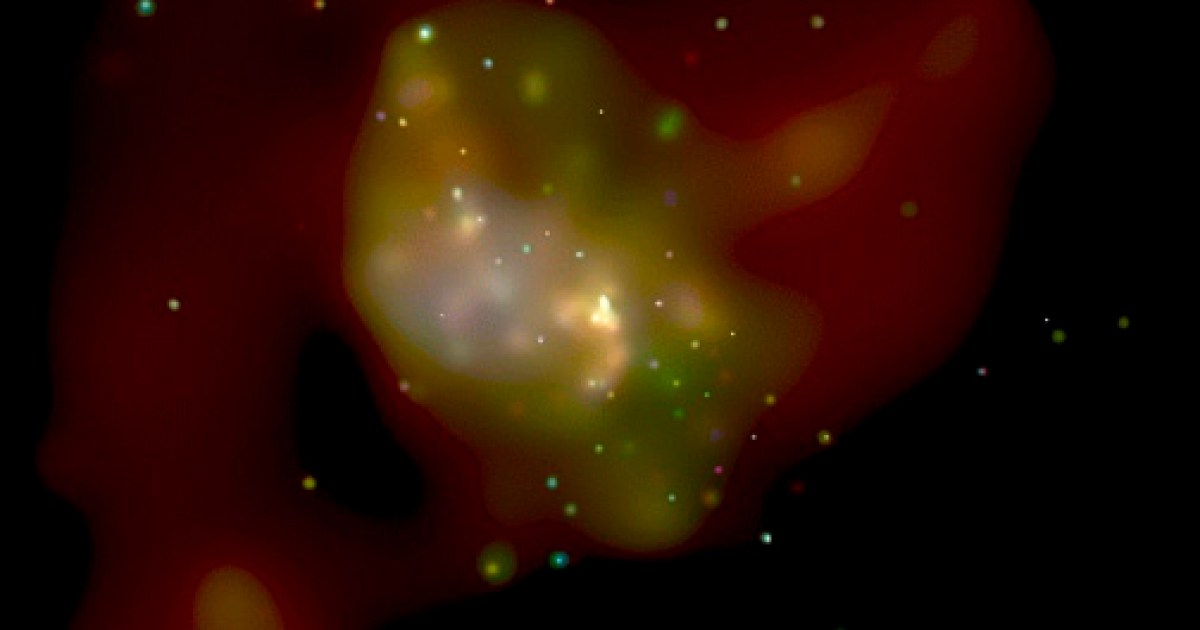
Today in the history of astronomy, NASA announces evidence of material being consumed by the black hole at the center of our galaxy, confirming its existence. | Published: September 5, 2026 In this false-color image, the strong flare observed by Chandra is the very bright spot at center. The dramatic flare lasted only about three hours. Credit: NASA/MIT/F.Baganoff et al. NASA’s Chandra X-Ray Observatory is the agency’s flagship mission for X-ray astronomy. On Sept. 5, 2001, NASA announced that astronomers using Chandra in October of the previous year had witnessed a fast, strong X-ray flare coming from the supermassive black hole at the center of our galaxy. This black hole, named Sagittarius A* (Sgr A*) had long been assumed to be there – infrared and radio observations of the center of the Milky Way had indicated the presence of something large and dark. However, the faintness of the X-ray emissions seen from the supposed black hole puzzled scientists. The sharpness of the imagery from Chandra and the violence of the flare in 2000 dispelled any doubts: There is a supermassive black hole at the center of the Milky Way, and it is actively eating. Research published over a decade later, also based on Chandra observations, would suggest that Sgr A* is faint in X-ray because it ejects most infalling materials – less than 1% make it to the event horizon. Elisa Neckar is senior production editor of Astronomy magazine, and the editor of the Today in the History of Astronomy feature on Astronomy.com.
Sept. 5, 2001: The Milky Way has a black hole
Full Article
Original Source
Read the full article at Astronomy →KhanList aggregates and links to publicly available news content. We do not host full articles from third-party sources. Always verify important information with original sources.