
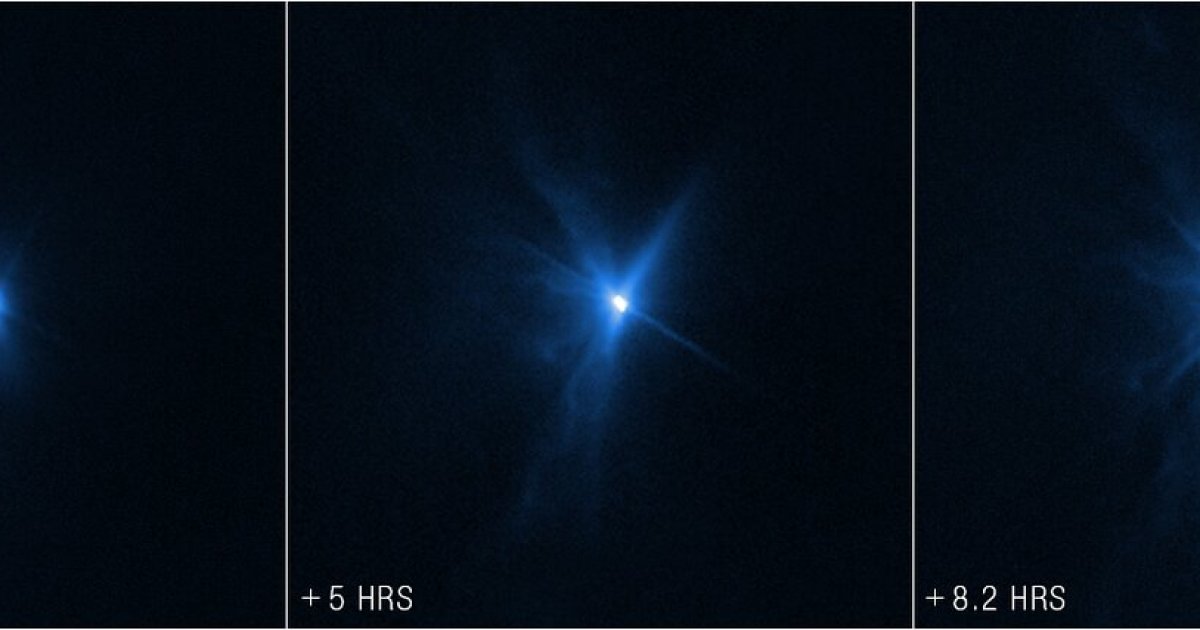
Today in the history of astronomy, Hubble’s images of DART hitting Dimorphos are released. | Published: September 29, 2026 Hubble's series of images show the growing plume of ejecta produced when the 1,200-pound (545 kg) spacecraft crashed into Dimorphos. Credit: NASA, ESA, Jian-Yang Li (PSI); Image Processing: Alyssa Pagan (STScI) On Nov. 24, 2021, the Double Asteroid Redirection Test (DART) launched. The spacecraft was on its way to Dimorphos, part of a binary system with the asteroid Didymos. Nearly a year later, on Sept. 26, 2022, DART crashed into Dimorphos at about 14,000 mph (22,000 km/h). The crash was intentional: The DART mission goal was to test our ability to use an impact to redirect a potentially dangerous asteroid. Fifteen minutes after the impact, the Hubble Space Telescope began capturing images of the aftermath; it would capture more at 22 minutes, five hours, and 8.2 hours after the collision. The images were released Sept. 29, giving the public a view of the bright ejecta spraying from the asteroid. While further work is needed to scale the process up for other and larger asteroids, and to analyze any risks from impact debris, DART did move Dimorphos, perhaps providing insight into the future of planetary defense. Elisa Neckar is senior production editor of Astronomy magazine, and the editor of the Today in the History of Astronomy feature on Astronomy.com.
Sept. 29, 2022: Seeing the DART impact
Full Article
Original Source
Read the full article at Astronomy →KhanList aggregates and links to publicly available news content. We do not host full articles from third-party sources. Always verify important information with original sources.