
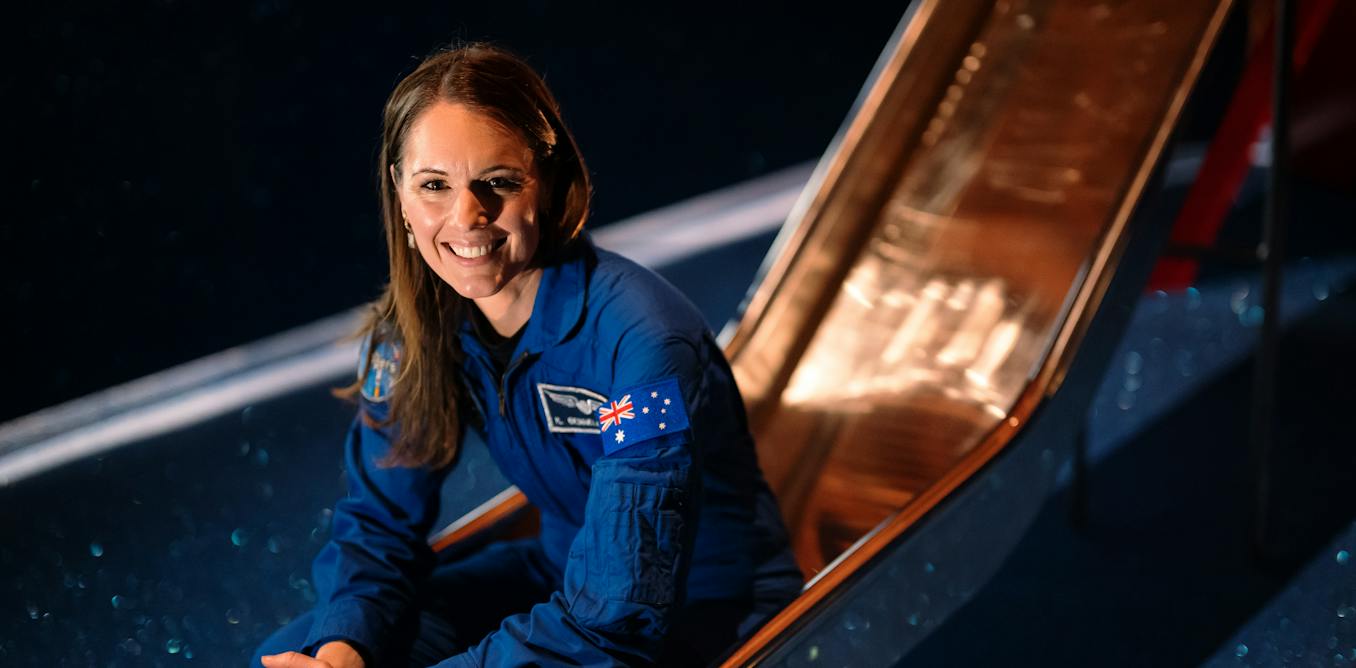
Australia is currently in talks with the European Space Agency (ESA) over potentially flying Katherine Bennell-Pegg on a future space mission. If accepted, Bennell-Pegg – who is the director of space technology at the Australian Space Agency and completed ESA training in 2024 – would become the first officially funded Australian astronaut. To “buy a seat” on a space mission, Australia has to make a financial contribution to the ESA. The precise sum is not public, but reports claim it could exceed the A$100 million mark. There has been interest in the press and excitement among space advocates. Many are pointing out that sending a home-grown astronaut to space would yield potential benefits to industry and the nation as a whole, inspiring younger generations. There would be a powerful symbolism in sending an Australian woman to space. However, while human spaceflight can deliver substantial benefits, it’s costly. As we’re in the midst of a substantial public campaign to #FlyKatherine, it’s crucial to properly analyse some of the claims being made about the potential benefits of such an expensive proposal. What counts as an Australian astronaut? The discussion raises an interesting point about what constitutes an Australian astronaut. To date, five Australian-born people have flown to space, two as NASA astronauts and three privately. The most recent was physicist Elaine Hyde, the first Australian woman in space. But her 2025 Blue Origin flight was privately funded, and she hasn’t been given the label of the first “female Australian astronaut”. The federal government hasn’t signalled a strong interest in flying an Australian astronaut. Science minister Tim Ayres unequivocally said state and territory governments and private industry would have to pitch in. However, only South Australia has agreed to contribute; industry has pledged up to $6 million. The Northern Territory called the proposal “reckless”. These debates are not new. In the 1980s, the Hawke government announced it would send an Australian astronaut on the space shuttle. However, then Minister for Science, Barry Jones, noted it wasn’t a high priority. Prestige and public relations were not considered reason enough when government spending was to be reined in. The cost would be substantial We don’t know if Australians would support spending $100m on a single space mission while facing a cost-of-living crisis. When surveyed in 2025, 51.5% of Australians supported government investment in an astronaut programme, but respondents were not given a cost. Generally speaking, once government programs reveal their costs, public support decreases. When asked in 2023, more Australians supported the cancellation of a $1.2 billion Earth observation satellite than disagreed with it being canned. Would these funds be better deployed within the space sector? Currently the Australian Space Agency’s funding is $21.7m over two years. The cost of flying a single Australian astronaut would fund a decade for the agency. Put another way, $100m is half of the total government investment in space or space adjacent companies in the last 18 months. Space science and research occurs at universities, in government agencies, and in private industry; many organisations have sent experiments to space, often relatively cheaply. Advocates have argued there would be significant benefits to Australia. There’s no doubt space is of immense benefit to industry and the nation, from banking to navigation to farming. An astronaut can’t meet all these needs, and we don’t know how they fit into our long-term plans. Australia doesn’t have a whole of government space policy and an astronaut is not a space program. The suggestion that Australia’s growing space industry would stand to gain similarly deserves deeper analysis. How and where specifically will funds flow back to Australia? Does the public think supporting industry is a reason to send an astronaut to space? ESA has a geographic return policy which sees member states receive industrial contracts proportional to how much they pay ESA. But Australia is not a paying member state, and not looking to be. The $100 million includes training, equipment and launch; it’s difficult to see how the bulk of those funds will be spent in Australia rather than in Europe, where ESA is based. What about inspiration? Representation matters, particularly for encouraging girls and young women to pursue careers in space. Bennell-Pegg’s selection and training have already inspired Australians across the country. However, research shows that when role models in STEM (science, technology, engineering, mathematics) fields have seemingly unattainable careers, they actually make students less motivated to pursue STEM. The selection process was not nationally competitive and there’s no currently published plan or pathway for a young girl in Australia to follow in Bennell-Pegg’s footsteps. What message does that send to young people? It might discourage them from pursuing careers in space. We shouldn’t ignore the fact many Australians would support sending an astronaut simply because it’s exciting. That is a legitimate foundation for policy – after all we fund the arts, entertainment industry and sport – but we should also recognise many Australians would not agree with such spending when it comes to space. Unanswered questions remain If we want to send an astronaut to space, the Australian public should know precisely what the tangible benefits are – to them, their economy and their sense of what Australia stands for. A key final question is: what next? There are currently no plans for Australia to send a second astronaut to space after Bennell-Pegg. Not only does this limit the pathway for future Australians to go to space, but also undermines the arguments put forward for an Australian astronaut. If the benefits are so tangible and important, we wouldn’t only do it once.
Sending an Australian astronaut to space is expensive. How do we work out if it’s worth it?
Full Article
Original Source
Read the full article at Theconversation →KhanList aggregates and links to publicly available news content. We do not host full articles from third-party sources. Always verify important information with original sources.