
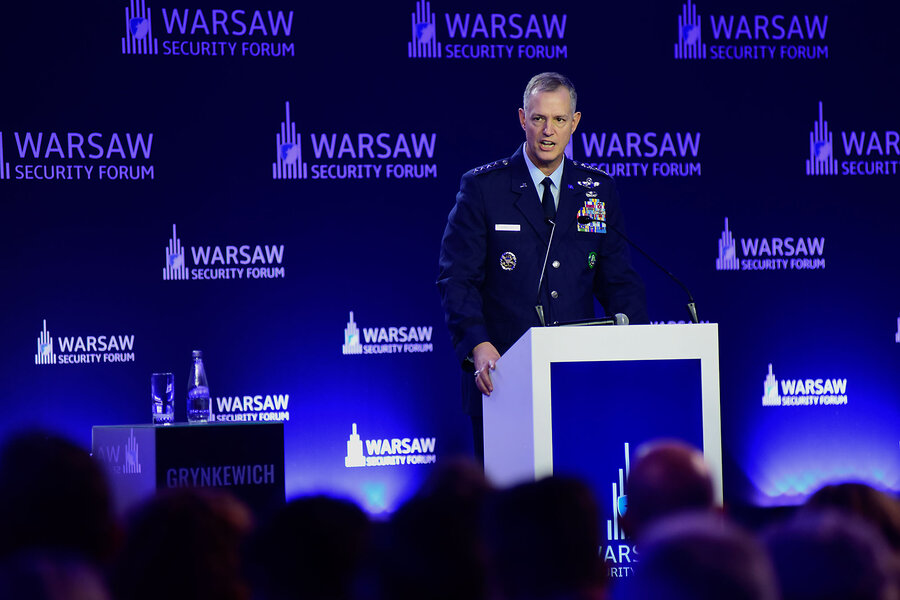
Washington | Oct. 16, 2026, 3:28 p.m. ET | 5 min read At the U.S. Army’s annual convention here this week, an exhibitor banner greeted attendees: “Welcome to the Unfair Fight.”At booths touting everything from laser weapons to attack drones, the idea that defense companies are selling is that, in any contest with the U.S. military, opponents will not only lose but also be sapped of their will to fight on.In the current war against Iran, Defense Secretary Pete Hegseth has spoken of “crushing” the regime “in an overwhelming display of technical skill and military force. We will not relent until the enemy is totally and decisively defeated.” He was echoing nearly verbatim President Donald Trump’s promises of a quick victory from early March. On Thursday, news came that the administration is considering using the “Mother of all bombs,” or “MOAB” in Pentagon parlance. It’s the most powerful non-nuclear bomb in the U.S. arsenal, and such a strike would allow the Republican administration to declare a “definitive victory,” if not actually achieve it, in an unpopular conflict that has driven up gas prices ahead of next month’s midterm elections.But the kind of military rout that leaves the vanquished prostrate in salted fields doesn’t happen anymore, and it is thinking along these lines, analysts add, that leads politicians to start wars which, like with Iran, drag on far longer than the immense resources of the U.S. armed forces might suggest.If military superiority alone could end wars, then Afghanistan and Iraq would have been relatively easy American wins. Instead, many modern acts of aggression have devolved into long-running conflicts, notes Stephen Biddle, professor of international affairs at Columbia University and former strategic adviser to retired Gen. David Petraeus. General Petraeus commanded U.S. forces in Iraq and later served as CIA director. The best use of military power in modern times is to convince adversaries that it is time to come to the negotiating table, argues Dr. Biddle, who recently co-authored a Foreign Affairs article about the “myth” of military victory.“No war can end without an offer the enemy can accept, no matter how powerful one’s armed forces, or how one-sided the fighting,” he argued. Kylie Cooper/ReutersDefense Secretary Pete Hegseth participates in a panel on Project Agincourt, an initiative about autonomous warfare, during the 2026 Association of the United States Army (AUSA) Annual Meeting and Exposition at the Walter E. Washington Convention Center in Washington, DC, on October 14, 2026. When threats don’t speed winsIn the pursuit of surrender, or at least a ceasefire, the promise of crushing defeat has rarely been enticing.By way of example, Dr. Biddle offers up the Morgenthau Plan for post-World War II Germany. Precursor to the Marshall Plan and named for the U.S. treasury secretary at the time, the punitive plan, later abandoned, suggested seizing German assets, destroying its factories, and forcing Germans to work abroad at the war’s end, among other things.When it leaked in 1944, the plan’s grim prospects were a propaganda boon for the Nazis, who used it to stir “fanatical resistance” in some quarters, Dr. Biddle notes. American officials soon dropped that idea.U.S. military commanders tend to be dedicated students of history, and there were echoes of this in a speech Monday by NATO’s supreme allied commander, American Gen. Alexus Grynkewich, as he laid out his “Theory of Victory” for the alliance. A warning clearly aimed at any attack Russia would be “foolish enough” to wage, it notably did not mention vanquishing losers but rather sought to head off conflict in the first place. Should it come to that, General Grynkewich said, “We are not seeking to impose a strategic defeat on our adversary. We are only seeking to stop any attack in its tracks.”Russian President Vladimir Putin often says NATO’s defensive measures are an aggressive threat to his country. This is a feint, analysts say: Mr. Putin’s true fear is that support for democratization might lead to too much enthusiasm for regime change. The Russian leader is also ambitious and thinks he can break up NATO, they add.What is clear is that, when pressed on the “why now” of going public with a strategy written months ago, General Grynkewich acknowledged that Europeans are “a bit nervous” and need reassurance that, whatever happens, the alliance can respond with “We’ve got this.”Managing perceptions and expectationsAmericans are looking for some reassurance on the homefront as well. Rather than reconsider his approach as the economic consequences of the Iran war – inflation, higher prices at the pump – mount, Mr. Trump has doubled down on aggressive rhetoric, analysts say, raising concerns that his administration is losing control of events it helped set in motion. He has upended Ukrainian war strategy – which hinges in part on striking at oil refineries inside Russia to reduce the revenue financing its war – by announcing a deal to buy diesel from Moscow to try to offset the rise in U.S. prices caused by Iran.This week, the Trump administration also seemed to disrupt Ukraine’s military-grade Starshield satellite access, which Elon Musk’s SpaceX owns, and which Ukrainian troops rely on to communicate. The administration’s apparent move was widely regarded as a way to get President Volodymyr Zelenskyy to the negotiating table and end the war that Mr. Putin started. As for ending the war in Iran, Mr. Trump is still trying to get Iran to give up its nuclear ambitions and stop resisting U.S. demands.On this front, military force – and lethality, to use one of Mr. Hegseth’s favorite words – has proved not only ineffective but, in some cases, counterproductive, Dr. Biddle says. The early strike that so effectively eliminated Iran’s leadership, for example, killed people who could have helped negotiate and enforce a ceasefire deal. Deepen your worldviewwith Monitor Highlights.Politics with respectGet political stories with respectful analysis.There‘s a world of new ideas in everyBooks newsletter.There‘s more to life, enrich yours withCulture & Learning weekly.Follow humanity‘s discoveries withScience & Nature stories in your inbox.Gain a spiritual perspectivefrom the stories in your inbox.Want to understand the deeper impact of critical events? Learn the Monitor‘s insight.Already a subscriber? Log in to hide ads. Because the U.S. military is “so good at the tactical level, it seduces political leadership into thinking” that force alone will win a war, he adds.“If we were less good at it, the administration would probably spend more time thinking about how is it, exactly, that we’re going to deal with the enemy – and bring this thing to an end.” ALREADY A SUBSCRIBER? LoginReal news can be honest, hopeful, credible, constructive.The Christian Science Monitor was founded in 1908 to lift the standard of journalism and uplift humanity. We aim to “speak the truth in love.” Our goal is not to tell you what to think, but to give you the essential knowledge and understanding to come to your own intelligent conclusions. Join us in this mission by subscribing.
Securing a military victory is not easy. What Iran is teaching America.
Full Article
Original Source
Read the full article at Csmonitor →KhanList aggregates and links to publicly available news content. We do not host full articles from third-party sources. Always verify important information with original sources.