
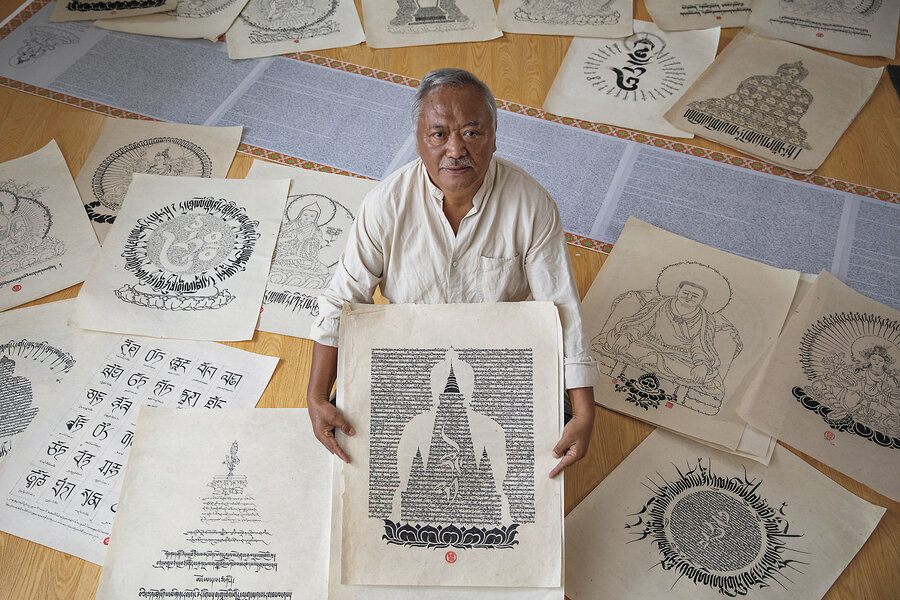
For Jamyang Dorjee Chakrishar, the importance of beautiful handwriting was instilled early on, while he was growing up in the Indian Himalayas in the late 1950s and early 1960s.“When I was in Class 1 till Class 5, we had such wonderful, scholarly teachers,” he recalls. Like Mr. Chakrishar and his family, these educators were born in Tibet but had fled the Chinese occupation there and sought refuge in India’s northeastern Sikkim state. Mr. Chakrishar went on to work in Sikkim’s tourism department and its ministry of culture, as well as undertaking a decade of volunteer service for the Tibetan government in exile in Dharamshala, India. Upon retiring, he began practicing Tibetan calligraphy. He also creates images by writing Tibetan prayers and scriptures in miniature form with the help of a magnifying glass. Today, this self-taught artist holds the world record for the longest calligraphy scroll – 165 meters (about 180 yards) – which he created in 2010. Monitor contributor Anne Pinto-Rodrigues interviewed Mr. Chakrishar, who was visiting his son in upstate New York, via a video call. This transcript has been condensed and edited for clarity. Melanie Stetson Freeman/StaffMost of the lines of Mr. Chakrishar’s art are created with miniature calligraphy. What inspired you to create the longest calligraphy scroll in the world?In 2009, I was trying to find out where Tibetan calligraphy stands. In doing my research, I came across a person carrying a certificate in his hand which had one line written in Chinese: “150 meters long, Guinness World Record.” I thought, “Let me break that record, so that [Tibetan calligraphy] will come into the global limelight.” So I started working on that. I found out that there are 35 to 36 great masters of Tibet, from all schools of Buddhism, who have composed long-life prayers for His Holiness the 14th Dalai Lama, and all these compositions are compiled into two book volumes. So I said, “Why not write all the long-life prayers in one single [scroll]? It would be very auspicious, and that would be my practice of calligraphy as well. If it’s longer than 150 [meters], then I can beat the record.”It took me almost six, seven months to complete. What is the scroll made of? The paper was a traditional handmade paper that I got from Nepal. My friend Nimto Sherpa has a paper-making factory there. Number one, [the paper] had to be made without chemicals. I also thought it’s very important to use Lokta paper. Lokta is a plant that grows [at altitudes] above 10,000 feet. The plant is never cut; it’s pruned. The more you prune, the more it grows. Melanie Stetson Freeman/StaffThe artist works on a piece in his studio inside his son’s home in upstate New York. He also has a home studio in India. For the ink, there’s already a long tradition in Chinese and Japanese calligraphy of using sumi ink, which is very good. So, I used sumi ink and a [fountain] pen. Then I’ve used four kinds of [calligraphy] styles in there. I brought [the scroll] to New York. It’s 52 kilos [about 115 lbs.] heavy.Tibetan youths, especially in the diaspora, are often disconnected from their roots. How important is it to you to give talks and lectures to young people and to introduce them to Tibetan calligraphy? Not only talks, but in the monasteries and schools that I visit, I teach writing. I teach them good handwriting in different styles.I’m in the evening of my life. So, it’s very important for me to inform [young people]. With my limited knowledge and resources, I’ve been able to do it quite a bit these [past] few years. Melanie Stetson Freeman/StaffMr. Chakrishar creates his art with a pen and a magnifying glass, using sumi ink from Japan and handmade paper. The younger generation of Tibetans has to be told that they are the custodians of a very important tradition that can help bring peace to the world, to give happiness to others. We have that knowledge. So, I always tell Tibetan youths that they must first of all, understand it. I try to explain to them the importance of the [Tibetan] script, which is the custodian of great knowledge, and then after that, they can practice visual art from that wisdom. Wherever I go, one of the things I do is to write people’s names in calligraphy, with brushstrokes. Everybody becomes excited to see their own name in calligraphy, and they frame it. This has been one way of inspiring them. Melanie Stetson Freeman/StaffHis tools include ink, brushes, manga pens from Japan (the colored caps denote the size of the pen’s nib), a magnifying glass, and a stamp pad. How have young people reacted?When they see their own name in calligraphy, with the brushstrokes – sometimes the brushstrokes overlap, creating beautiful art out of their names – many of them cry. Sometimes, when I go to an exhibition, people are already lining up, and I can’t say no to them. In Bhutan, in two days of my exhibition there, I wrote the names of 1,500 people. I’m very happy that there are at least 1,500 people who have my calligraphy in their living room. Tibetan calligraphy remains a little-known art form. What gives you hope that it will not die out? Deepen your worldviewwith Monitor Highlights.Politics with respectGet political stories with respectful analysis.There‘s a world of new ideas in everyBooks newsletter.There‘s more to life, enrich yours withCulture & Learning weekly.Follow humanity‘s discoveries withScience & Nature stories in your inbox.Gain a spiritual perspectivefrom the stories in your inbox.Want to understand the deeper impact of critical events? Learn the Monitor‘s insight.Already a subscriber? Log in to hide ads. Before 2010, Tibetan calligraphy art was not known at all. But now, there’s a new awareness in Tibet, as well as in the Tibetan community in exile. Many calligraphy associations have come up in Tibet because they’re giving importance to calligraphy and calligraphy art. Every April 30th, they celebrate Tibetan Calligraphy Day all over Tibet and in some parts of India also. Every year, it’s becoming bigger and bigger, with more participation. Melanie Stetson Freeman/StaffMr. Chakrishar uses a brush to spell the photographer’s first name. Especially now, Tibetans have a fear in their hearts that we might lose our culture and tradition and language. I’m very, very optimistic that Tibetan culture, Tibetan calligraphy, and Tibetan handwriting will slowly come into the limelight.Last year, I was able to visit some universities here in America – Indiana University, Columbia University, and University of Chicago – where I talked about the evolution of Tibetan script and Tibetan calligraphy art. The Rubin Museum [of Himalayan Art in New York] was kind enough to do a [video] series on me. ALREADY A SUBSCRIBER? LoginReal news can be honest, hopeful, credible, constructive.The Christian Science Monitor was founded in 1908 to lift the standard of journalism and uplift humanity. We aim to “speak the truth in love.” Our goal is not to tell you what to think, but to give you the essential knowledge and understanding to come to your own intelligent conclusions. Join us in this mission by subscribing.
Scrolls, not screens: Tibetan calligrapher brings his art to the next generation
Full Article
Original Source
Read the full article at Csmonitor →KhanList aggregates and links to publicly available news content. We do not host full articles from third-party sources. Always verify important information with original sources.