
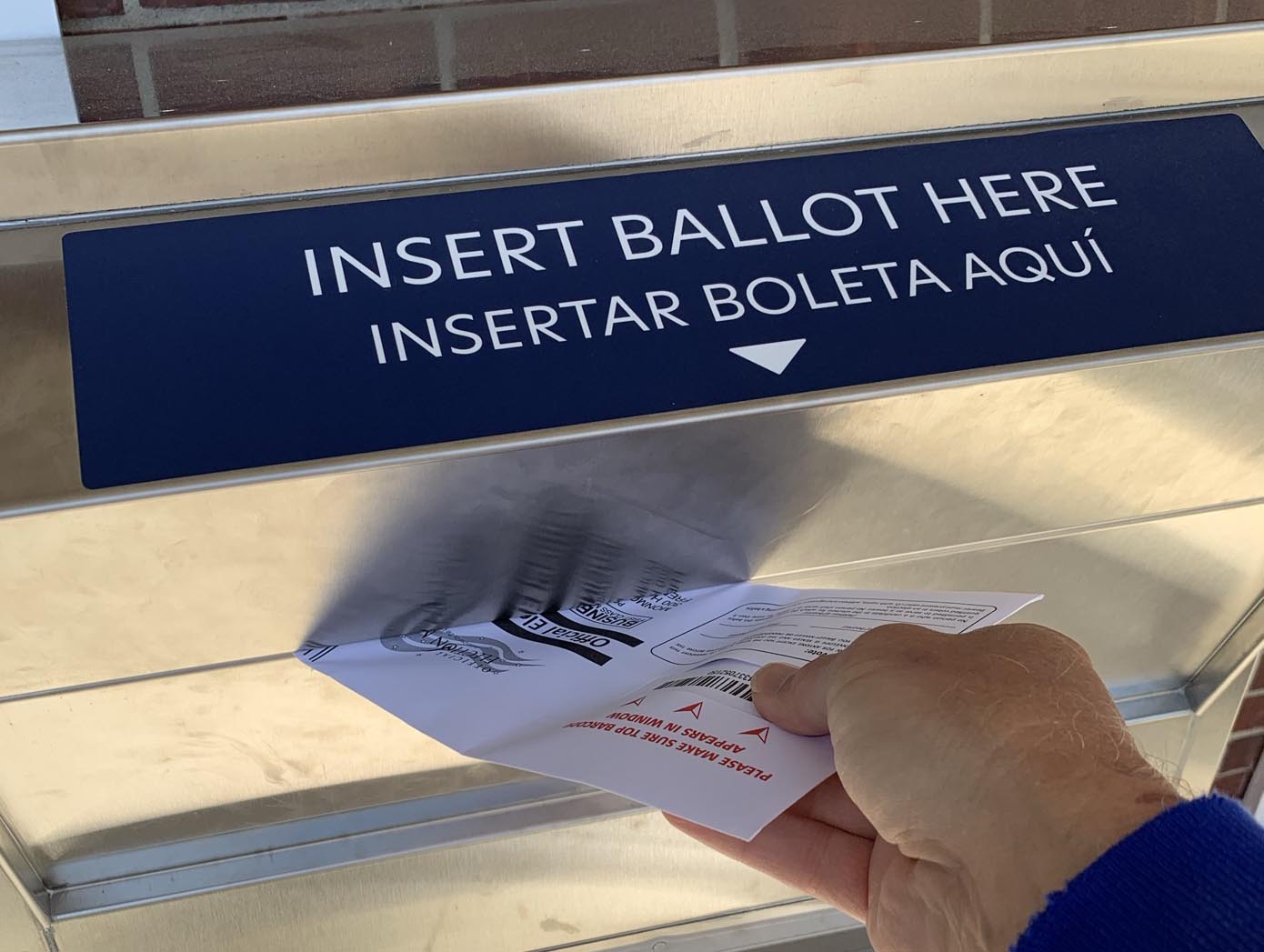
The U.S. Supreme Court declined to pause a lower court blockade on Monday night against President Trump’s mail-in voting executive order ahead of the 2026 midterms. The vote was presumably 7-2, with Justices Clarence Thomas and Samuel Alito dissenting. In its unsigned opinion, the high court rejected the Trump administration’s emergency application to stay a Sept. 4 decision by Massachusetts-based District Judge Indira Talwani. The Obama appointee and past Democrat donor issued a preliminary injunction blocking part of the U.S. Postal Service’s new policy that complies with the president’s mail-in voting order. The USPS rule “would require election officials to submit ballot-envelope designs for approval and upload voter information and unique tracking barcodes to a new USPS portal,” as described by Fox News. The preliminary injunction replaced a temporary restraining order Talwani had issued against the new rule days prior. The Trump administration — which initially appealed the TRO to SCOTUS — withdrew its initial application over the TRO and filed a new one asking the high court to pause Talwani’s injunction. The Supreme Court previously overturned a separate injunction by Talwani against Trump’s mail-in voting order last month. In a 6-3 ruling, the high court ruled that it was too soon for courts to consider the challenge brought by Democrat-led states and D.C. because the administration had yet to issue rules at that time, as required by the president’s edict. The challengers — which also included left-wing groups like the League of Women Voters — then amended their lawsuits after the Postal Service published its rule, prompting Talwani’s latest blockade against the order. In its short ruling, the Supreme Court determined that the Trump administration “is unlikely to succeed on the merits of its challenge” to Talwani’s injunction. The majority further contended that “the equitable factors applicable for obtaining emergency relief from this Court do not favor a stay.” Justice Brett Kavanaugh authored a separate opinion explaining that the preliminary briefing on the case indicates “there is at least a fair prospect that the final rule falls within the Postal Service’s statutory authority.” He ultimately decided to deny the government’s application, however, because he believes that “applying the rule in the 2026 elections would be arbitrary and capricious in violation of the Administrative Procedure Act because state and local election officials do not have sufficient time to reasonably implement the rule before the elections.” Writing on behalf of Thomas and himself in dissent, Alito argued that SCOTUS “incorrectly” decided the issue because “[s]ome of the plaintiffs lack standing, while the remainder are pursuing a claim that this Court has recently called a ‘”Hail Mary pass”‘ that ‘”rarely succeeds.”‘” He further contended that the Trump administration “has made the showings necessary for a stay.” The Bush 43 appointee went on to dissect why the left-wing organizations challenging the USPS rule “likely lack standing” to bring their suit. He said, for example, that the groups’ claim that the directive “supposedly thwarts their ability to educate members about voting” falls flat because it “is based on ‘”a setback to the organization’s abstract social interests”‘ and an effort to ‘spend its way into standing simply by expending money to gather information and advocate against the defendant’s action[s].'” Alito then turned to exploring why the Democrat states’ claims “are unlikely to succeed.” “They claim the rule violates the Elections Clause. … This claim, however, collapses into an inquiry about whether the Postal Service has statutory authority to promulgate the rule,” Alito wrote. “Even assuming the rule here is a regulation of elections, Congress may create such rules under the Elections Clause. And, by statute, it may authorize the Postal Service to issue such rules. Because litigants cannot convert claims that a federal entity has “acted in excess of [its] statutory authority” into constitutional claims … the crux of the dispute is whether the Postal Service has statutory authority to issue the rule.” Alito noted that, in order to bring a claim against an agency that it went beyond its statutory authority, a challenger “needs a cause of action,” which is sustained by the Administrative Procedures Act (APA). He detailed how the problem for challengers in this case is that “Congress broadly exempted ‘the exercise of the powers of the Postal Service’ from review under the APA” and “channeled many claims” against the agency “to initial review before the Postal Regulatory Commission followed by review in the United States Court of Appeals for the District of Columbia.” “Unsurprisingly,” Alito wrote, “the statutory claim here is not subject to APA review. It is a challenge to the scope of the Postal Service’s general rulemaking authority and therefore exempt from the APA.” The Bush 43 appointee described how the states’ inability to proceed under the APA means “they must instead invoke … an ultra vires claim,” which he noted SCOTUS has “strictly limited” to a slim “set of circumstances.” He assessed that such a “Hail Mary pass is unlikely to be successfully completed here” because the USPS has broad authority to regulate the mail.” “In sum, the plaintiff States’ statutory claim is based on a contestable reading of a broadly drawn statute empowering the Postal Service to regulate the mail. Given that the plaintiff States advance an ultra vires claim, the Government must show only that the agency’s interpretation of the statute is not ‘”patently a misconstruction,”‘” Alito wrote. “I express no view on whether the Government would be likely to succeed on de novo review of the Postal Service’s powers. But for now, the Government has satisfied its burden of making a strong showing that the plaintiff States’ ultra vires claim is not likely to succeed.” Alito and Thomas also agreed that the government will likely suffer irreparable harm if Talwani’s injunction is allowed to remain in effect. They furthermore assessed that the “remaining equitable factors” favor pausing her order. While taking states’ alleged concerns about “the practical effects of implementing the rule close to the midterm elections” “very seriously,” Alito wrote that they are “not enough to convince me [and Thomas] to deny the application.” He pointed out how not even the challenging states agree “about the nature of these effects,” and that states and the federal courts — including SCOTUS — “bear a substantial share of the blame for the rule’s timing.” “Not only was the Government subject to months of premature litigation and a series of injunctions that this Court later determined were likely issued without jurisdiction, the Government had to wait nearly another full month for this Court to issue its decision so holding,” Alito wrote. “Indeed, this Court spent from late July to the end of August drafting nearly 40 pages of opinions, including two dissents, despite the Government’s public notice that it would not publish a final rule while subject to the injunctions … and its representation that it had a strong interest in issuing its rule in early-to mid-August to allow time to implement it.” “The plaintiff States cannot claim the timing of the rule tilts the equities in their favor when they, and courts hearing their claims, are responsible for so much of the delay,” he added. Shawn Fleetwood is a staff writer for The Federalist and a graduate of the University of Mary Washington. He is a co-recipient of the 2025 Dao Prize for Excellence in Investigative Journalism. His work has been featured in numerous outlets, including RealClearPolitics and RealClearHealth. Follow him on Twitter @ShawnFleetwood 2026 midtermsElectionsemergency docketIndira Talwanimail-in votingSCOTUSSupreme CourtTrump AdministrationU.S. Postal Servicevoter list maintenance
SCOTUS Blocks Trump’s Mail-In Voting Order Ahead Of Midterms
Full Article
Original Source
Read the full article at Thefederalist →KhanList aggregates and links to publicly available news content. We do not host full articles from third-party sources. Always verify important information with original sources.