
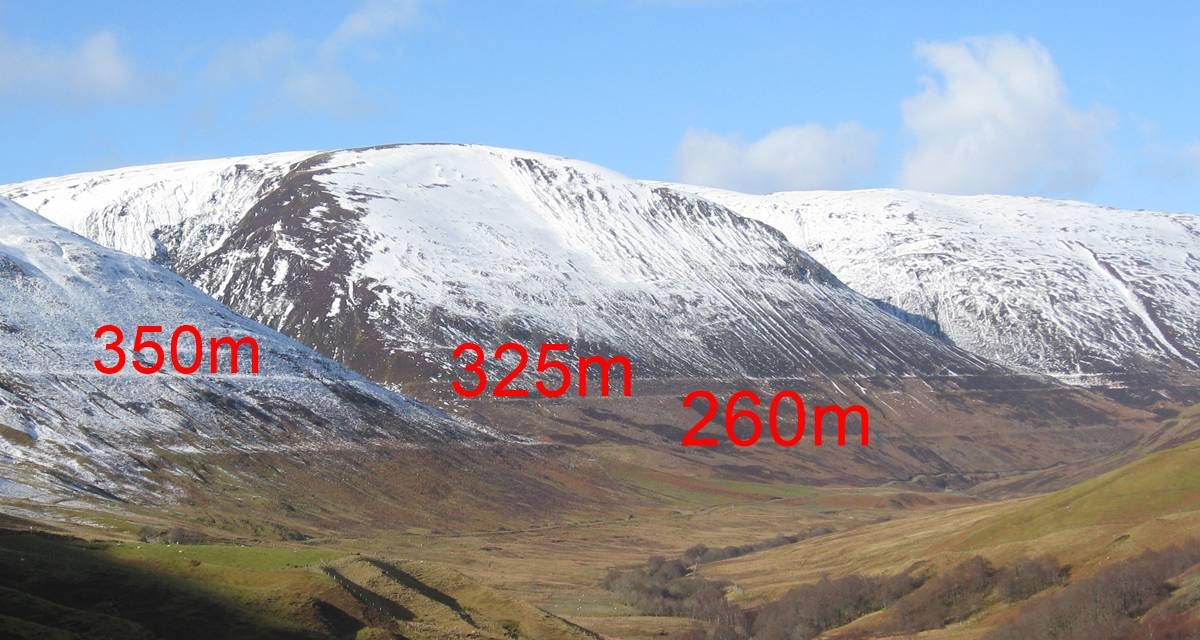
For ages, the Parallel Roads of Glen Roy have mystified people across Europe. At the U.K.’s highest summit, the valley features three parallel lines that run across the hillsides at 260, 325, and 350 meters. Local folklore held that Fionn MacCumhaill and his renowned huntsmen, the Fianna, carved the roads with their tracks. Many theories explain how the parallel roads came about. Some suggest they were evidence of a Biblical flood or an ancient art exhibit. But the road theory falls apart pretty quickly when you consider who would create multiple roads only 25 meters apart. Some of the brightest minds of the 18th and 19th centuries studied the roads, including Charles Darwin, who was perplexed by the lines that appear to be perfectly carved into the landscape. In a Scottish glen about 24 km (15 mi) from Ben Nevis, three perfectly level lines run for miles along the hillside, at 260 m, 325 m and 350 m (850 ft, 1,066 ft and 1,150 ft).They look very much like roads, but aren't. In fact, their name is the Parallel Roads of Glen Roy.1/3 pic.twitter.com/rRgZE4uuXk— Iain Cameron (@theiaincameron) November 10, 2026 Darwin had a theory about how the lines were formed “It is far the most remarkable area I ever examined… I can assure you Glen Roy has astonished me,” Darwin wrote in 1838. Darwin pushed back against the Biblical flood theory, saying that the formations were actually sea beaches. “I have fully convinced myself… that the shelves are sea-beaches, although I could not find a trace of a shell, and I think I can explain away most, if not all, the difficulties,” he wrote. The Parallel Roads at Glen Roy. Photo credit: Banco de Imágenes Geológicas/Flickr However, Darwin was wrong. Louis Agassiz, a Swiss-born American biologist and geologist, correctly deduced that glaciers created the roads. “…at the foot of Ben Nevis, and in the principal valleys, I discovered the most distinct morains and polished rocky surfaces, just as in the valleys of the Swiss Alps, in the region of existing glaciers; so that the existence of glaciers in Scotland at early periods can no longer be doubted,” Agassiz wrote. The ice-dammed shorelines of Glen Roy. Photo credit: TheIanCameron/X (public domain) Glacial Theory was a new idea at the time Agassiz’s hypothesis was part of glacial theory, an idea introduced in 1837 that proposed glaciers once covered large parts of Europe and shaped much of its topography. This challenged the popular geological theory at the time, which held that scratched rock surfaces and giant boulders were created by drifting icebergs and floods. Glacial theory wasn’t completely accepted until the 1870s. Charles Darwin. Photo credit: National Portrait Gallery/Wikimedia Commons Modern science believes that the parallel roads are the shorelines of ice-dammed lakes that formed around 13,000 years ago. As the ice fluctuated over the years, it created three distinct beaches that looked like roads. As the climate warmed, the glaciers melted, the water drained, and the three distinct shorelines became visible along the valley sides. Darwin stubbornly held onto the idea that the parallel roads were sea beaches until 1862, when he finally admitted he was wrong. “I was never before fully convinced of the land glacialisation of Scotland,” he said, before cursing the mysterious formation. “Now and for evermore I give up and abominate Glen Roy and all its belongings. How many have blundered over those horrid shelves!”
Scotland’s 3 mysterious parallel hillside roads weren’t built by humans. Even Darwin was puzzled.
Full Article
Original Source
Read the full article at Upworthy →KhanList aggregates and links to publicly available news content. We do not host full articles from third-party sources. Always verify important information with original sources.