
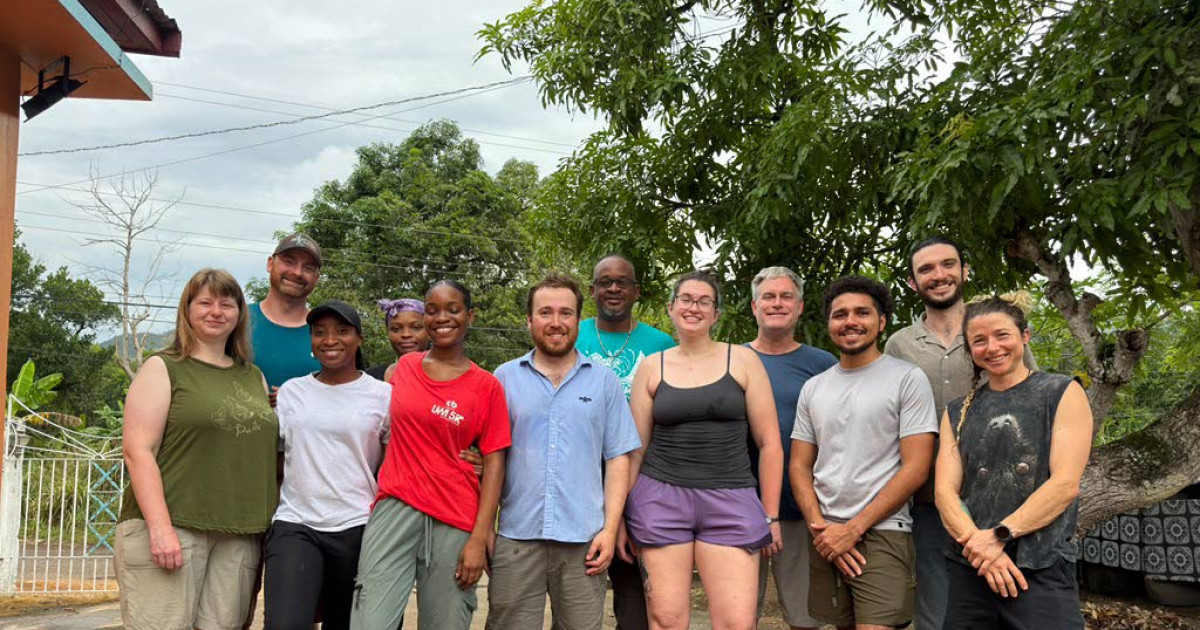
The research team (front, from left) Dr Karen Vanderwolf, Nashay Robinson, Tattihanna Green, Dr Phillip Oelbaum, Dr Jerrica Jamison, Nicholas Lee, and Dr Shannon Joslin. At back (from left) are: Ryan Byrnes, Kareen Barnett, Damion Whyte, Prof Kenneth Welch, and Dr Caleb Ryan. AN international collaboration of scientists and Jamaican researchers is strengthening efforts to understand and protect the island’s diverse bat population, combining advanced monitoring technology, cave surveys and hands-on training to support long-term conservation. The latest field season, held from October 3 to 13, brought together researchers from The University of the West Indies (The UWI), the Smithsonian Tropical Research Institute in Panama, Pennsylvania State University in the United States, and the University of Toronto in Canada, alongside local cave experts and The UWI post-graduate students. The 11-night exercise combined research across several cave sites with practical training in bat capture, handling, body measurements, blood and tissue sampling, and acoustic monitoring. A major breakthrough was the introduction of electronic tagging technology that will allow individual bats to be identified and monitored over time. “The work is particularly important for Jamaica, which has 21 bat species belonging to six different families,” biologist Damion Whtye told the Jamaica Observer. “With about 1,500 species worldwide, bats are among the most diverse groups of mammals, and the variety found on the island is remarkable, given its relatively small size,” he said. According to Whyte, bats’ ecological contributions are equally significant as they help control insect populations, pollinate plants and disperse seeds, supporting healthy ecosystems and forest regeneration. Tattihanna Green (left) and Nashay Robinson from The University of the West Indies marking a bat with an RFID PIT tag. Whyte also disclosed that Jamaica is even home to a fish-eating bat, underscoring the diversity of feeding habits among the island’s species. Yet, he said, much remains to be learned about where Jamaican bats travel, what they eat, how they use their habitats and how their populations change over time. At the centre of the latest research is the Jamaican flower bat (Phyllonycteris aphylla), an endemic species found nowhere else in the world and classified as critically endangered. Whyte said that during the field season, researchers tagged 133 Jamaican flower bats across two caves — Stony Hill cave in Portland and Wellington Glade cave in St Andrew — while also installing radio frequency identification (RFID) readers at the locations. He explained that the small, battery-free passive integrated transponder (PIT) tags, implanted beneath the bats’ skin, carry unique identification numbers that can be detected by compatible readers when a tagged bat comes within range. “This creates electronic checkpoints that can record when individual bats enter or leave monitored caves and help us establish which animals return to particular sites,” Whyte said, adding that when the information is combined with capture-mark-recapture methods, it can also help scientists estimate cave populations and investigate changes in numbers over time. Tattihanna Green admires the wing of a Jamaican Fruit Bat prior to release. Dr Caleb Ryan, a post-doctoral researcher at the Smithsonian Tropical Research Institute, guided students in the tagging process and installation of the readers. “Establishing a system using PIT tags to re-identify individual bats across their lives will be a critical tool for understanding the population status and behaviour of the critically endangered Jamaican flower bats as well as provide a foundation for students in Jamaica to integrate next-generation technology into their research,” he said. The system provides a foundation for continued monitoring between field visits, although maintaining the equipment, revisiting sites and analysing accumulated data will be essential to realising its full potential. The collaboration also extends beyond population monitoring. Dr Jerrica Jamison, a post-doctoral researcher at Pennsylvania State University, collected wing-punch tissue samples to establish cell lines for laboratory research. At the same time, Professor Ken Welch of the University of Toronto shared expertise on sugar metabolism in bats, including adaptations that could help researchers better understand how fruit- and nectar-feeding species process sugar. That work, Whyte explained, could offer insights for future research into blood sugar regulation and diabetes, although, he emphasised that any potential medical applications would require further investigation. Damion Whyte admires a Jamaican Fruit Bat prior to release. Acoustic research also formed part of the programme, with Ryan Byrnes sharing techniques for identifying bats through their calls and developing a reference library. These recordings complement capture surveys by providing another way to study bat activity, including when researchers are not physically present at a site. For The UWI MPhil students Nashay Robinson, Kareen Barnett and Tattihanna Green, the field season offered an opportunity to learn directly from specialists while contributing to ongoing research. Whyte emphasised that the partnership between local and international researchers was central to the exercise. He said the Jamaican Caves Organisation provided guidance on cave locations, complementing the team’s scientific expertise. Its knowledge is especially valuable given that the Jamaican Cave Register contains more than 1,200 sites. Funding from Jamaica Conservation Partners, a project of the Cecil Boswell Facey Foundation, is also supporting the wider long-term monitoring programme. The organisation awarded US$25,000 to The UWI’s Department of Life Sciences to support the installation of PIT tag readers and surveys for threatened bats. Beyond the caves and laboratories, the researchers are placing emphasis on public education, recognising that conservation depends partly on how people understand and treat what they term “these often-misunderstood animals”. Dr Phillip Oelbaum and Dr Jerrica Jamison teaching students bat sampling techniques. Whyte said activities at the College of Agriculture, Science and Education and Hope Gardens introduced students, staff, and families to bat research, including demonstrations of capture methods. Researchers also shared their findings through university seminars and online outreach. Through RoostersWorldJA, Whyte uses social media to explain the importance of bats and encourage the public to report caves, roosts, and sightings of dead or injured animals. He urged people to avoid handling bats themselves, but to seek assistance from trained personnel. Noting that the outreach also seeks to dispel myths, including the misconception that bats are blind, Whyte said researchers hope that greater public understanding of their diversity and ecological value will encourage Jamaicans to protect bat roosts and habitats rather than destroy or disturb them. “Ultimately, the success of the collaboration will depend on whether the knowledge, technology and skills established during the field season can be sustained,” Whyte said. “Continued surveys, reliable monitoring equipment, data analysis, and further training will be needed to turn the initial findings into a clearer picture of Jamaica’s bat populations,” he added.
Scientists team up to track, protect Jamaica’s bats
Full Article
Original Source
Read the full article at Jamaicaobserver →KhanList aggregates and links to publicly available news content. We do not host full articles from third-party sources. Always verify important information with original sources.