
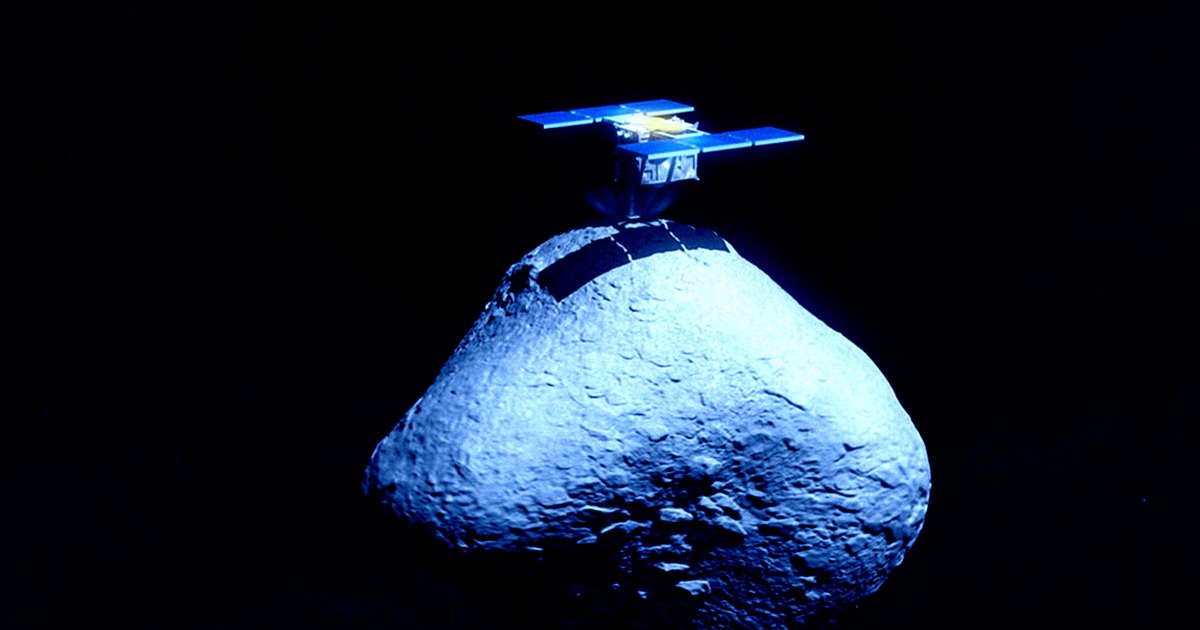
T. Santana-Ros et al. There’s something puzzling about 1998 KY26, a mysterious object that the Japanese space agency’s Hayabusa2 spacecraft is on its way to visit: it’s accelerating. That isn’t necessarily out of the ordinary for asteroids and comets, but it appears to be driven by a propulsion source that scientists have yet to understand, as ScienceAlert reports. One explanation, from Harvard astronomer Avi Loeb, suggests that 1998 KY26 is a derelict Soviet spacecraft that launched almost 40 years ago. More conventional attempts to account for its acceleration proffer that it’s a “dark comet,” a type of space object that acts like a rocky asteroid, but experiences acceleration that can’t be accounted for by gravitational forces. Yet according to new research published in the journal Icarus, it’s too warm to be a dark comet, which can accelerate by releasing ice that sublimates into gas. If that were the case, observations show that it would’ve run out of ice reserves a long time ago. “Our temperature model results indicate that the water outgassing rate on 1998 KY26 would be too high to maintain buried ice, refining the understanding of the asteroid’s composition,” authors of the paper and Georgia Institute of Technology aerospace engineers Korbin Hansen and Masatoshi Hirabayashi wrote. 1998 KY26 is a 36-foot space object that rotates every five and a half minutes and is currently located 186 million miles away from Earth. After modeling its temperature using pre-existing data, Hansen and Hirabayashi found that even its coldest regions measured upwards of -77 degrees Fahrenheit. While that may sound chilly, it’s too warm for stores of ice that could sublimate into gas and provide thrust. At such warm temperatures, 1998 KY26 would’ve run out of fuel in just 62 years, a blink of an eye for an object suspected to be billions of years old, as ScienceAlert points out. The team concludes that “1998 KY26 is likely a dehydrated asteroid,” meaning that it lost its stores of water long ago. Other explanations for its acceleration could be solar radiation or “thermal emission forces” pushing it. Fortunately, Hayabusa2 is expected to rendezvous with the mysterious object in July 2031, which could give scientists a first-hand look at whatever is going on. More on dark comets: Paper Claims the “Asteroid” Japan’s Probe Is Approaching Is Actually a Derelict Spacecraft
Scientists Stumped by Why Mysterious Object Is Accelerating as a Japanese Spacecraft Rushes to Catch It
Full Article
Original Source
Read the full article at Futurism →KhanList aggregates and links to publicly available news content. We do not host full articles from third-party sources. Always verify important information with original sources.