
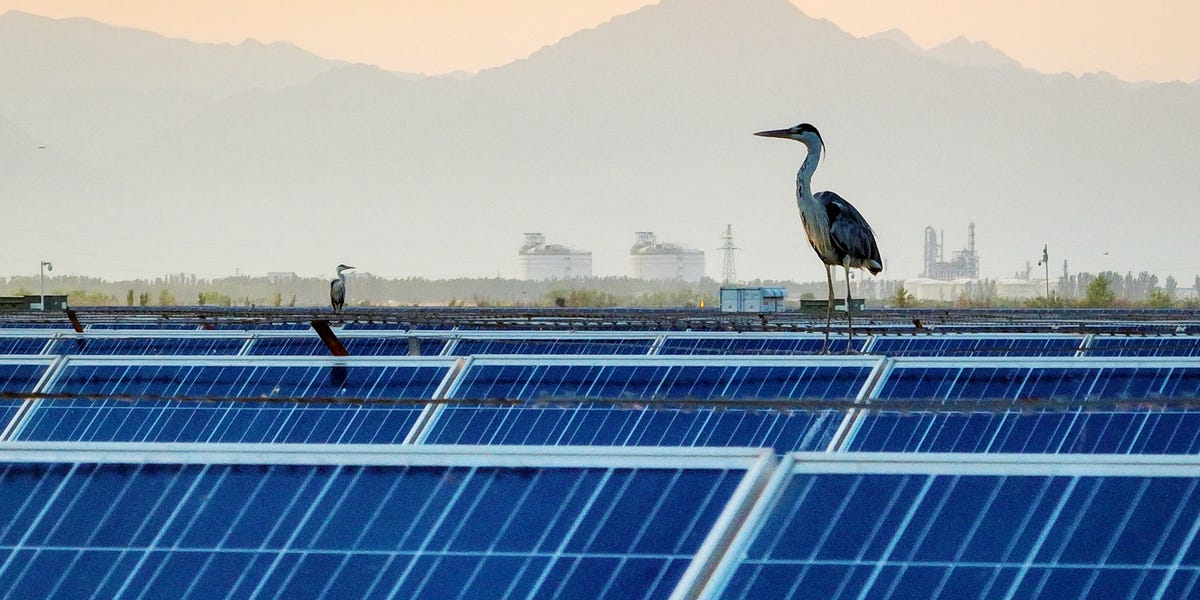
3 min readHere’s what you’ll learn when you read this story:Solar panels are one of humanity’s greatest tools for combating climate change, but they also come with downsides for wildlife. A new study analyzed China’s solar boom, and found declines in bird diversity in regions with pro-solar policies. The answer isn’t to stop building solar to protect wildlife, but rather to construct even more systems that are ecologically conscious and avoid sensitive habitats. Renewable energy is the solution for the climate crisis. Severely curtailing carbon emissions while harnessing the free energy provided by the fusion reactor known as our Sun (in the form of solar power) or the wind blowing across the plains is a clear win-win for humanity, but that doesn’t mean that energy sources like this don’t come with downsides that require careful consideration.For instance, 400-foot-tall wind turbines and sprawling photovoltaic arrays need space, often to the detriment of the wild animals that rely on those once-undisturbed habitats. Now, in a new study published in the journal Science, an international team of researchers details their analysis of the effects of China’s solar boom on bird species—and they’ve found some unsettling trends. Looking at data from more than 2,344 counties in China from 2014 to 2023, the researchers noticed that those with pro-photovoltaic policies saw a decrease in bird diversity.To come to this conclusion, the authors paired this data with citizen science datasets of bird activity. Specifically, they found that the correlation between solar build-out and bird diversity was greatest in wealthier, non-arid regions of the country. The growing colossus of solar infrastructure in the country has taken over bird species’ foraging and breeding habitats.They also investigated a strange paradox in the data known as “inferior greening.” Some datasets—particularly the satellite-derived leaf area index (LAI) that measures geographic greening—are often seen as “proxies for ecosystem health,” the authors wrote, but actually mask ecosystem loss. These “green” spaces where leafiness has increased are actually often filled with a homogeneous mixture of plants, and do not contain the flora biodiversity required for a thriving ecosystem.“The dense but homogeneous undergrowth that may flourish under solar panels lacks the structural complexity and resource diversity of the natural habitats it replaces, thereby failing to support specialist avian communities,” the authors wrote. “Our investigation of this mechanism calls for a rethinking of what constitutes ecological health in the context of renewable energy expansion and underscores the danger of relying on simplistic biomass indicators for environmental monitoring.”The authors argue that this solar-driven bird decline is an example of a “green dilemma”—a problem where the build out of the solar system is necessary to avoid the apocalyptic scenarios of anthropogenic climate change, but presents land use challenges for preserving wild spaces for animals. But the take away, the authors stress, is not to stop building solar panels.“The main message is not to slow the renewable energy transition, but to make solar development more ecologically informed,” Huiming Zhang, lead author of the study from Nanjing University, told AFP.And that’s a message China—and the rest of the world—needs to take to heart. One of the downsides of China’s solar blitz is that sites weren’t initially chosen based on sunshine frequency or available land, but on economic development in specific regions, producing poor ecological results in the process. China currently accounts for half of the world’s wind and solar capacity, and hopes to power 45 percent of the country using solar by 2060.While this study states that this goal could be bad news for birds, it doesn’t have to be. The authors argue for better site selection moving forward, and steering away from ecologically sensitive areas. The hope is that by understanding the negative impacts of solar panels, future systems can (and will) be designed in a way that preserves space for our wild friends while building a sustainable planet for future generations.Darren lives in Portland, has a cat, and writes/edits about sci-fi and how our world works. You can find his previous stuff at Gizmodo and Paste if you look hard enough.
Scientists Say Solar Panels in China is Killing Bird Diversity. They Still Want More Solar Panels.
Full Article
Original Source
Read the full article at Popularmechanics →KhanList aggregates and links to publicly available news content. We do not host full articles from third-party sources. Always verify important information with original sources.