
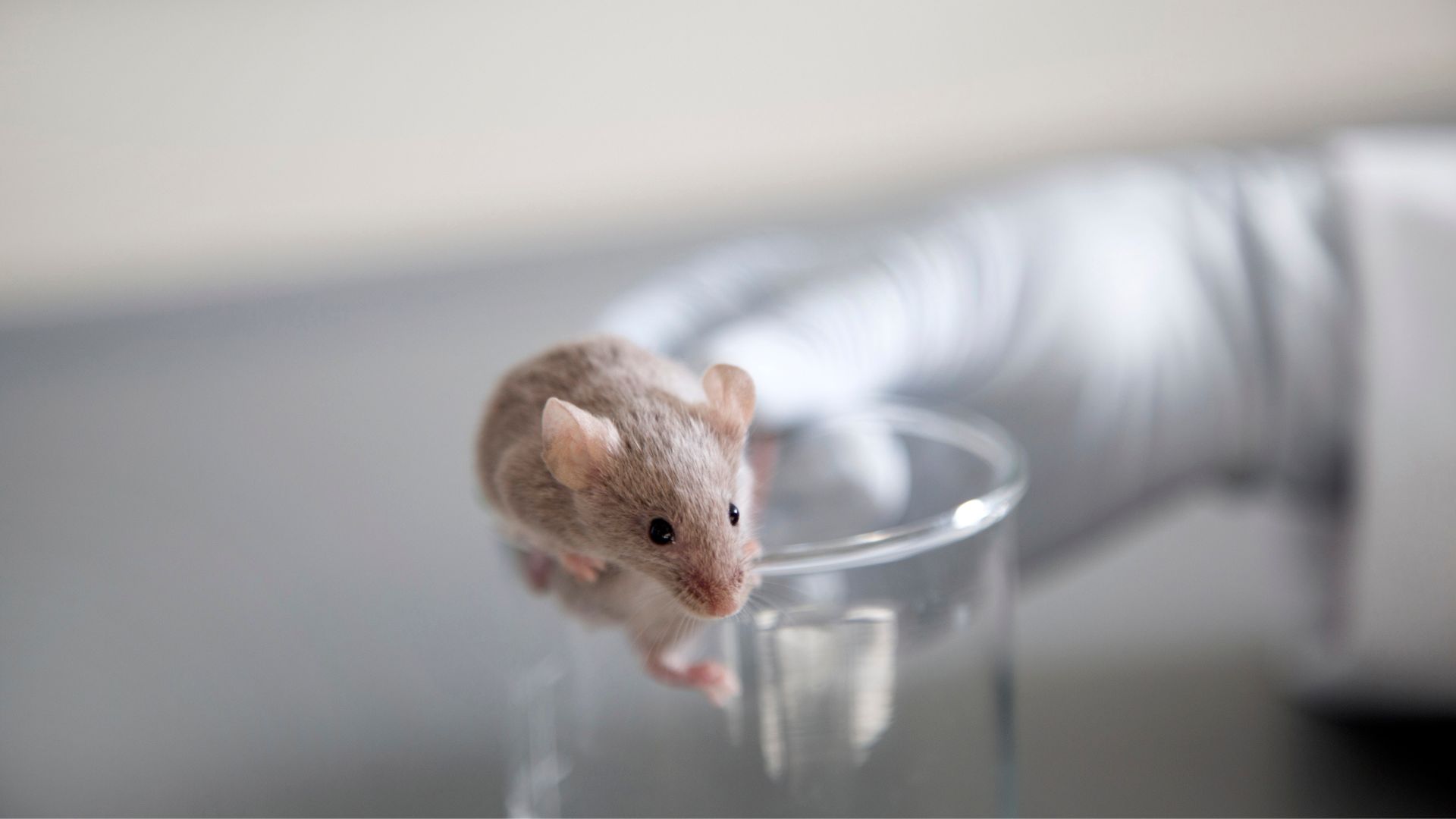
Medical science sometimes sounds bizarre. Researchers have created living mice whose outer brains are almost entirely human. Stanford University cleared out the rodents’ native neural pathways to create a spatial vacuum, allowing lab-grown human brain tissue to fill the void. Taking over roughly half of the mouse’s total brain space, the human cells successfully hooked into the host’s blood supply, local neurons, and spinal cord. The resulting “xenocortical” animals offer an unprecedented window into human neurological conditions from epilepsy and autism to cerebral palsy. “We envision that xenocortication will be useful for obtaining circuit- and behavior-level readouts using human neurons to study neurodevelopment, model disease and develop therapeutics,” the researchers wrote in the study paper. Cross-section MRI scan through a xenocortical mouse brain showing a map of estimated nerve-fiber pathways and directions.Pasca lab Rewiring the lab mouse Human brain tissue is inherently inaccessible, making the study of neural development and function remarkably difficult. Human stem-cell-derived neural models are now helping researchers overcome this barrier. This technique also provides insights into host behavior alongside cellular development. Ultimately, these hybrid models offer a promising way to examine human brain health and disease in real time. Typical rodent brains are too crowded to let human tissue grow at scale. Spatial competition always won. The human cells were squeezed out. To overcome this issue, a team led by Dr. Sergiu Pașca genetically modified mice to block the development of their own cerebral cortex and hippocampus. The animals were born with a vast structural emptiness. Then came the graft. Scientists converted human skin cells into stem cells, grew them into mini-brain organoids, and injected them into mouse pups. The tiny human clusters survived and also expanded rapidly. Within three months, the grafted human tissue had expanded fivefold, connecting directly to mouse blood vessels and extending neural wires down into the animal’s spinal cord. The lab-grown human brain tissue expanded rapidly after transplantation, growing to fill most of the mouse’s cortical space. As it grew, it developed into a wide variety of specialized human brain cells. These new cells then hooked up directly to the mouse’s existing nervous system. Surprising view of rare nerve cells Brain scans and electrical measurements showed that the transplanted human cells fired in organized patterns, behaving like developing brain circuits. The mice could still walk around and move normally. However, researchers noticed subtle tweaks in how they coordinated their limbs and carried out daily spontaneous habits. “Behavioral analyses of apallial and xenocortical mice revealed broadly preserved locomotion alongside selective differences in limb coordination and altered organization of spontaneous behavior,” the team noted. The medical implications are immediate. In proof-of-concept tests, researchers exposed the xenocortical mice to low oxygen levels for five hours. The human neurons suffered severe, selective damage, mimicking the cellular breakdown that causes cerebral palsy in human infants during difficult childbirths. Surprisingly, the platform also yielded rare von Economo neurons, specialized cells heavily impacted by frontotemporal dementia that previously couldn’t be cultured effectively in a lab. Ethical oversight remains rigorous. Bioethicists and philosophers actively monitor the welfare and cognitive state of the animals as the research progresses. Yet, for millions living with untreatable neurological conditions, these chimeric rodents represent a crucial step forward — bringing the dark box of the human brain into the light. The study findings were published in the journal Nature on September 16. Get the latest in engineering, tech, space & science - delivered daily to your inbox.Mrigakshi is a science journalist who enjoys writing about space exploration, biology, and technological innovations. Her work has been featured in well-known publications including Nature India, Supercluster, The Weather Channel and Astronomy magazine. If you have pitches in mind, please do not hesitate to email her.
Scientists grow half-human brains in living mice to study neurological disorders
Full Article
Original Source
Read the full article at Interestingengineering →KhanList aggregates and links to publicly available news content. We do not host full articles from third-party sources. Always verify important information with original sources.