
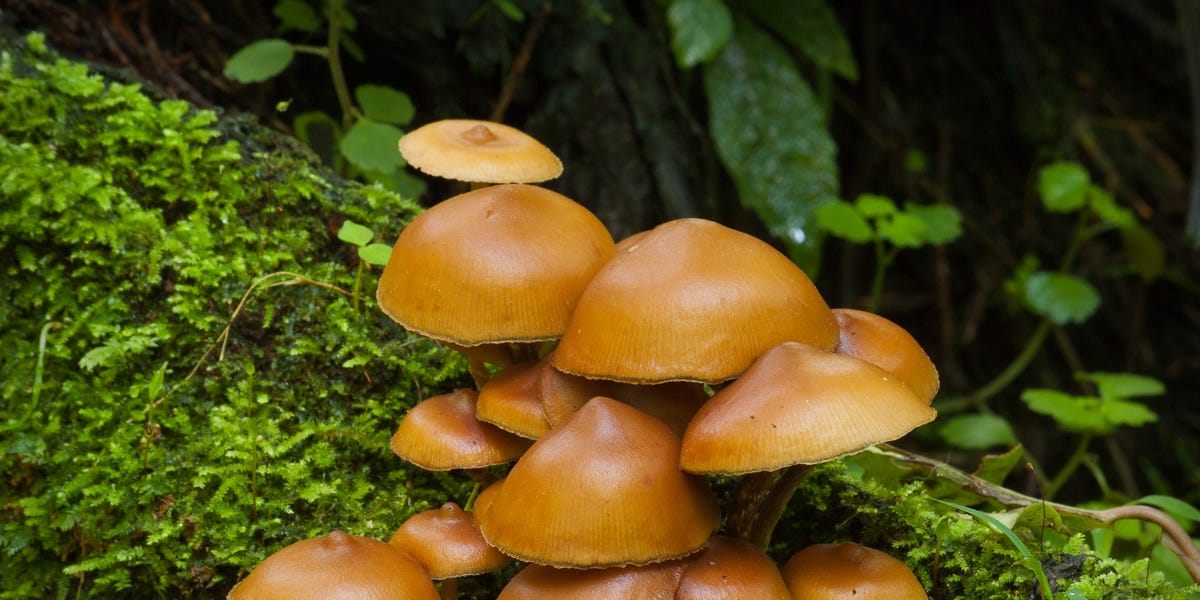
Magic mushrooms get their magic from psilocybin and psilocin, psychedelic compounds that warp reality and open portals to other realms. They have also been used by Indigenous Mesoamerican and South American peoples for centuries to induce visions. Though it was once thought that mushrooms were either magic or poisonous, there is one newly discovered species that, because of a bizarre turn in evolution, produces both psilocybin and lethal amatoxins, possibly as a defense against being eaten. That’s one trip you never want to take.Galerina indica looks unassuming. Growing on rotting palm trunks in the humid swamps of Florida, this tiny brown mushroom has no fairytale spots or fantastical colors, so it seems like just another fungus bound to be stepped on. Under its dark cap is a darker reality. Matthew Smith of the University of Florida is the state’s official mycologist, identifying species that could be toxic and regularly consulting with Poison Control, and his team was searching for potentially lethal mushrooms when undergrad researcher Andrew Kunik noticed something strange. While documenting fungi, he found that handling G. indica turned it blue. This often occurs in psychedelic mushrooms. Further investigation found that, despite having this telltale characteristic, the mushroom Kunik had been analyzing had a more sinister kind of magic.“Although the effects of psiloids and amatoxins in humans are well documented, their natural roles in the environment remain unresolved, with anti-fungivore defense being the leading hypothesis for both compound classes,” Smith and Kunik, who discovered both substances occurring in this species through mass spectrometry, said in a study recently published in Current Biology.While G. indica did contain psilocybin, it turned out that the ‘shroom also secreted deadly amatoxins. There is no other species of mushroom known for producing both of these substances, and while trippy psiloids have been shown to have possible therapeutic properties, ingesting amatoxins is fatal because these peptides inhibit the enzyme RNA polymerase from creating RNA copies of genes, which leads to organ failure. Fungi are thought to have evolved to produce amatoxins in order to ward off fungivorous creatures such as snails and nematodes. The genes behind production of both psiloids and amatoxins are usually passed down through fungi to their descendants, but the way these genes are acquired is not always so straightforward. Previous studies have suggested they can be horizontally transferred between different fungal species.Psiloids are known to be synthesized by a cluster of collaborative genes for which evidence of horizontal gene transfer has been found. The same is suspected of amatoxin synthesis, and though there is less evidence for horizontal transfer, it probably began with a fungal donor lineage (which may not have been the same species) that has yet to be identified. Genome analysis has shown that these and other fungal attributes were acquired by genes that were transferred from one species to another growing in the same vicinity. The genus Galerina is already infamous for amatoxins that make many mushrooms within the genus so deadly. How psiloids entered the genus remains a mystery, though just one fateful transfer could have incorporated the genes for amatoxin synthesis into these mushrooms.What evidence does exist for the transfer of genes that produce psiloids suggests they seeped into a lineage that did not already contain amatoxins, and in a separate evolutionary event, was absorbed by a separate toxic lineage. Kunik’s discovery also revealed how unpredictable fungi can be. The blue pigmentation that is known to be a sign of a magic mushroom comes from psilocin oligomers, molecules linked together from a few repeating structural units, or monomers. Galerina indica has shown that seeing blue does not always mean a mushroom only contains psilocin or psilocybin. While the exact genes that are responsible for amatoxins in this species are still unidentified, and exactly how psiloids evolved in the Galerina genus can only be hypothesized, there is now another thing in Florida more dangerous than alligators.“G. indica brings together in a single species the biosynthetic systems associated with both ‘magic mushrooms’ and the world’s deadliest poisonous mushrooms,” Kunik and Smith said, “providing a rare natural system for studying how horizontally acquired secondary-metabolite pathways impact organismal fitness.”Elizabeth Rayne is a creature who writes. Her work has appeared in Popular Mechanics, Ars Technica, SYFY WIRE, Space.com, Live Science, Den of Geek, Forbidden Futures and Collective Tales. She lurks right outside New York City with her parrot, Lestat. When not writing, she can be found drawing, playing the piano or shapeshifting.
Scientists Found a Mushroom That Shouldn’t Exist: It Makes Psychedelics and Deadly Toxins
Full Article
Original Source
Read the full article at Popularmechanics →KhanList aggregates and links to publicly available news content. We do not host full articles from third-party sources. Always verify important information with original sources.