
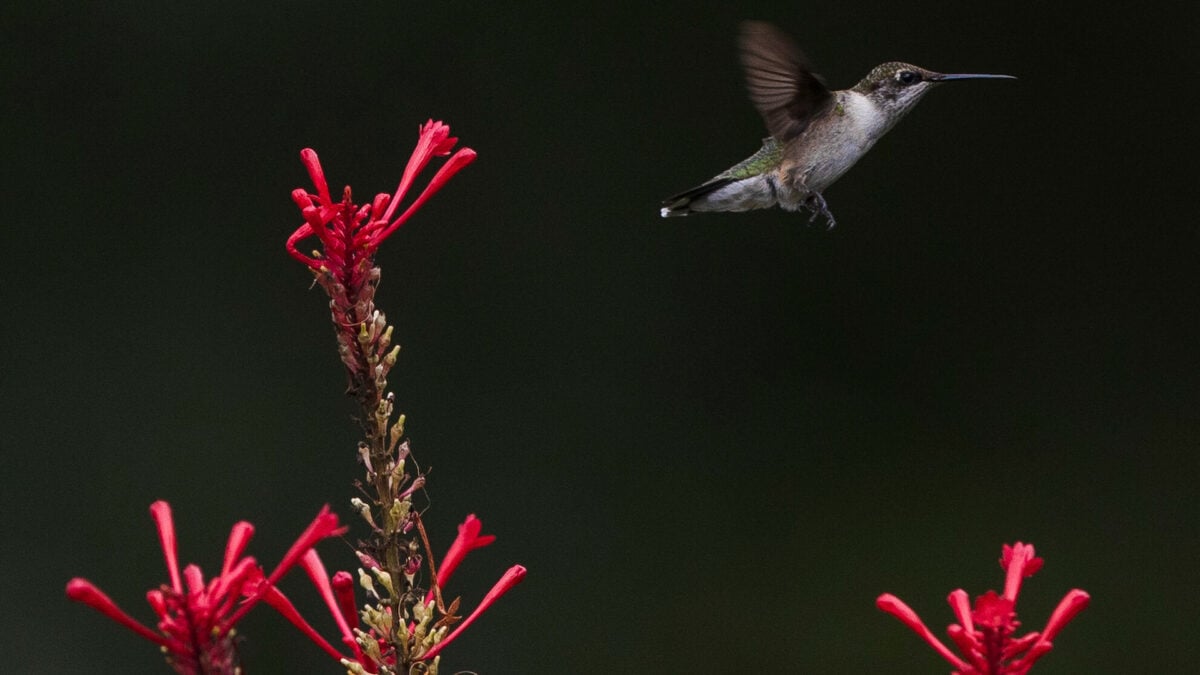
They may be small enough to fit in the palm of your hand, but hummingbirds are surprisingly ambitious travelers. With wings that beat dozens of times per second, these tiny, iridescent creatures are capable of covering enormous distances. But following their journeys has presented scientists with a peculiar problem: The tracking technology available until recently was simply too heavy for their miniature subjects. That’s changing. Using ultralight solar-powered transmitters, researchers have managed to track individual hummingbirds across the continent, including one particularly adventurous bird that traveled from Alabama to Alaska in what is now the longest recorded hummingbird migration. The traveler was a Rufous hummingbird, a species known for its impressive migrations despite weighing less than one ounce. The bird traveled a total of 4,055 miles (6,526 kilometers) in just 38 days. In a new paper published in Ecology and Evolution, a team of researchers detail the record-breaking journey and the technology that allowed them to follow the birds in real time. Tiny trackers for tiny birds Scientists have been trying to track hummingbirds for years, but their diminutive size has presented a technological challenge. Early attempts involved attaching radio transmitters to the birds, allowing researchers to monitor their movements over relatively short distances. But even these devices could affect the birds’ flight activity, and following individual hummingbirds across an entire continent remained difficult. To overcome this issue, the scientists behind the new study developed a tracking device light enough for the birds to carry. The ultralight transmitter, called the BlūMorpho, weighs just 0.002 ounces (0.06 grams). Unlike earlier tracking devices, which relied on batteries that added considerable weight, this miniature gadget runs on solar power, using a tiny capacitor to store energy for its transmissions. The tracking device emits a Bluetooth signal that can be picked up by nearby smartphones and other compatible devices, which relay the bird’s location to researchers. By tapping into an existing network of everyday electronics rather than relying solely on dedicated tracking stations, the technology allowed the scientists to follow hummingbirds across much greater distances without having to recapture them to retrieve their tracking data. The team attached BlūMorphos to 11 hummingbirds, four Rufous (Selasphorus rufus) and seven ruby-throated hummingbirds (Archilochus colubris), in coastal Alabama and Florida in the spring of 2025. The tracking device was glued on a small patch of trimmed feathers on each bird. Credit: Emma Rhodes et al, 2026. Trailblazing birds The researchers were able to document hummingbird movements across North America, including migration routes, travel distances, and seasonal movements that would have been difficult to observe otherwise. The standout bird was an adult male Rufous hummingbird tagged in Lillian, Alabama, on March 27, 2025. It traveled west across northern Mexico, then north along the Pacific coast before reaching Juneau, Alaska on May 3, 2025. At just over 4,000 miles along its winding route, that’s the longest hummingbird migration to date, according to the study (the previous record involved a female Rufous that was banded in Florida in 2010 and found 3,500 miles (5,632 km) away in Alaska). Aside from the record-breaking journey, the data also revealed that individual hummingbirds don’t necessarily follow the same routes even when they belong to the same species. Another Rufous hummingbird headed north before making a rather unusual, winding journey across several eastern U.S. states, including a roughly 214-mile (345-kilometer) loop through Tennessee and Missouri. While two ruby-throated hummingbirds traveled north along remarkably similar routes, a third one traveled southeast from Alabama into Florida. The new tracking devices gave scientists a new way to follow some of nature’s smallest long-distance travelers, but more research is needed to find out if wearing them would have any long-term effects on the birds. The data could, however, help conservation efforts for hummingbirds. “With both Rufous and Ruby-throated Hummingbirds experiencing recent population declines, this new technology will provide critical insights for species management, conservation, and to understand the current population shifts,” the authors wrote in the study.
Scientists Finally Found a Way to Track Hummingbirds—and One Just Broke a Migration Record
Full Article
Original Source
Read the full article at Gizmodo →KhanList aggregates and links to publicly available news content. We do not host full articles from third-party sources. Always verify important information with original sources.