
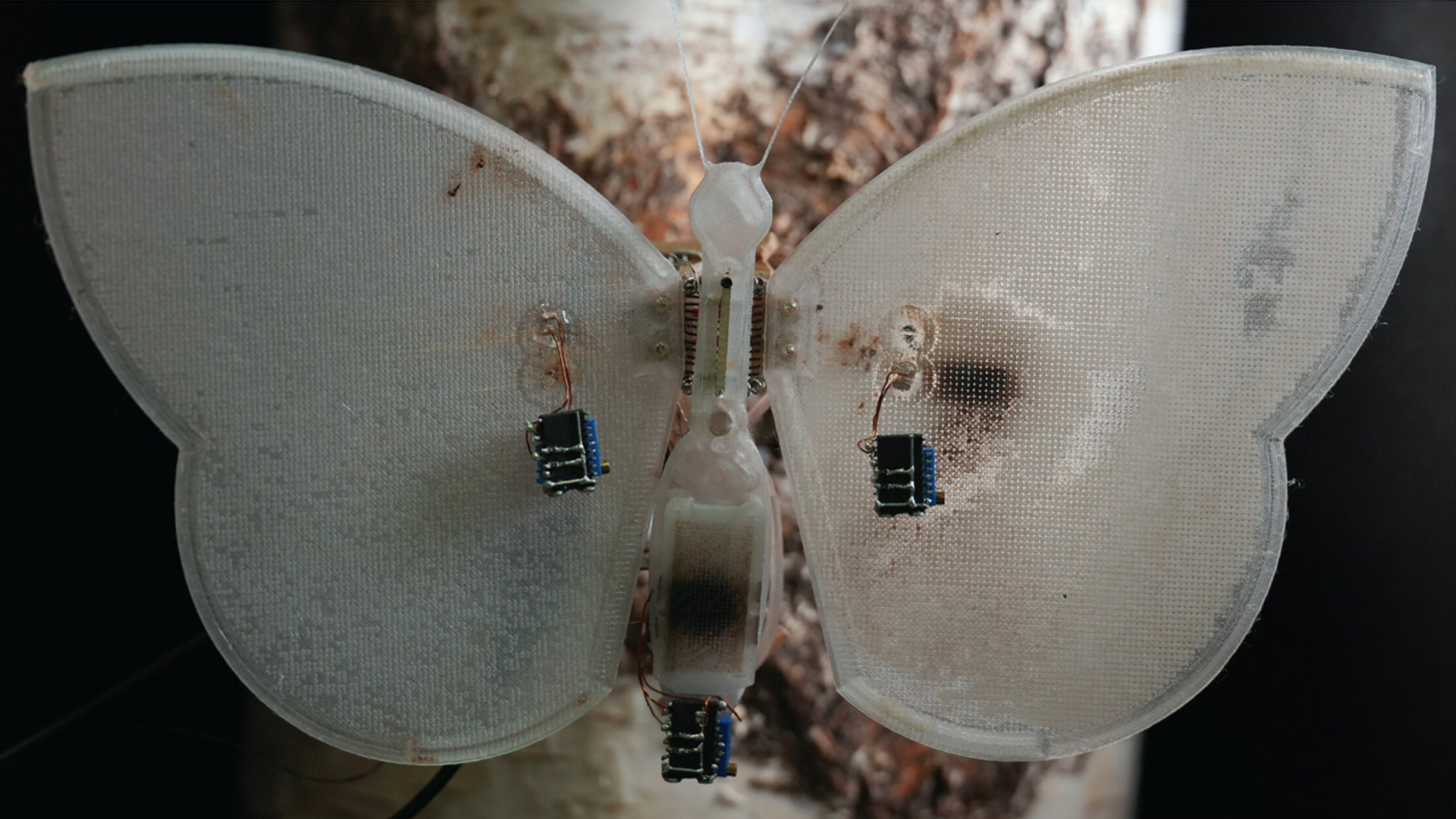
Imagine sending a robot into an unfamiliar environment without knowing what it might encounter. If it comes across something its existing sensors cannot detect, it would normally need to return to a workshop for new equipment. But what if it could instead grow a new sensor right where it needs one? A team of researchers has demonstrated a step toward this possibility with a moth-shaped robot that uses an artificial circulatory system to transport chemical ingredients through its body and grow a functioning light sensor wherever ultraviolet (UV) light strikes. “I’m working on giving robots a circulatory system, so they can transport molecular building blocks across the whole body and create the hardware they need, on site, where and when it’s needed,” Kadri-Ann Pankratov, lead researcher and a PhD student at the University of Tartu in Estonia, said. The experiment suggests that robots could eventually adapt not just by changing how they use existing hardware, but by chemically creating entirely new capabilities within their bodies. Taking a cue from how insects circulate materials Most robots leave the factory with their hardware already decided. Engineers must anticipate which sensors they will need and where to install them. Although adaptive software can help robots respond to unexpected situations, it cannot compensate for a missing physical sensor. Adding entirely new capabilities after deployment remains a significant engineering challenge. The researchers from the University of Tartu in Estonia and the Italian Institute of Technology explored whether a robot could overcome this limitation by borrowing an idea from nature: circulation. In insects, an open circulatory system pumps hemolymph, a blood-like fluid, through the body, allowing it to reach different organs and tissues. The team took inspiration from moths, particularly the blue underwing (Catocala fraxini). Its relatively flat wings offered a convenient model because their circulation happens largely in a single plane, simplifying the robot’s internal plumbing. The researchers 3D-printed a transparent plastic body using polyethylene terephthalate glycol (PETG). Each of its two wings covered 86 square centimeters and contained millimeter-wide channels resembling veins. Smaller gaps between the printed plastic lines formed a network of microchannels, allowing liquids to penetrate about 10 micrometers into the material. A single pump circulated around 3 milliliters (ml) of liquid throughout the robot, distributing chemical ingredients across its body. UV light turns part of robot into a sensor To create a light receptor, the researchers circulated an artificial hemolymph containing pyrrole, a light-activated chemical initiator, and a cellulose-based additive called cellulose acetate propionate (CAP). The mixture entered the plastic’s internal microchannels and infused the surrounding material. When UV light struck a particular area for approximately one minute, it triggered a chemical reaction that converted pyrrole into polypyrrole, an electrically conductive polymer. The previously transparent plastic gradually turned black wherever the reaction occurred, providing visible evidence of the newly formed material. Using a stencil, the researchers could control the sensor’s shape and position with a precision of 0.3 millimeters. The resulting material responded to UV exposure by temporarily changing its electrical properties. When UV light hit it, its electrical impedance dropped, allowing an onboard microcontroller to detect the signal. The robot could then respond by flapping its wings using a shape-memory wire or flashing an LED. In other words, the robot acquired a sensing ability it did not possess when it was manufactured. “You can, of course, use a ready-made photodiode, but you’d have to know quite precisely where to put it. That can be difficult to know beforehand as robots go into more dangerous and complicated environments. Growing the receptor on site means the environment itself can pattern the robot, based on what is actually happening at that time,” ,” Pankratov said. The researchers also noticed something unexpected: the sensor became increasingly sensitive with repeated UV exposure. Residual pyrrole continued polymerizing, creating additional polypyrrole structures and changing the sensor’s electrical properties. The team interprets this as a form of material memory, in which the sensor’s physical structure retains a record of its previous experiences. Remarkably, the sensors remained functional after more than four months of storage. Will robots grow their own hardware? The demonstration is still a proof of concept. It relies on a single predetermined chemical reaction, and sensor formation is irreversible. Researchers also controlled when the chemical mixture entered the robot and used a stencil to determine where the sensor developed. Plus, the robot cannot yet independently decide which new hardware it needs or invent a way to manufacture it. Nevertheless, the approach could eventually help robots operating in unfamiliar environments, from forests and collapsed buildings to underwater locations and other planets. The same circulatory network could transport different chemicals to produce materials for corrosion protection, electromagnetic shielding, or even interfaces with living tissue. Researchers also hope to explore chemical systems that could be reversible. The next challenge is making the process less dependent on predetermined instructions. “Right now, the robot’s central intelligence knew which component was coming. How do we make it so that it doesn’t have to be predetermined? We don’t yet have a good source of inspiration in biology for that,” Pankratov said. Pankratov hopes that artificial blood and circulatory systems could become an established option in robotics within the next decade, potentially allowing machines to develop capabilities in response to the environments they encounter. The study is published in the journal Advanced Science. Get the latest in engineering, tech, space & science - delivered daily to your inbox.Rupendra Brahambhatt is an experienced writer, researcher, journalist, and filmmaker. With a B.Sc (Hons.) in Science and PGJMC in Mass Communications, he has been actively working with some of the most innovative brands, news agencies, digital magazines, documentary filmmakers, and nonprofits from different parts of the globe. As an author, he works with a vision to bring forward the right information and encourage a constructive mindset among the masses.
Scientists create moth-inspired robot that grows new senses using artificial blood, UV light
Full Article
Original Source
Read the full article at Interestingengineering →KhanList aggregates and links to publicly available news content. We do not host full articles from third-party sources. Always verify important information with original sources.