
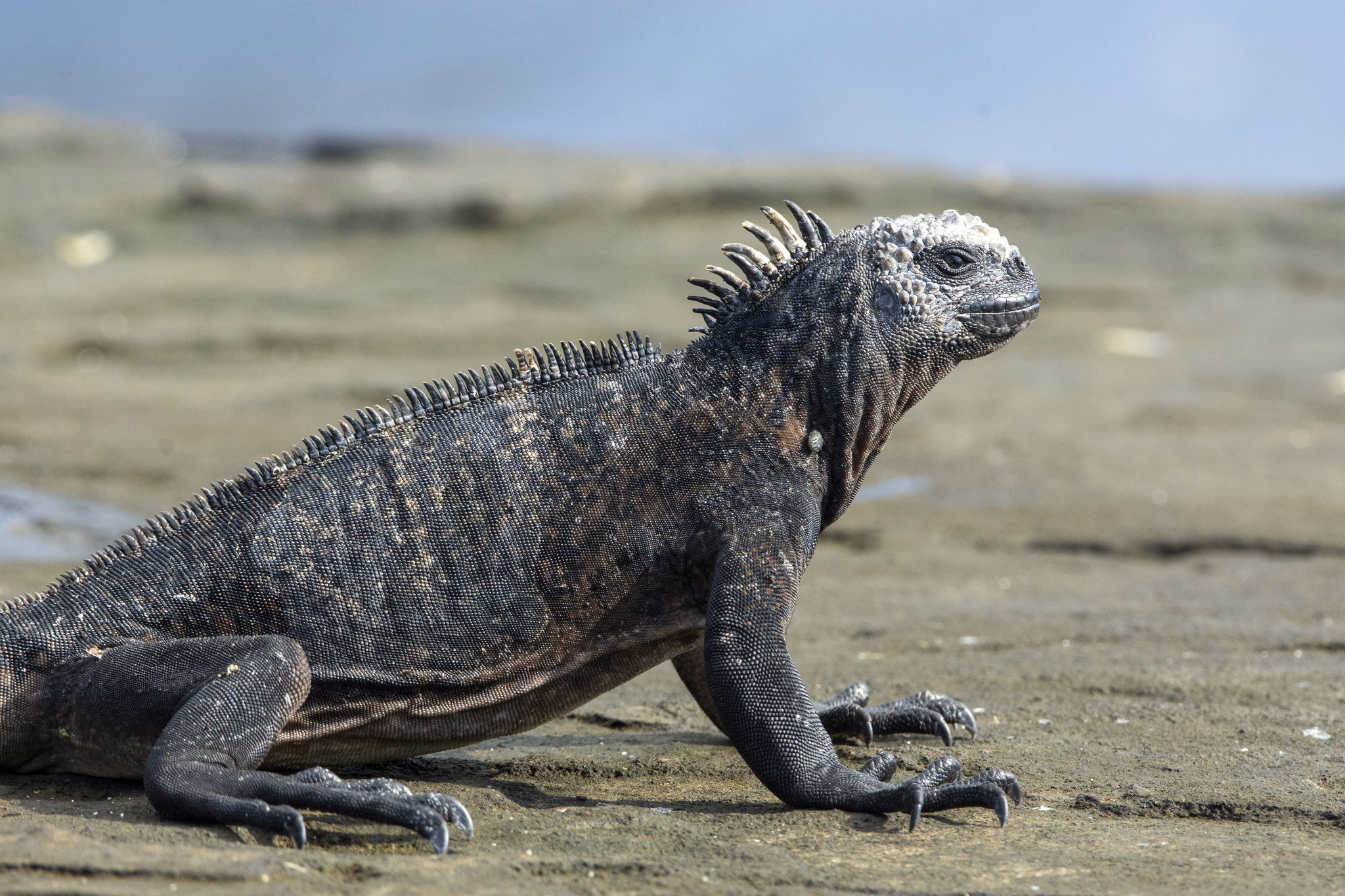
In a recent letter, scientists call on Ecuador to stop the trafficking of marine iguanas, endemic to the Galápagos Islands, amid a surge in seizures.The archipelago is home to four species of endemic iguanas, and all are in demand as exotic pets, despite it being illegal to take them from the wild under Ecuadorian laws or sell them internationally under CITES, the global wildlife trade treaty.The authors say that international wildlife traffickers recruit domestic artisanal fishers whose livelihoods are impacted by drug cartels, dwindling fish, and poverty.Conservationists say Ecuador must audit its systems designed to stop wildlife trafficking in the Galápagos and countries must close CITES loopholes that let traffickers legally trade offspring of smuggled wildlife. Ecuadorian authorities said they caught a Russian woman at the airport in Quito, the capital city, trying to smuggle 32 live marine iguanas, endemic to the Galápagos Islands. The iguanas — bound and stuffed in eight plastic boxes — were headed to Iceland. The dehydrated lizards were transferred to a conservation center in Pichincha for specialized care after being found in August, authorities said. About a month later, 24 of the surviving iguanas were released back on Galápagos — where they are believed to be stolen from. In May, authorities arrested three Thai nationals with 12 young marine iguanas destined for Asian markets. A week earlier, four separate cases of these lizards mysteriously appearing on sidewalks in Guayaquil on the mainland were reported. The marine iguana (Amblyrhynchus cristatus), a threatened species, is the only lizard in the world that swims in the ocean and eats sea algae. About 11 subspecies of these colorful lizards are known to science. Under Ecuadorian laws, it’s illegal to remove any wildlife from the Galápagos. In 2025, the lizards were added to Appendix I of the CITES global wildlife trade treaty, which means they cannot be commercially traded internationally. Yet, they continue being smuggled as collectors in Europe and Asia want them as exotic pets. So far this year, authorities have confiscated nearly 50 marine iguanas. The global commerce is so lucrative that international wildlife traffickers are involved in smuggling them, experts say. Marine iguanas confiscated by authorities from a Russian woman in August 2026. Image courtesy of the Ecuadorian Ministry of Environment and Energy via Facebook. “This is basically organized crime,” Juan José Alava, a marine conservationist at Simon Fraser University, Canada, told Mongabay. Wildlife trafficking is adding to other stressors, such as climate change, habitat degradation, plastic litter, and chemical pollution that already threaten biodiversity on the Galápagos, including the iguanas. “So, we need to do something about it,” Alava, who does research in the archipelago, said. In a recent letter published in Science, Alava and his colleagues call on Ecuador to combat marine iguana trafficking by addressing gaps in its policies, including auditing airport detection systems and dismantling wildlife smuggling networks. They also urge countries signatory to CITES to close legal loopholes that let traffickers smuggle endemic iguanas and legally sell their offspring worldwide. Seizures typically represent a tiny fraction of the actual trade, and an increase in confiscations could be due to better enforcement or a spike in illegal commerce. Audit current processes, authors say The Galápagos has one of the strictest regulations for visitors: Their bags are inspected before entry and after leaving the islands by the Galápagos Biosecurity and Quarantine Agency, for any prohibited substances, including wildlife. Visitors must be accompanied by park-certified naturalist guides and must stay at least two meters (6.6 feet) away from wildlife. But recent seizures from foreign nationals have meant these regulations aren’t effective, the authors say. “What surprised me is that some people that have been caught — international tourists — say, ‘Oh, for me, it was easy to buy these species in the market because someone was selling.’ That really shocked me,” Alava said. “How do [the traffickers] get around that?” He said corruption, especially at airports, could be enabling a network of people to continue trafficking. A Wolf marine iguana (Amblyrhynchus cristatus ssp. jeffreysi), one of the 11 subspecies of Galápagos marine iguanas endemic to Wolf Island. Image © Ryan Jones via iNaturalist (CC BY-NC). The authors call on Ecuador to dismantle trafficking networks by increasing oversight at airports and auditing current approaches to detecting wildlife smuggling, including checking people currently overseeing the airports and those working for the Galápagos National Park. The country must “explore why trafficking continues to happen despite strict laws governing the archipelago,” Alava said. “There has to be a kind of environmental audit system to detect these loopholes in the airport.” The authors say traffickers may recruit artisanal fishers in the Galápagos and coastal Ecuador, who have lost their livelihoods as they became stuck between drug cartels and recent U.S. boat strikes. “These smugglers often do not collect the animals themselves on-site, but they are closely working with locals to find the animals,” said Sandra Altherr, co-founder of German NGO Pro Wildlife, who has studied the illegal trade in Galápagos iguanas. “It’s not just in the Galápagos. It’s a practice wherever people are poor and need extra money.” Altherr did not co-author the letter. Alava said the government must provide alternative livelihoods for these fishing communities, because they might find wildlife trafficking attractive since it often pays more than fisheries. The Super El Niño predicted for 2027 would further affect their catch, he said. “So, you put all of this together, we are talking about multi-stressors conspiring against the survival of species, and that also affects the economy of the coastal communities.” Close CITES loopholes that enable illegal trade, experts say Studies analyzing legal international trade have raised suspicions about the legality of land and marine iguanas from Galápagos lawfully traded worldwide. Ecuador has not declared any live exports of its endemic iguanas. But Switzerland, Uganda, Mali and Japan have issued CITES export permits for several individuals, declared as ‘captive-bred,’ without verifying their origins. These are exported to markets in Asia and Europe. Trade data from Import Genius, obtained by Mongabay, show that four marine iguanas were sent from Uganda to Vantara, the billionaire-run megazoo in India, in December 2025, days after the species was added to CITES Appendix I, offering it the highest protections from trade. Examples of Galápagos iguanas posted for sale on social media platforms. All species of endemic iguanas from the Galápagos are in demand from collectors of exotic pets. Images courtesy of Auliya et al (2025). Alava said no authorized captive breeding facilities exist for these iguanas, and breeding them is challenging. “They need a specific kind of sand that is in the Galápagos. They need the macroalgae that they feed on. You cannot really simulate that.” However, despite questions about their origins, the iguanas can be traded once legal permits are obtained. Conservationists are hoping that will soon change. At an upcoming CITES meeting in November, countries will discuss new guidelines for determining whether trading individuals from illegally taken parents or founder stock is still legal. “We hope that this analysis will not stop with the parents, but with the legality of the founder stock,” Altherr said. “If that is agreed by the CITES parties, they are obliged to fight against illegally sourced founder stocks and all the offspring.” That would mean all Galápagos iguanas in terrariums worldwide would have to be confiscated and repatriated to Ecuador, she said. Closing these systemic loopholes would ensure that the unique biodiversity on the Galápagos — which informed our understanding of evolution and continues to do so — would be preserved for the future, Alava said. “I think future generations also deserve the same opportunity, the equal chance as we have today to really enjoy the beauty of the ocean, appreciate the ecological function of these unique species that are in the Galápagos.” Spoorthy Raman is a staff writer at Mongabay, covering all things wild with a special focus on lesser-known wildlife, the wildlife trade, and environmental crime. Banner image: Galápagos marine iguanas are the only lizards on the planet that swim in the ocean and eat sea algae. Image © Oliver W Patrick via iNaturalist (CC BY-NC). Citations: Alava, J. J., Molineros, E., Vega, F., Jacquet, J., & Petrossian, G. A. (2026). Combat Galápagos marine iguana trafficking. Science, 393(6815), 981–982. doi: 10.1126/science.aek3898 Salinas-De-León, P., Andrade, S., Arnés-Urgellés, C., Bermudez, J. R., Bucaram, S., Buglass, S., . . . Worm, B. (2020). Evolution of the Galápagos in the Anthropocene. Nature Climate Change, 10(5), 380–382. doi:10.1038/s41558-020-0761-9 FEEDBACK: Use this form to send a message to the author of this post. If you want to post a public comment, you can do that at the bottom of the page. Credits Topics
Scientists call on Ecuador to stop the rising trafficking of Galápagos iguanas
Full Article
Original Source
Read the full article at News →KhanList aggregates and links to publicly available news content. We do not host full articles from third-party sources. Always verify important information with original sources.