
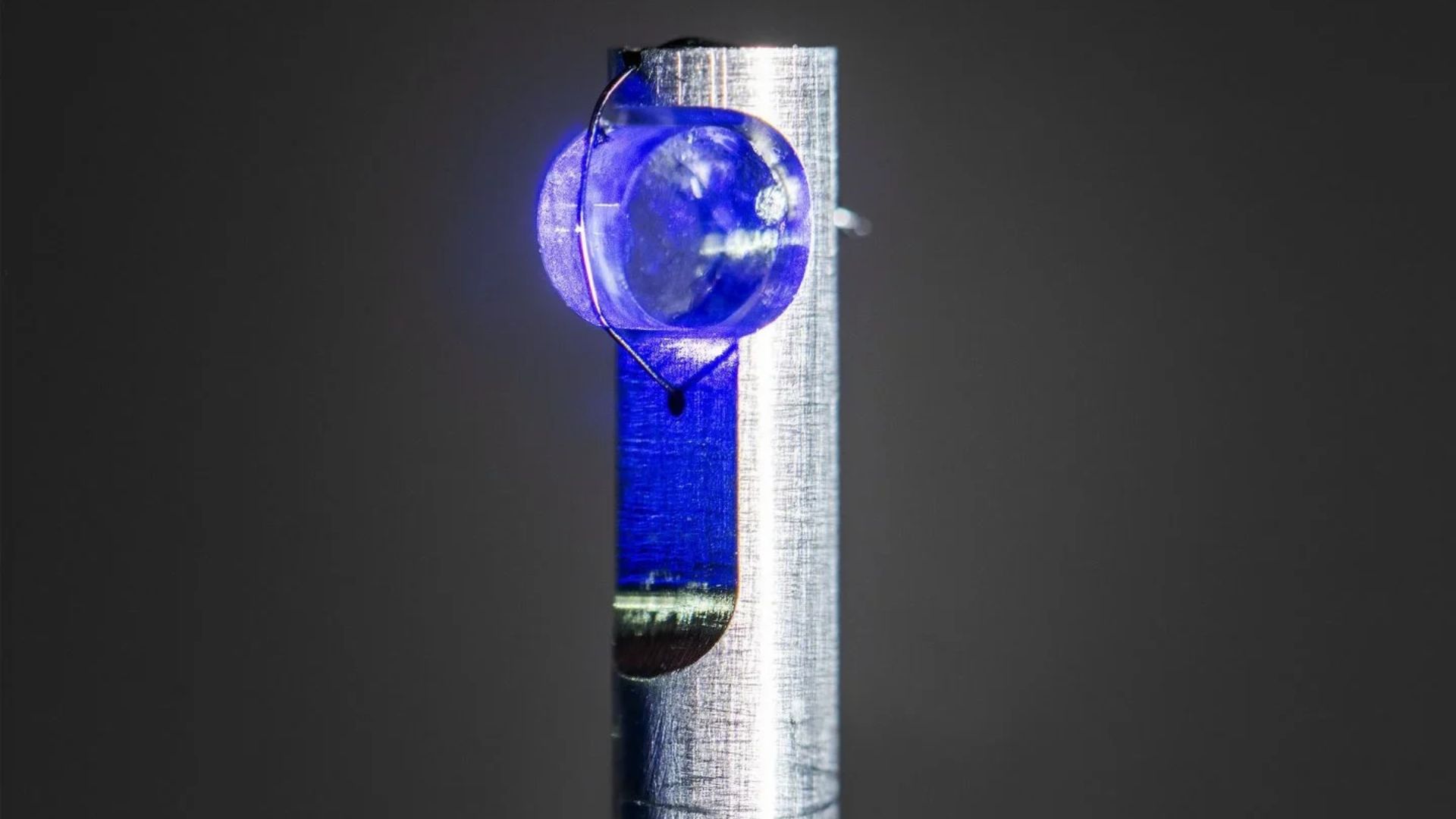
Scientists at the Vienna Institute of Technology have found the perfect site inside a crystal where a thorium-229 atom can sit and help build a nuclear clock that it up to 10 times more precise than existing clocks, making it the most accurate nuclear clock ever. This might sound like an accidental find, but the researchers spent for 15 years just building the crystal alone. Atomic clocks that track time by measuring the way electrons jump between energy states when exposed to a laser light are the backbone of the modern world we live in today. From the satellite navigation systems that we use to find our destinations on an app to tracking financial transactions happening across the globe, atomic clocks are used everywhere, even though, we might not interface with them every time. Yet for all their accuracy, atomic clocks are also extremely delicate. To protect them from interference from magnetic or electric fields, scientists have to dedicate large vacuum chambers and shields that can take up big lab spaces. To avoid this, scientists are now building nuclear clocks that go a level deeper into the atom and use the energy flips of a neutron inside the nucleus to track time. Nuclear clock using thorium The nucleus of the atom is surrounded by its electron cloud, which serves as a natural shield for stray electric and magnetic fields, reducing dependence on external systems. Scientists operate them using materials or crystals and at room temperature, further aiding the miniaturization of the clock itself. Additionally, using higher-frequency ultraviolet light, scientists are able to create larger energy jumps and measure them more frequently, allowing time tracking in much finer increments, thereby increasing precision. The problem with making these clocks, though, is that flipping a neutron requires a gamma-ray laser, which hasn’t been made yet. Instead, they use ultraviolet lasers to flip neutrons in an isotope of thorium, with an atomic mass of 229. To make a nuclear clock, researchers need to build a crystal that can house thorium-229 atoms and remove the need for vacuum chambers for the clock to function. This makes it feasible to use these clocks in smaller devices too. The perfect site in the crystal A crystal may only look like a piece of glass, but building the right one with a perfect site is rather difficult. The team at Vienna Institute of Technology, led by physicist Thorsten Schumm, spent over 15 years perfecting the recipe for a crystal that could be used for a nuclear clock. Schumm compares the process of crystal making to cooking or even alchemy, where you need to keep trying and changing a few things to get the intended result. Through the years of experimentation, the team learned that if the calcium fluoride crystals they were making ended up with thorium-229 in a bad internal position, then the crystal developed an uneven electric field that disturbed the clock’s timing. To know which were the best positions to place the thorium-229 inside crystals, the researchers used the ultraviolet laser for 60 seconds, then switched it off and waited for five minutes as the nuclei emitted the light to return to their lower energy levels. The researchers repeated the experiment with different frequencies and found that the thorium atoms can sit at four sites inside the crystal lattice. Three of them though returned the laser light at different wavelengths, which suggests that there was an uneven electric field around them, The fourth site returned the laser light with just one wavelength, making it the perfect site for a nuclear clock. The researchers used this to build the first prototype of their nuclear clock, which could eventually fit into a small chip. By the end of the year, the team expects their nuclear clock to improve precision by at least three orders of magnitude, but the main focus is miniaturizing the clock so it can be deployed in real-world scenarios as early as possible. The research findings were published in the journal Science. Get the latest in engineering, tech, space & science - delivered daily to your inbox.Ameya is a science writer based in Hyderabad, India. A Molecular Biologist at heart, he traded the micropipette to write about science during the pandemic and does not want to go back. He likes to write about genetics, microbes, technology, and public policy.
Scientists build crystal for nuclear clock that will be up to 10 times more precise
Full Article
Original Source
Read the full article at Interestingengineering →KhanList aggregates and links to publicly available news content. We do not host full articles from third-party sources. Always verify important information with original sources.