
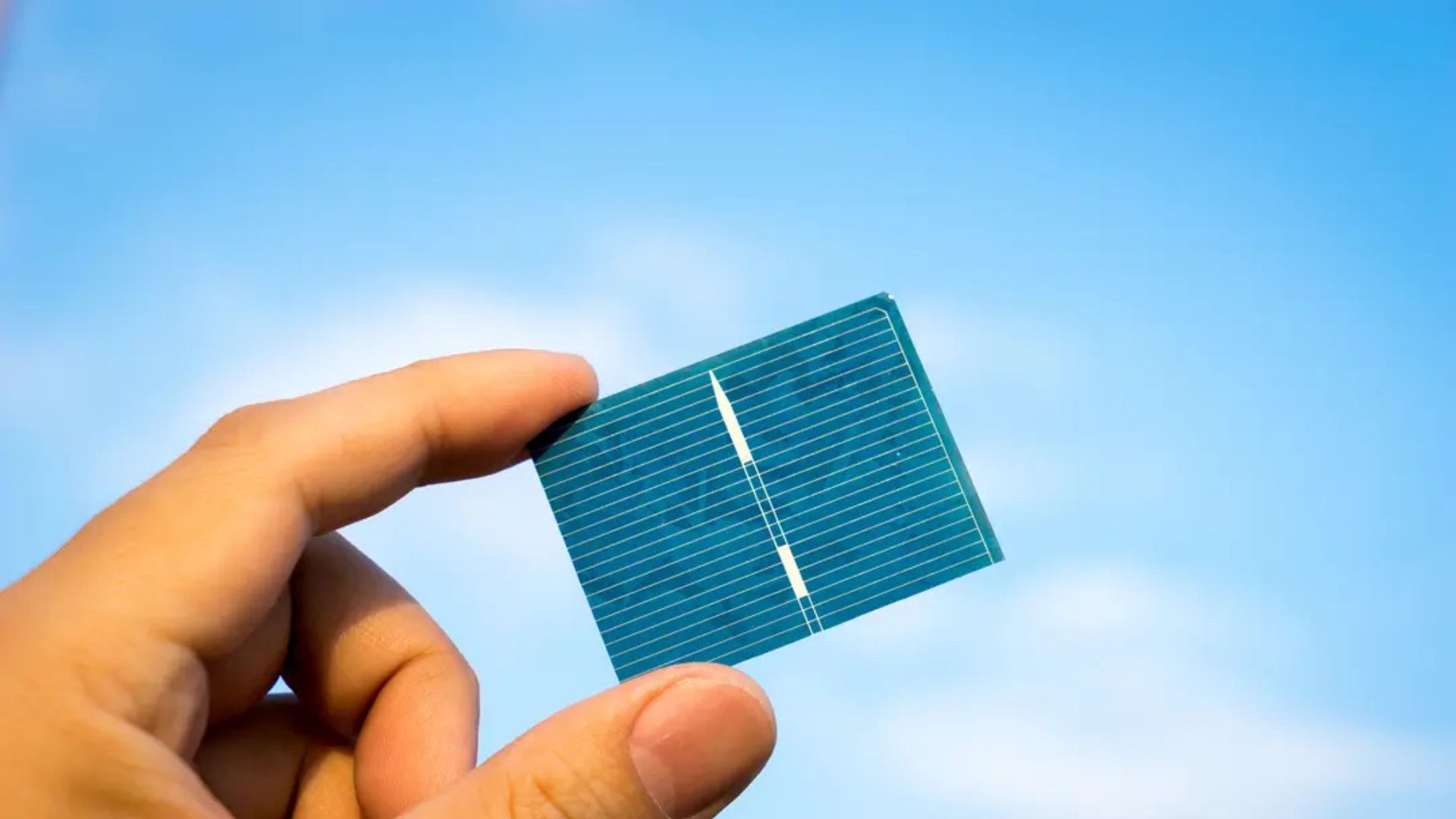
Helmholtz-Zentrum Berlin (HZB) in Germany has revealed a simple way to boost the performance and commercial viability of high-efficiency “tandem” solar cells, which layer light-sensitive perovskite on top of silicon. Particularly, researchers improved monolithic perovskite-silicon tandem solar cells by adding an ultra-thin seed layer of cesium chloride between the sub-cells. The technique helped achieve a 30.3 percent efficiency rating using solvent-free co-evaporation. Scanning electron microscopy reveals that perovskite layers grown on nanostructured silicon without a seed layer (left) are fine-grained and defect-rich. Credit: HZB Microscopic fix for solar tech Standard silicon layers feature a nanostructured surface to optimize light absorption. But this rough terrain makes it difficult for organic self-assembling monolayers (SAM) to form uniformly. SAM is mostly used as hole transport layers. Scientists at HZB used advanced infrared and X-ray tools at the BESSY II synchrotron facility to zoom in on the interface. What they saw explained years of manufacturing frustration. The organic SAM molecules were pooling inside the valleys of the textured silicon, leaving peak areas virtually bare. When researchers tried to vapor-deposit the top perovskite layer, the uneven surface triggered a chemical failure: unwanted lead iodide formed at the gaps, crippling the cell’s energy output. The introduction of the cesium chloride seed layer changes the microscopic terrain. It acts as a chemical foundation, evening out the underlying imperfections of the SAM layer and encouraging the perovskite crystal to grow smoothly across the textured silicon. According to lead author Dr. Viktor Škorjanc, this seed layer compensates for surface unevenness, promoting uniform co-evaporated perovskite growth on textured silicon. It also prevents defect formation caused by patchy hole-transport coverage. As a result of this enhanced layer quality, a fabricated tandem solar cells reached a 30.3 percent efficiency. As per the press release, it is “an outstanding value for evaporation-based perovskites.” Solvent-free co-evaporation This method uses vacuum co-evaporation, which is a solvent-free process already widely utilized across commercial manufacturing industries. Removing chemical solvents from the process targets a major barrier to commercializing perovskite solar cells: long-term material degradation and instability. Solvent-free manufacturing protects the underlying layers from degradation, producing far more durable tandem cells. It could support commercial manufacturing by providing a viable foundation for mass-producing high-efficiency solar panels. Most record-breaking perovskite cells in labs rely on spin-coating or wet-chemical solution processing, which doesn’t scale well to large, textured industrial silicon wafers. Vacuum co-evaporation is already the standard process used to make OLED screens and microelectronics, making factory adoption far easier. “This represents a real step forward in translating record efficiencies from the laboratory into reliable, industrially manufacturable tandem solar technologies,” said Dr Marcel Roß, team leader of evaporated perovskite solar cells at HZB. The HZB team may have finally given industrial solar manufacturing the key to affordable, next-generation solar panels. Perovskite-silicon tandem solar cells produce much more power per square foot than silicon, making them ideal for space-constrained urban rooftops and energy-intensive industrial facilities looking to maximize clean energy generation. Moreover, perovskites are lightweight and can be engineered to be semi-transparent, enabling Building-Integrated Photovoltaics (BIPV). This allows energy-harvesting technology to be integrated directly into architectural elements, such as skyscraper facades, glass windows, and skylights. The findings were published in the journal Joule. Get the latest in engineering, tech, space & science - delivered daily to your inbox.Mrigakshi is a science journalist who enjoys writing about space exploration, biology, and technological innovations. Her work has been featured in well-known publications including Nature India, Supercluster, The Weather Channel and Astronomy magazine. If you have pitches in mind, please do not hesitate to email her.
Scientists achieve 30.3% efficiency in perovskite-silicon tandem solar cells
Full Article
Original Source
Read the full article at Interestingengineering →KhanList aggregates and links to publicly available news content. We do not host full articles from third-party sources. Always verify important information with original sources.