
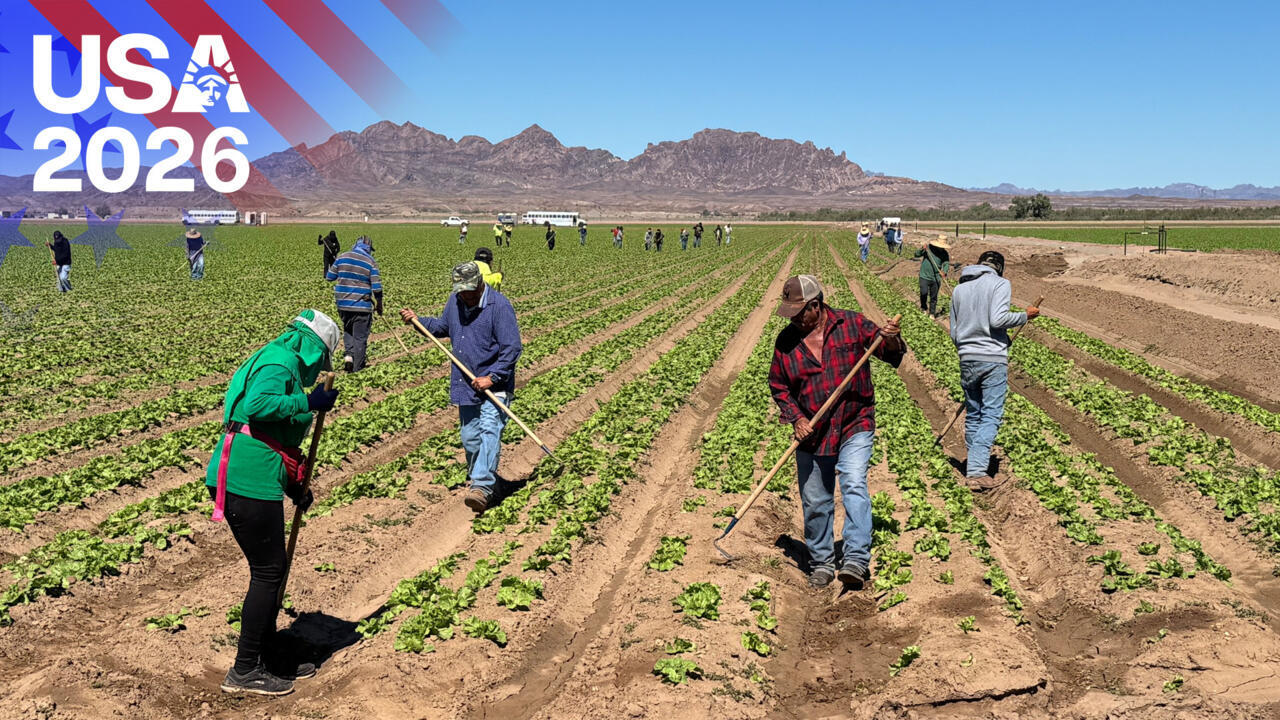
A melon in one hand and a machete in the other, John Boelts squints at the fruit, carves off a hunk and pops it in his mouth. Out in his sprawling fields in Yuma, Arizona, he knows how to spot a ripe cantaloupe. Even in early October, the temperature still reaches 43°C (109°F) in the region after having soared to a scorching 47°C at the start of September – well above the seasonal average. The harvest begins next week. “The melons are starting to pull sugar, they are getting ready,” he said, dressed in jeans and a pristine checkered shirt. “Once they're ready to harvest, you typically have about two days to get the melons harvested and off the vine.” Last spring, this race against the clock took a heavy toll. Even as the produce stood ripe in the fields, the Mexican labourers he had hired to bring in the crop still hadn’t received their working visas. They finally arrived, six days late. Farmer John Boelts inspects a melon in his fields in Wellton, Arizona, October 15, 2026. © Barbara Gabel, FRANCE 24 They lost most of two or three fields, he said, adding that it could have cost him as much as $100,000. “Those fields were the fields we probably could have made the most money off of during the spring season this year – we were super frustrated.” Boelts, 49, is one of the main figures of this agricultural sector that depends so deeply on foreign labour. He sits at the head of Desert Premium Farms, an agricultural operation he set up with his wife Alicia and another couple. He also presides over the Arizona Farm Bureau. North America's 'winter salad bowl' To get to the Boelts’ farm, you first have to go through Wellton, a small town in the middle of the Sonora Desert. The roads cut straight between the fields, bordered by clay-coloured mountains. Here, there are no hedges or trees, just vast fields in brown and green, dotted with tractors and workers tending row after row of lettuce, covered head to toe to shield them from the sun. Standing in the arid landscape, it’s hard to imagine that this region grows between 70 to 90 percent of all the leafy greens and vegetables consumed by the US and Canada during the long winter stretch between November and April. Irrigation channels bring water from the Colorado River to nourish sweeping fields of lettuce, broccoli, cauliflower, spinach and melon – the fields of Yuma bring forth these greens on a massive scale, earning southwest Arizona its reputation as North America’s “winter salad bowl”. These farms rely heavily on foreign workers – many of whom live on the other side of the border in San Luis Rio Colorado, in Mexico. In the high season, around 15,000 farm labourers cross the border every day to work in American fields, according to the Arizona Farm Bureau. The hardline immigration policies put into place by US President Donald Trump, including the mass detention and deportation of suspected undocumented migrants by Immigration and Customs Enforcement (ICE) agents, have only complicated the flow of workers. Read moreWhy Trump wants H-1B skilled worker visas to cost employers more than $100,000 ‘People are scared’ One man spoke to FRANCE 24 near an irrigation canal while helping his coworkers shift heavy pipes, explaining in Spanish that some labourers have become more reluctant to cross the border since Trump returned to power. “They’re not comfortable with the laws, they think they won’t come anymore because of the problems linked to immigration,” said Alan, who has worked these fields for five years. “It’s not as easy as it was before – things have really become more complicated under Trump. People are scared of crossing the border, because they can get sent off to other places.” In another field, Ana said that she now has to anticipate long lines at the border crossing. She said she regularly gets there at 1am to avoid missing the bus that brings workers from the border to the fields. “Sometimes we wait one or two hours in line,” she said. Alan and his coworkers set up an irrigation system on a farm in Wellton, Arizona, October 15, 2026. © Barbara Gabel, FRANCE 24 Ana said that she had, however, noticed a recent reduction in the wait time, which she attributes to the renovation and expansion of the border crossing. “It’s really modern, and a little bit faster,” she said. Once in the fields, Ana works beneath the pounding sun, skin hidden behind long sleeves, gloves, and a black cap and mask. Around her, colleagues work to the sound of music. It’s tiring work, she said, but she appreciates the solidarity she feels with her fellow workers. “We know each other really well,” she said. “We support each other, and we make a good team. And in any case it’s very pleasant to work in the fields, in the open air." The work continues until midday. Ana, a farm worker hired to work the fields in Wellton, Arizona. © Barbara Gabel, FRANCE 24 No one comes around looking for work To work his fields, Boelts directly employs between 30 to 50 workers and puts out calls for teams of between 30 to 100 temporary workers every day. Almost all of them are Mexican. “We're short of workers in American agriculture,” he said. “Each year, for the last 20 years, we've been more in need of people. No one hardly ever comes around looking for work – it's pretty rare to have somebody come asking if they can work for us.” Workers on his farm are paid above the minimum wage, and sometimes more than $20 an hour depending on the technical skills required for different tasks, he said. Read moreThird-country removals: Trump’s deportation policy by the numbers “We'd be glad to hire folks that are here in the country, a legal workforce here in the country,” he said. “But we don't have it.” Of the more than 415,000 job listings in agriculture posted over the 2025 fiscal year, just 182 received domestic applications. For Boelts, the conclusions are simple enough to draw – there just aren’t enough willing US workers to meet the industry’s needs. Farming is about more than just picking fruit, he said. Bringing in a harvest requires specific skills, and not every worker is suited to each position. “The federal government wrongly thinks that people who work in agriculture are unskilled workers,” he said. “It’s absolutely not the case.” Bringing in ‘guest workers’ To hire foreign workers legally, farmers can apply through the H-2A visa programme set up in 1986. It only allows employers to hire foreign workers temporarily if they are unable to find US citizens to fill the posts. Employers are first required to establish that they have tried to recruit locally, as well as to respect basic obligations around salaries, accommodation and transport. While Boelts considers the programme essential to his business, he complained that navigating the system often felt like running an obstacle course. “If the programme was easier to work with, streamlined and simpler to use – if you didn't have to hire a professional HR team and lawyers to be able to work with the federal government, to have to work with four or five federal agencies, wait nine months, plan nine months in advance for the workers you need ... the whole idea is crazy, really,” he said. John Boelts is the director of Desert Premium Farms. © Barbara Gabel, FRANCE 24 The sight of melons wasting in their fields shows how costly this system can be. Boelts is calling for the scheme to be reformed, as called for by Republican Congressman Glenn “GT” Thompson, who has been arguing for the programme’s modernisation in Congress. Boelts credits the Trump administration for trying to streamline the programme, while at the same time slamming the political obstacles that he said are holding up the reforms. “It's getting derailed by folks that are telling all kinds of lies, that talk about the H-2A programme like it's an immigration programme,” he said. “It's not. It's a guest worker programme.” For Boelts, the distinction is fundamental: bringing in foreign workers on a temporary basis to meet specific needs has nothing to do with opening up the US southern border. ‘Tired of being a political football’ He is not shy about his support for the current administration. “I think President Trump and [Agriculture Secretary Brooke] Rollins are doing an amazing job,” he said, though he suggested that the president could sometimes let himself be steered in the wrong direction. He called on Trump to publicly defend the H-2A visa programme reforms. “Farmers are tired of being a political football,” he said. “We're tired of being left with certain administrations making things more difficult.” He added that he hoped the Republicans would be able to work together on agriculture after the upcoming midterm elections. For Boelts, the priority is securing the border while still ensuring there are legal pathways for the foreign workers that the US economy needs. He said that one of his employees was struck in the head by a “drug trafficker” while watering the fields at night in an apparent attempt to steal his vehicle. The attacker fled over the border to Mexico, he said, with his haul in tow. “That's the sort of crap we have to put up with here,” he said. “Our border regions can be safe places of legal commerce, and they don't have to be places where there's contraband and human smuggling going on.” A team of workers install irrigation equipment on a farm in Wellton, Arizona on October 15, 2026. © Barbara Gabel, FRANCE 24 Boelts said he doesn't see workers getting more worried about crossing the border – but not everyone agrees. “We live in a community here where 15,000 people cross the border each morning from November until sometime in March, when the season starts to wind down,” he said. “Those people aren't afraid to come to work ... I have not seen them act in fear. People that have a legal right to work, they go to work. That's it.” In the fields, the day’s work goes on. The labourers will soon be able to take a short lunch break before returning to the fields for a few more hours’ work. Later in the afternoon, once their work is done, they will get back in the buses that will take them across the border to San Luis. Behind the difficulties of recruiting, another anxiety is weighing more and more heavily on the minds of Arizona’s farmers: the growing scarcity of water, a crucial issue in the midterms. So far, priority water rights have spared Yuma’s farms from the restrictions imposed on the Colorado River by the Trump administration since August. But Boelts worries that this protection may soon not be enough. “The only reason the system hasn't run dry is agriculture typically isn't using its full allocation,” he said. “We're worried we're going to be up against it in the next year or two.” This article has been adapted from the original in French.
‘Scared of crossing the border’: The Arizona farmers who rely on Mexican workers
Full Article
Original Source
Read the full article at France24 →KhanList aggregates and links to publicly available news content. We do not host full articles from third-party sources. Always verify important information with original sources.