
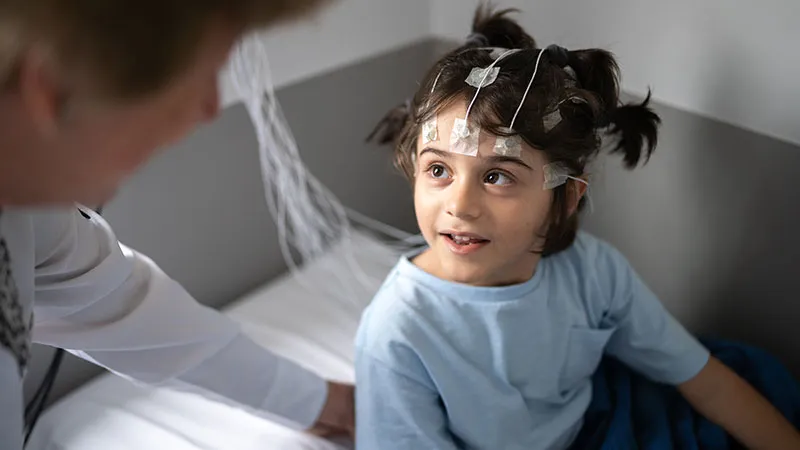
TOPLINEScalp high-frequency oscillation (HFO) rates measured on a single routine EEG were higher in neonates with hypoxic-ischaemic encephalopathy (HIE) and seizures than in those without seizures. In multivariable models, the HFO rate was the strongest contributor to seizure classification.METHODOLOGYResearchers conducted a retrospective study to assess whether HFO rates measured on routine scalp EEG could distinguish term neonates with HIE and seizures from those with HIE without seizures.They analysed data from 33 term neonates with HIE (mean gestational age at birth, 39.24 weeks; 63.63% boys) who underwent routine scalp EEG between 2021 and 2024. Of these, 17 (mean gestational age at birth, 39.35 weeks; 70.58% boys) had seizures and 16 (mean gestational age at birth, 39.12 weeks; 56.25% boys) did not.Sleep-compatible, low-movement EEG recordings were analysed for each neonate, with a mean duration of 38 minutes in neonates with seizures and 36 minutes in those without seizures; recordings were obtained at a mean postnatal age of 4 days. A validated automated detector quantified HFO rates (HFOs/min/channel; 80-250 Hz) within sleep segments across 24 bipolar channels.HFO rates were compared across seizure status, exposure to therapeutic hypothermia, antiseizure medication (ASM) response, HIE grade, EEG background activity, and MRI findings.The researchers combined HFO rates with EEG background activity and MRI findings to build multivariable classification models, then tested how accurately these models can distinguish neonates with and without seizures.TAKEAWAYNeonates with seizures had a higher mean scalp HFO rate than those without (0.12 vs 0.03 HFOs/min/channel; adjusted P = .02). A cutoff of 0.07 HFOs/min/channel showed better discrimination power between the two groups (mean area under the curve [AUC], 0.81).HFO rates did not vary significantly by HIE grade, EEG background activity, or MRI findings across the entire cohort, nor by therapeutic hypothermia or ASM response among neonates with seizures.Combining HFO rates with EEG background activity and MRI findings accurately distinguished neonates with seizures from those without (AUC range, 0.92-1.00), with the HFO rate emerging as the strongest contributor to seizure classification.In the multivariable model, higher HFO rates (odds ratio [OR], 1.40 per 0.1 HFOs/min/channel increase; P =.002) and more abnormal results on MRI (OR, 8.78; P =.006) were associated with increased odds of having seizures, whereas EEG background activity was not.IN PRACTICE"Scalp HFO rate could therefore serve as a complementary EEG biomarker in seizure classification models incorporating EEG background activity and neuroimaging, with potential applicability beyond HIE to broader neonatal populations at risk for seizures," the authors wrote."[The study] findings support further evaluation of scalp HFOs as an adjunct to neonatal neuromonitoring, because improved identification of neonates with seizures may guide EEG monitoring and treatment decisions," they added.SOURCEThis study was led by Panagiota Karatza, University Children's Hospital Zurich, Zürich, Switzerland. It was published online on November 14, 2026, in Epilepsia.LIMITATIONSBecause most EEGs were recorded after seizures had started, it was unclear whether HFO rates predicted seizures or were a consequence of them. The timing of EEG recording varied in relation to birth, therapeutic hypothermia, or seizure onset. HFO rates may have differed depending on how soon after the hypoxic-ischaemic injury the EEG was recorded.DISCLOSURESThis study was funded by Schweizerischer Nationalfonds zur Förderung der Wissenschaftlichen Forschung, Vontobel Stiftung, and Anna Mueller Grocholski-Stiftung. The authors declared having no conflicts of interest.This article was created using several editorial tools, including AI, as part of the process. Human editors reviewed this content before publication.
Scalp EEG May Help Identify Seizures in Neonatal HIE
Full Article
Original Source
Read the full article at Medscape →KhanList aggregates and links to publicly available news content. We do not host full articles from third-party sources. Always verify important information with original sources.