
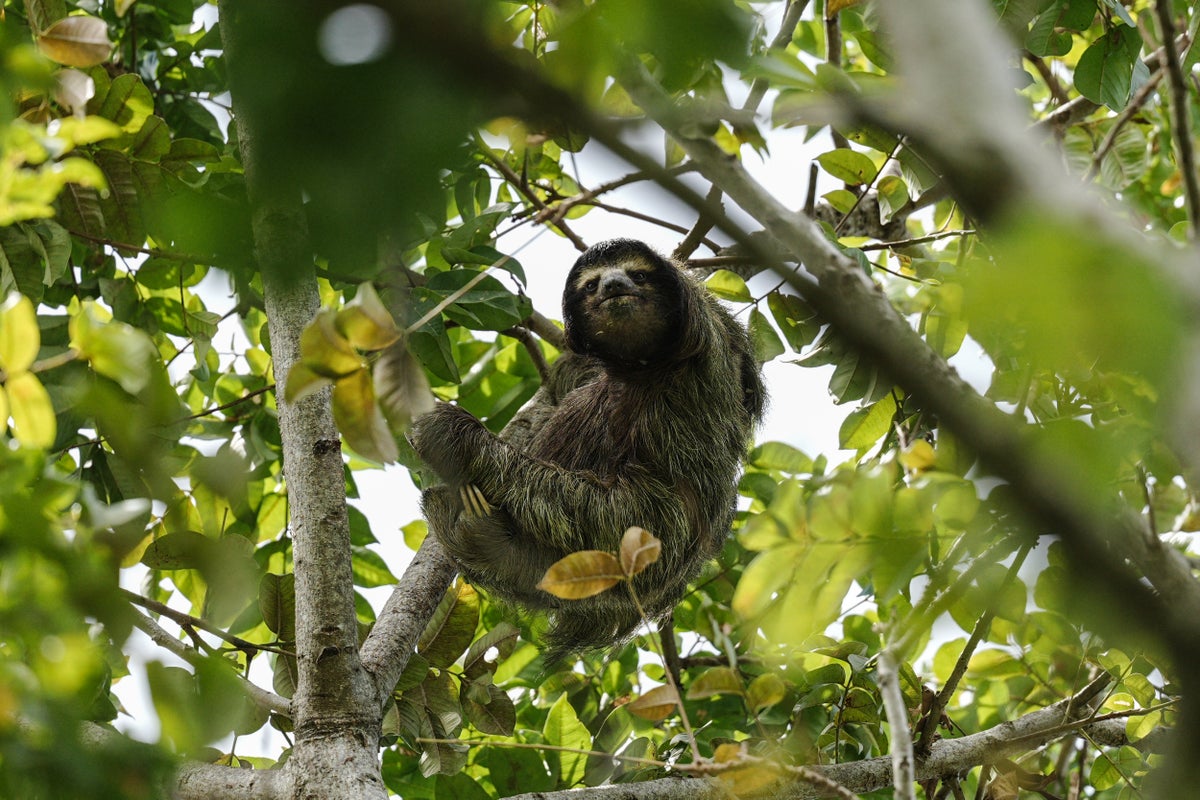
A break in the forest canopy of only 2 or 3 meters (about 7 to 10 feet) can force a sloth to come down from the trees and find another way across.The slow-moving mammals cannot jump between trees in the way monkeys do. Once on the ground, they risk being attacked by dogs, struck by vehicles or electrocuted on power lines.To give them safe passage through the treetops, the Sloth Conservation Foundation has installed approximately 410 rope bridges, often across areas divided by roads and buildings.Behind a beachfront hotel on Costa Rica's Caribbean coast, conservationists are installing rope bridges between trees, creating pathways for sloths in a landscape increasingly shared with tourists, hotels and other development.Deily Mora, from left, Mariano Salceda and Dayber Barker, members of The Sloth Conservation Foundation, attach a rope to a tree for sloths to cross Tuesday, Nov. 3, 2026, in Puerto Viejo, Costa Rica (AP Photo/Ivan Valencia)“The wildlife bridges that we install are just made from single ropes, which don’t look very elaborate, but for arboreal species, they work,” said Rebecca Cliffe, a British zoologist who founded the organization and has spent nearly two decades studying sloths. “It is a lifeline to cross a gap that they otherwise couldn’t cross.”Costa Rica has been celebrated for reversing decades of deforestation. Forest cover has risen from an estimated 21% of its territory in 1987 to 59%, according to a 2023 report by the Organization for Economic Cooperation and Development.But the recovery has not eliminated habitat fragmentation, as development and tourism infrastructure continue to put pressure on coastal ecosystems.Helping sloths avoid roads and power linesSloths spend much of their lives suspended from branches, relying on familiar routes between trees to find food and shelter. It is a phenomenon Cliffe calls “microfragmentation.”“They’re creatures of habit,” she said, explaining that sloths tend to follow routes learned early in life, even as their surroundings change.Cliffe began experimenting with wildlife bridges after working at the Sloth Sanctuary nearly two decades ago. There, she repeatedly saw animals arriving with injuries from dog attacks, vehicles and electrical cables.“I thought, well, the sloths just need a safer way to get somewhere,” she said.A worker installs some electricity cables Wednesday, Nov. 4, 2026, in Puerto Viejo, Costa Rica (AP Photo/Ivan Valencia)With little funding, she began installing single ropes between trees. Cameras monitoring some of the bridges have since recorded more than 22,000 wildlife crossings, including animals other than sloths, Cliffe said.Her team now travels to sites where sloths have been spotted, including hotels and other properties along the Caribbean coast.At one beachfront hotel in Puerto Viejo, workers installed bridges among trees near an area frequented by tourists. The project also involves planting trees and working with property owners to restore natural connections between neighboring plots.The bridges are not permanent. Cliffe said ropes deteriorate after about four or five years in tropical conditions, requiring replacement.Forest recovery doesn't guarantee connectivityCarlos Morera Beita, a geographer at the National University of Costa Rica, said much of the country's regained forest has grown on former pastureland within landscapes fragmented by decades of agricultural expansion.Morera said sloths have demonstrated greater adaptability than previously believed, using tree-lined pastures, living fences and riverside vegetation to move between forest patches. Connections remain essential. Without them, even recovering forests can leave sloth populations isolated, limiting their access to food, mates and shelter.Rope bridges can help animals cross specific obstacles, Morera said.But long-term conservation requires protecting existing forests, restoring biological corridors and ensuring new development does not further fragment habitats.A sanctuary for sloths unable to return to the wildAt the Sloth Sanctuary of Costa Rica on the outskirts of the small town of Penshurst, tourists observe sloths that cannot return to the wild because of severe injuries, disabilities or the loss of their mothers before they learned the skills needed to survive independently.Inside, founder Judy Avey-Arroyo's bedroom is filled with sloth memorabilia, from stuffed animals and paintings to lamps and ornaments. She and her daughter even have sloth tattoos.Just beyond a connecting door is a nursery where rescued and orphaned baby sloths are cared for in separate enclosures. Many arrive after their mothers are killed by cars, electrocuted on power lines or attacked by dogs. The youngest are kept in incubators and fed milk.A sloth hangs from the branch of a tree Tuesday, Nov. 3, 2026, in Puerto Viejo, Costa Rica (AP Photo/Ivan Valencia)Older babies are given leaves, outdoor exercise and opportunities to learn to climb. Avey-Arroyo said replacing a mother is nearly impossible.Young sloths spend about a year learning which leaves are safe to eat, which plants to avoid and how to navigate the forest along familiar routes. Mothers also teach them which leaves to seek out when suffering from parasites, she said.Without that knowledge, even apparently healthy orphaned sloths can struggle to survive in the wild.Avey-Arroyo's work began after she and her husband rescued an orphaned sloth named Buttercup. For her, knowing that some animals will never return to the forest is the hardest part of running the sanctuary.A changing climate brings new threatsClimate change could worsen the effects of fragmentation, as rising temperatures and prolonged droughts alter the conditions sloths depend on.Small forest patches are more exposed to heat, wind and lower humidity than continuous forests, Morera said, reducing habitat quality even where trees remain standing.Sloths rely on their surroundings to regulate body temperature and metabolism, moving between shaded and sunlit areas of the forest.A sloth hangs in a cage at the Sloths Sanctuary of Costa Rica, Tuesday, Nov. 3, 2026, in Penshurst, Costa Rica (AP Photo/Ivan Valencia)Cliffe said prolonged periods of extreme heat can deplete their limited energy reserves, while cold conditions can disrupt digestion.The concern has prompted conservationists to look beyond rope bridges toward broader habitat restoration, including planting trees that provide shade.“It’s not just bridges that are going to save sloths,” Cliffe said. “You’ve got to provide the connectivity, you also have to provide the thermal refuges.”New technology helps track slothsDespite their popularity as symbols of Costa Rica's wildlife, scientists lack reliable estimates of how many sloths live in the country's forests or how their populations are changing.Cliffe's organization is experimenting with thermal imaging drones, trained detection dogs and field surveys to improve estimates.She said two rescue centers in the region receive approximately three sloths a day, although historical data is needed to determine whether rescues are increasing.In coastal communities like Puerto Viejo de Talamanca, conservationists hope the bridges will eventually be replaced by trees growing close enough together for sloths to move freely through the canopy.For Cliffe, protecting sloths ultimately comes down to the collective impact of small actions, whether planting a tree, preserving a branch or installing a simple rope bridge.“It’s the cumulative power of many individual actions,” she said. “That’s what really gives me hope.”
Saving sloths: 410 rope bridges installed as a ‘lifeline’ for beloved species
Full Article
Original Source
Read the full article at Independent →KhanList aggregates and links to publicly available news content. We do not host full articles from third-party sources. Always verify important information with original sources.