
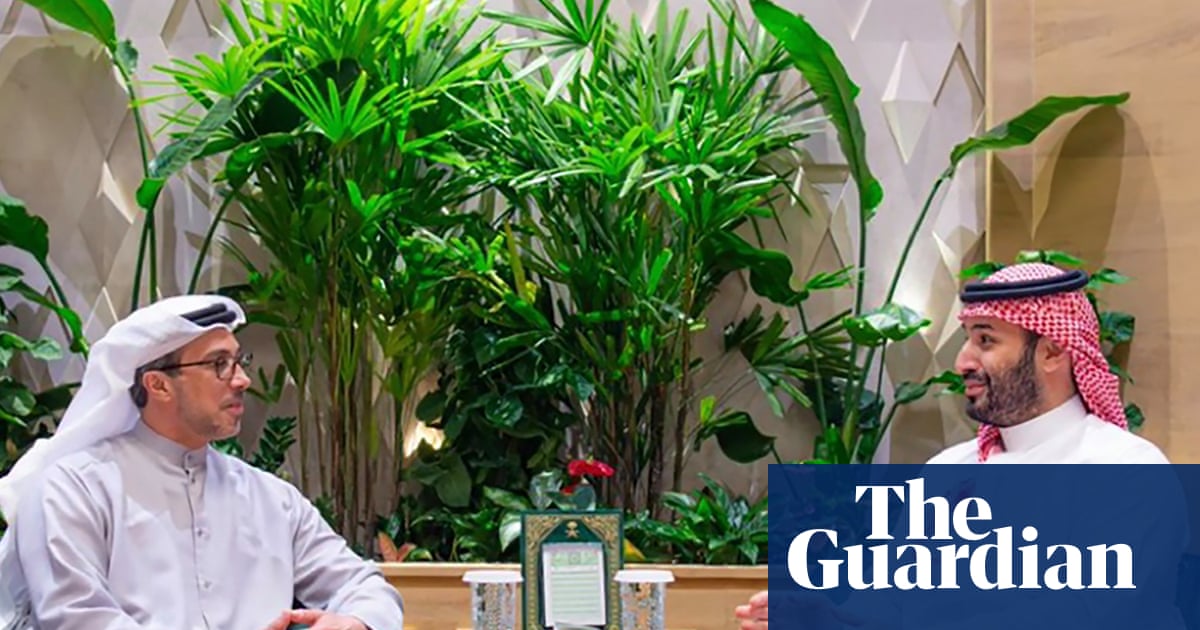
Saudi Arabia is being urged to reconcile with the United Arab Emirates over Yemen as the price Riyadh must pay to form a military alliance capable of driving the Houthis back.Relations between the UAE and Saudi Arabia in Yemen, where both had backed anti-Houthi forces, plummeted in January this year when a force with which it had been aligned – the separatist Southern Transitional Council (STC) – was attacked and defeated by Saudi Arabia in a move intended to squash its attempt to recreate a separate southern state. The UAE subsequently effectively quit Yemen.But the unexpected success in mid September of the Iran-aligned Houthi drive to the narrow Bab al-Mandab strait against pro-government forces has transformed the geopolitics of the region again. The push south defeated the previously UAE-backed National Resistance Forces led by Tareq Saleh, whose front rapidly collapsed.The future role of the UAE in Yemen was discussed at a meeting in Abu Dhabi on Sunday attended by the Israeli prime minister, Benjamin Netanyahu, UAE president Mohammed bin Zayed al Nahyan and a group of other Arab states, including representatives of Saudi Arabia.Why the civil war in Yemen has world governments on edgeNetanyahu reportedly offered to help Saudi Arabia defeat the Houthis, an offer that Riyadh would probably find near impossible to accept, even though Donald Trump has failed to answer the Saudi call for US help in Yemen.A further meeting to discuss Yemen took place on Tuesday in Riyadh between Prince Khalid bin Salman al Saud, the Saudi defence minister, and Mansour bin Zayed Al Nahyan, the UAE vice president.It is part of a range of signs from the two sides suggesting they may want to find a path to reconciliation, even if only on energy.Following the Houthi push to the Bab al-Mandab strait, a chokepoint on Saudi oil exports, its forces are now trying to consolidate their gains and take the south-western city of Taiz.“The Houthi forces are mounting simultaneous waves of attacks on the city trying to exhaust the Taiz Axis force defending the city. The Houthis are pushed back, but then the next day they come again on a different front,” said Baraa Shiban, a Gulf and Yemen specialist at the defence think tank Rusi who has just spent a week in Taiz.“Efforts are being made to try to end the rift between Saudi Arabia and the United Arab Emirates and there may be some confidence-building measures. But the UAE has left Yemen, and it is unlikely that Riyadh would let them back in since they are aligned with the STC, and that would spell trouble … the UAE and Saudi Arabia are fundamentally on opposite sides.”The STC leader, Aidarous al-Zubaidi, fled into exile following the Saudi attack on its forces and the movement became marginalised as a political force.But the former Yemen foreign minister and STC supporter Khaled Alyemany told the Guardian that Saudi Arabia may have to reconsider its political approach to the southern issue since the Giant Brigades, the UAE-trained southern forces once associated with the STC, provide some of the most reliable, well-equipped forces on the ground to stem the Houthi advance.The Giant Brigades, however, have been urged by the STC to resist merging with Yemen government forces, arguing to do so will set back the separatist cause.“We cannot fight and wage wars in the north against the Houthis if we do not have a horizon for our independence,” Alyemany said.“The UN recognised government … operating from exile in Riyadh, insists that southerners fight to retake the capital, Sana’a, on its behalf, but without any promise of the south’s right to self-determination,” he said. “The problem is so long as the Yemen government derives its legitimacy from its Saudi funders rather than its people, the outcome is not Saudi Arabia’s stated goal of security along its southern borders.”The White House has also been privately urging the UAE and the Saudi to bury their differences and allow a unified military command including the Southern Giants Brigades to challenge the Houthi advance. An additional proposal is to use Israeli intelligence and hire Israeli private security firms, something the UAE has done sometimes to brutal effect in the past in Yemen.Saudi Arabia, reluctant to be seen cooperating with Israel, has also always resisted helping the southern separatists since division of the country might entrench Houthi rule in the north along its border. The Houthis have used drones and missiles to attack Saudi energy installations.Despite Saudi air cover and support, the current battle to prevent the Houthis consolidating their gains is such that the parliament of the UN-recognised government has sanctioned a general mobilisation of the Yemeni people to fight the Houthis.The World Health Organization stated that 838 people were killed and 3,643 others were injured due to the recent escalation in Yemen from 6 August last year until 26 September this year.The Houthis insist they are not seeking to block general commercial shipping in the strait, but only that linked to Saudi Arabia. On Monday it published figures showing commercial shipping was flowing as normal.The Houthis claim Saudi Arabia is in effect a colonial power, and the UN-recognised government based in Aden is a creature of Riyadh with no independent ability to govern the country.April Longley Alley, senior fellow at Washington Institute, told an International Crisis Group seminar that the war is existential for the Saudis, but the Houthis are not going to compromise. “We will have to see if they hold these territories, but what the Houthis learned from the Iran war is that Saudi under pressure and attack will seek de-escalation,” she said. “The Houthis are demanding a victor’s peace.”
Saudi Arabia urged to reconcile with UAE to drive back Houthi separatists in Yemen
Full Article
Original Source
Read the full article at Theguardian →KhanList aggregates and links to publicly available news content. We do not host full articles from third-party sources. Always verify important information with original sources.