
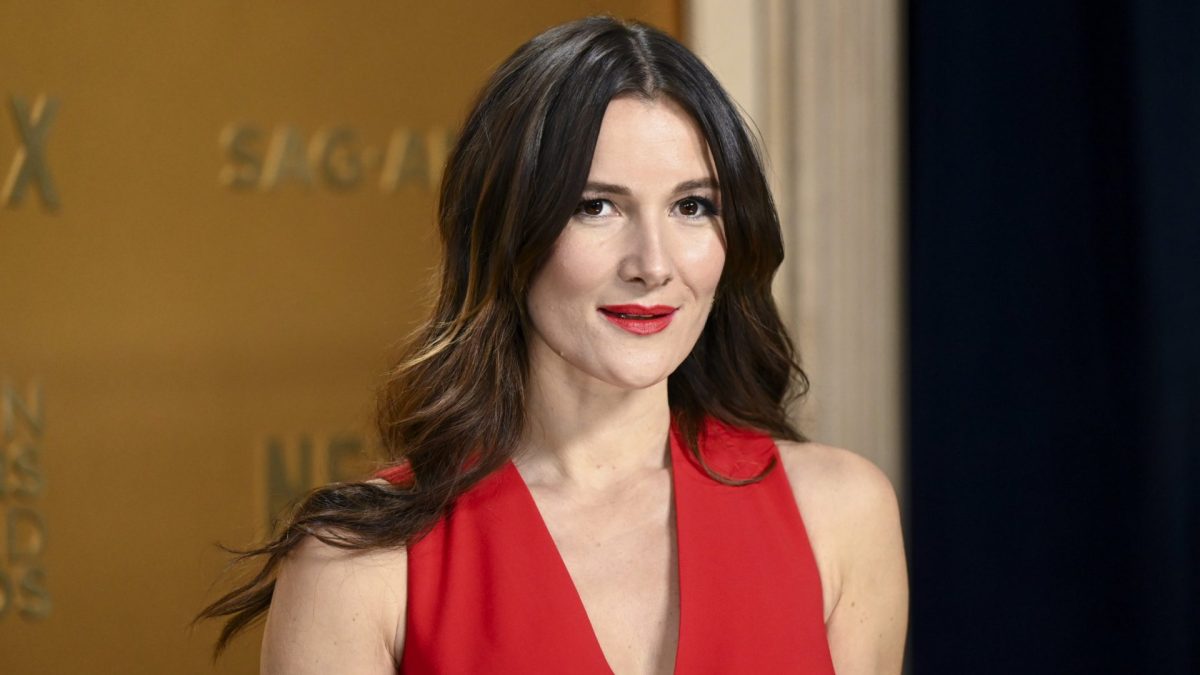
“I just can’t seem to shake off acting,” says Sarah Solemani. “Every time I start a new job, I say: ‘This will be the last one’.” Surely the star of Bad Education, Inside No 9, Bridget Jones’s Baby and Bridget Jones: Mad About the Boy, and the Bafta-winning Him & Her isn’t serious. “It’s true!” she exclaims. “Acting is hard work and it means time away from my children. It’s a lot of pressure, and I’m generally more comfortable hiding behind my laptop. I tried to get out of The Party, but then Luke [Evans] called me and said: ‘You have to do it’. And so I did and, of course, I loved it.” The Party is adapted from Elizabeth Day’s 2017 novel, and is a gripping tale of class, ambition and obsession revolving around working-class journalist Martin (Evans) and Tory politician Ben (Tom Cullen), two old friends with a dark secret. The series unfolds during Ben’s 40th birthday bash, during which an incident occurs that is best not spoiled. Solemani plays Lucy, Martin’s wife who is six months pregnant and who, like her husband, is a fish out of water among the hard-partying aristocrats. You can understand why Solemani wanted to back out of the role when you learn she is also The Party’s writer and showrunner. “You’re problem-solving, you’re working with the channel and with producers to literally get the show on the road, and the worst thing you can do is have all that running through your head when you’re trying to act,” she says. Solemani (above, right) was persuaded to take the role of Lucy Farni in ‘The Party’, for which she is also writer and showrunner (Photo: Simon Ridgeway/World Productions/ITV) Nonetheless, she is glad she did it. “I love to write, and I do it every day even when I’m on holiday. But nothing compares to the surge of adrenaline as an actor of walking out of your trailer and on to set and all these people are focusing on one camera which is on your face.” I meet Solemani – whose other writing credits include the #MeToo drama Chivalry, Ridley Road, a BBC drama about the British 1960s antifascist movement, and this year’s short film Mashhad – at a London hotel. She is warm, thoughtful in her reflections on the industry and endlessly curious, asking almost as many questions as she answers. She has come straight from Broadcasting House, where she was interviewed on Radio 4’s Woman’s Hour. It’s reminded her of a previous appearance on the show when the then-presenter Jenni Murray called her character Becky in Him & Her “slutty”. Murray meant slovenly, rather than the word’s more modern meaning. Still, she says, “I did have that moment of ‘Did Woman’s Hour just call me a slut?’” Solemani says she has spent years trying and failing to get scripts about the British class system off the ground. “The questions were always along the lines of: is this going to be a Downton Abbey or Ken Loach? People viewed class as a genre in itself.” When she read Day’s novel, she knew immediately what the first and last scenes would look like on TV. “I understood the world and the idea of this character, Martin, who crosses class boundaries. James Baldwin said you can see your country better from a distance. I’m very attached to Britain, even though I live in America now, and the class system never leaves you.” Solemani and Steve Coogan were the co-writers and stars of ‘Chivalry’ (Photo: Nicole Wilder Shattuck/Channel 4/PA) By way of research, Solemani also read the 2022 book Chums by Simon Kuper, which traces the rise of an elite group of students from Eton, via Oxford, into the British government in the 2010s, among them Boris Johnson, Michael Gove and Jacob Rees-Mogg. “They were a generation of Tory ministers who hadn’t been to war, and so they constructed their own mission [Brexit],” she reflects. “There was this sense of a group who were bred for leadership and presented themselves as wise and capable, but then Covid happened and it was chaos and then they sustained a huge electoral defeat.” Solemani got up close to the wealthy elite while studying Political Science at New Hall, Cambridge in the late 90s. “The only reason I got in was because of a British-Ghanaian anthropologist called Dr Sue Benson, who was renowned for accepting wildcard state schoolgirls. She told me: ‘This is a macho place, so you’ve got to work. You can’t just do Footlights’.” She did Footlights anyway, which was fun despite her often being the only woman in touring productions. Solemani was born and raised in Crouch End in London, with an Iranian father and Northern Irish mother. Hers was a happy and loving childhood, though tragedy struck in her teens when her mother was diagnosed with terminal cancer. She was eventually admitted to a hospice, and it was there that 16-year-old Solemani told her that she wanted to join the National Youth Theatre. “My mum said: ‘Don’t get your hopes up as it’s competitive.’ I performed two monologues – one Shakespeare, one modern – at the foot of her hospice bed. Then, two weeks later, she died.” The following day, Solemani got a letter from the National Youth Theatre saying she had been accepted. “So it was a summer of grief, but then I became part of a company and something bigger than myself and I pushed through being drowned in my own suffering. I think there’s something about childhood bereavement that helps you achieve success, because you’ve felt pain and seen mortality. It’s now or never.” Solemani (above, far right) was part of the starry cast of the most recent Bridget Jones film, ‘Bridget Jones: Mad About the Boy’ (Photo: Alex Bailey/Universal Studios) That urgency and determination helped propel her to a West End production of The Graduate in her gap year, then on to Cambridge Footlights and, later, the TV series Red Cap, alongside Tamzin Outhwaite. But it wasn’t until she played the lazy, loveable Becky in the Bafta-winning sitcom Him & Her that her career really took off. By now she was also firing off scripts to TV production companies and, after lots of rejections, was deemed promising enough to join the writing team of Barry, the awards-festooned HBO series about a depressed hitman, which ultimately led her to up sticks and move to Los Angeles. Solemani was still new to the city when the #MeToo movement was gathering pace. Unlike Cate Blanchett, who said last May that “#MeToo got killed very quickly”, Solemani – who at the time wrote about an unnamed director who invited her to his house when she was 19, and asked her to prove her willingness to do nudes scenes by taking her clothes off – believes the movement successfully “dismantled an old Hollywood system”. “It purged the culture of dangerous men. They’re removed and some of them are in prison. I witnessed that, and I witnessed the introduction of intimacy supervisors, and I saw male showrunners complain ‘We’re being policed’ while women were going: ‘Finally, something is different.’ To be on a set now compared to when I was a young actress, it’s night and day.” As a writer, Solemani still deals with rejection. When I ask what proportion of her scripts don’t end up getting made, she says: “Most of them. But that doesn’t mean it’s wasted work because you find that the themes or the characters will turn up in other work.” She adds that “every time I sit at my laptop, I’m trying to write The Hangover“. “I’m aiming for a broad commercial billion-dollar franchise. But then I’ll end up writing something like Masshad, which is about 1930s Iran and based on my grandmother. It comes down to following my own curiosity.” Now Solemani is a patron of the National Youth Theatre, where she mentors young actors. They talk a lot about rejection and the concept of a thick skin. “I actually think to be a creative person, you need a thin skin,” she tells me. “You almost need a layer of skin missing because empathy is our medium. We’re also truth fanatics. We want to open the door, lift the lid, and you can’t have an armour for that. So it’s not about developing a thick skin but accepting you will be wounded and learning to keep going.” ‘The Party’ starts tonight at 9pm on ITV. All episodes are streaming on ITVX
Sarah Solemani: ‘I performed at my mum’s hospice bed two weeks before she died’
Full Article
Original Source
Read the full article at Inews →KhanList aggregates and links to publicly available news content. We do not host full articles from third-party sources. Always verify important information with original sources.