
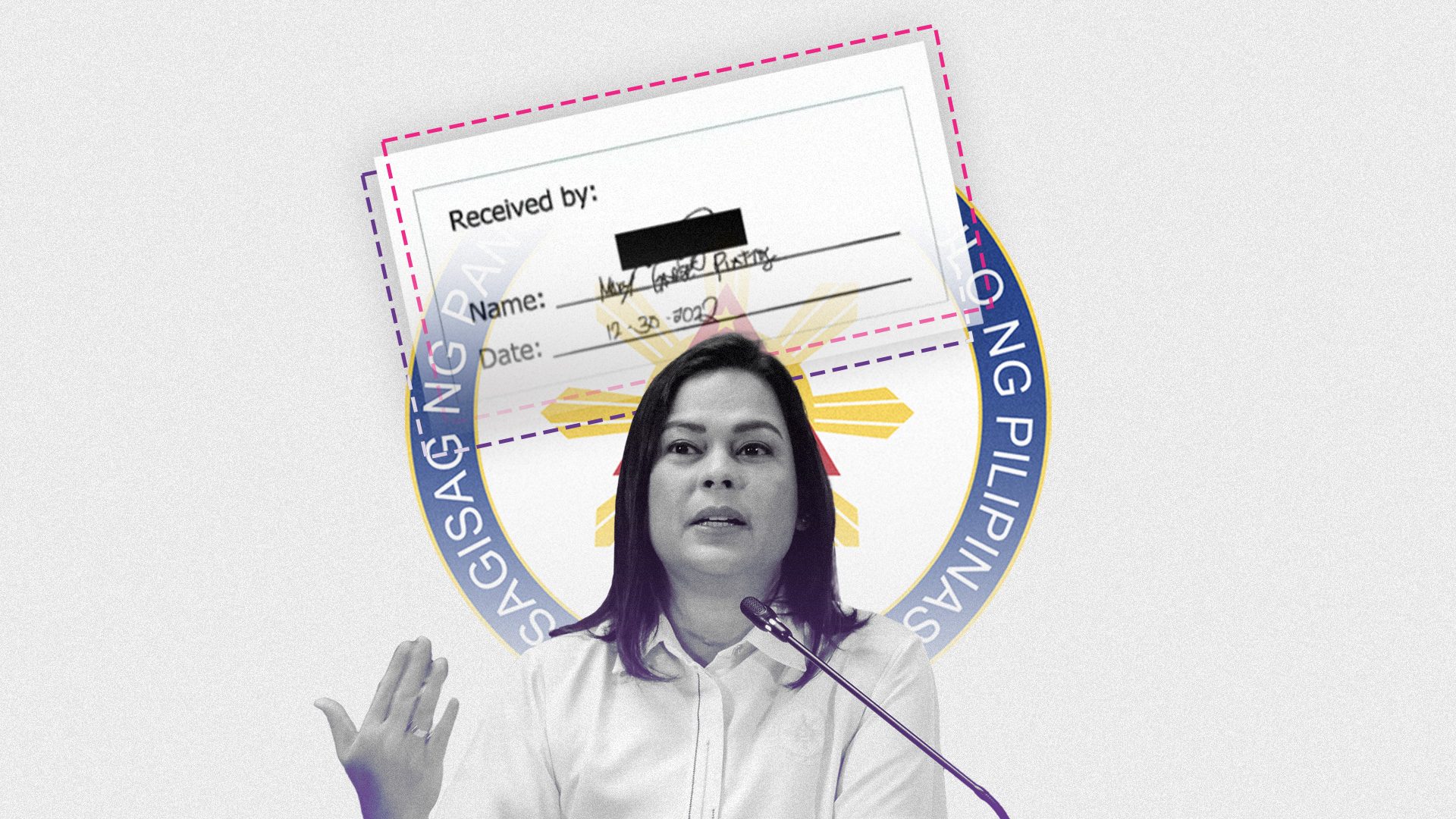
Photos from Jire Carreon/Rappler, House screenshot; Illustration by Raffy de Guzman/Rappler The anti-alias law as amended states that persons wanting to use an alias must obtain judicial authority, and must still affix their real name in documents Vice President Sara Duterte's camp claims that recipients of her office's confidential funds used aliases, raising questions about potential violations of the anti-alias law. Prosecutors argue that the use of aliases in acknowledgment receipts may constitute a violation of the law, which carries penalties including jail time and fines. This is AI-generated. Read the article for full context. Report any errors. For the first time, the camp of Vice President Sara Duterte made the claim that the recipients of her offices’ confidential funds used aliases. It’s a plausible explanation that could justify the oddity of the names of the signatories on the acknowledgment receipts — from surnames of senators to a mix of brand names, such as the infamous Mary Grace Piattos. This, however, raises another question: did Sara Duterte, as head of agency for the Office of the Vice President and previously the Department of Education, violate the anti-alias law? The prosecution believes so. “This does not fall under any of the exemptions to the Anti-Alias Law. This could be yet another case or violation against them,” public prosecutor Joel Chua said. What does the law actually say? The original law dates back to 1936, when the National Assembly of the Philippines passed Commonwealth Act No. 142. It was extensively amended by Republic Act 6085 in 1969. The amended law prohibits a person from using any name other than the one he was registered with at birth, or the one he was baptized with, or the substitute name approved by a competent court. The only exceptions are pseudonyms “solely for literary, cinema, television, radio or other entertainment purposes and in athletic events.” If persons wants to use an alias, they need to obtain judicial authority to do so. They also cannot have more than one alias. “The judicial authority for the use of alias the Christian name and the alien immigrant’s name shall be recorded in the proper local civil registry, and no person shall use any name or names other, than his original or real name unless the same is or are duly recorded in the proper local civil registry,” the law reads. RA 6085 also explicitly states that no person — even those who use a pseudonym or those who obtained judicial authority to use an alias — shall execute any public or private document without affixing his or her actual name. Violation of the law entails jail time of up to five years and a fine of P5,000 up to P10,000. “It is clear that the Vice President, when she took her oath of office, swore under the Constitution that she would uphold all of our laws. This is again a culpable violation of the Constitution,” Chua said. “Regarding its application to the acknowledgment receipts of confidential funds, it’s something that the impeachment court should answer,” prosecutor Lordan Suan also added in a separate interview with Rappler. One Supreme Court ruling in 1996 may be relevant to this issue. Ursua vs Court of Appeals says that the use of a fictitious name in a single instance without indication that the person intends to be known by that name does not fall within the prohibition contained in C.A. No. 142 as amended. Defense lawyer Justine Gular, who publicly offered this fresh theory of their case for the first time, said they will thresh out their arguments when they present their evidence. Private prosecutor Mae Divinagracia, however, objected to what she called an “eleventh hour” admission of their position, since the angle on aliases was not revealed during the pre-trial. – Rappler.com How does this make you feel? Loading
Sara Duterte trial: Confi fund admission may violate anti-alias law
Full Article
Original Source
Read the full article at Rappler →KhanList aggregates and links to publicly available news content. We do not host full articles from third-party sources. Always verify important information with original sources.