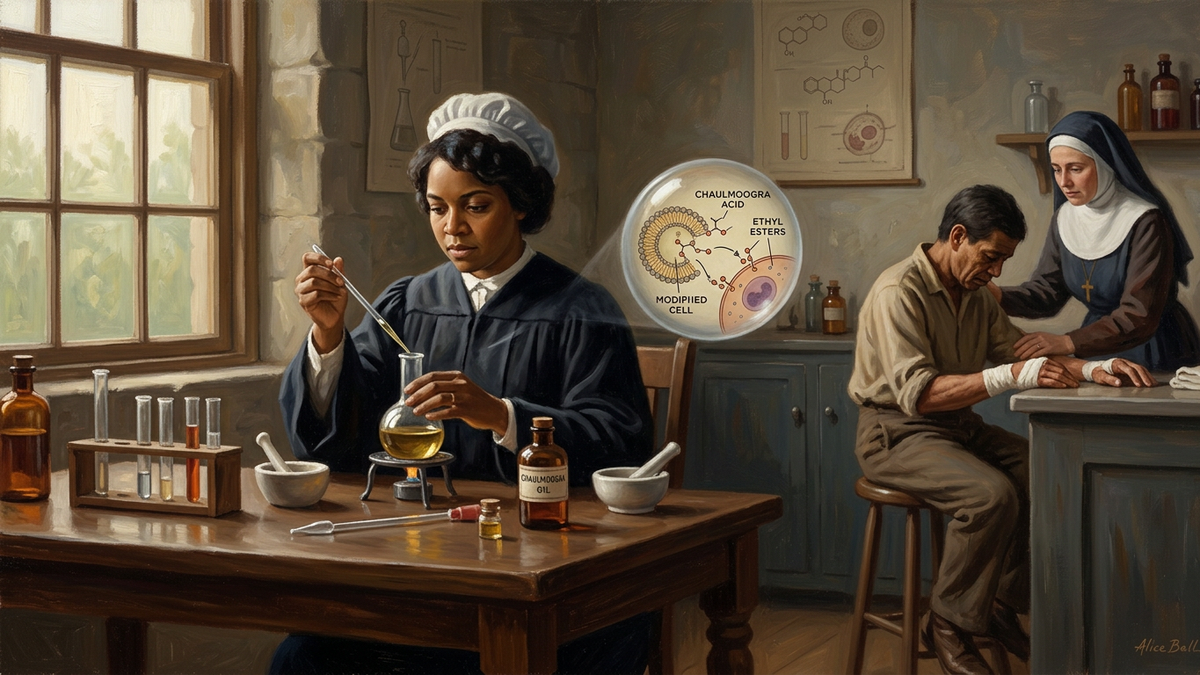
Alice Augusta Ball’s innovation revolutionised leprosy care and reunited patients with their families, but her scientific legacy was acknowledged only many years after her death |Inage used for representational purpose only | Photo Credit: Image created with the assistance of AI Alice Augusta Ball lived a very short life. In 24 years, she had remarkable achievements, and was predictably forgotten for a while, until the world was shaken up to her brilliance. Her work on distilling chaulmoogra oil for use as effective treatment for leprosy brought hope to a number of patients globally. An African American woman born into middle class in the late 1800s, Alice Ball benefitted from an early exposure to chemical processes as her family was involved in photography. She went on to shine in science at school, and could hope to move on to university, a rare opportunity for a woman and a person of her race at that time. She lived up to her potential and at the University of Washington, racked up her skills in chemistry and pharmacy. She finished two degrees – a bachelor’s in pharmaceutical chemistry and a bachelor’s in pharmacy – thus arming herself for a career –short lived, but so sparkling, people are still talking about her, though subsequent innovations have transformed care for leprosy. With a full scholarship, another rarity for the times, Alice moved to the College of Hawai‘i, and became the first woman and the first African American to earn a master’s degree in chemistry. We mention it because it is an achievement, but also because it was an achievement that attracted the kind of attention a career flourishes on. It is said that Harry T. Hollmann, a public health officer, thought her thesis research on extracting active compounds from the kava (awa) root might have implications for his passion – finding cures for leprosy. Leprosy or Hansen’s disease is caused by Mycobacterium leprae, and was discovered by Norwegian physician Gerhard Armauer Hansen in the 1870s. While it is prevalent in people living in tropical regions, leprosy which affects the nervous system, also has the moniker of being the world’s oldest disease. Evidence of leprosy has been found in skeletons from back in 2000 BCE. Those affected develop visible skin lesions and extremities including fingers and toes malformed and misshapen fingers. Sometimes amputations were also performed on limbs that could not be salvaged. As a result of the disfiguration, the stigma surrounding the disease was so high, those with leprosy had to be sequestered in camps and asylums outside the community. Alice did accept Hollman’s invitation and what she managed to achieve was to revolutionise the field of leprosy care in the very near future. Described as the Ball Method, Alice devised a method that would “convert the oil’s fatty acids into water-soluble ethyl esters that could be injected into patients. Until then Chaulmoogra oil was promising as treatment for leprosy, but it was thick, not soluble in water, besides difficult to inject and swallow. Soon the world adopted the Ball Method and the landmark contribution changed life for the better for people who were battling leprosy across the world, without hope until then. Alice was in her early 20s at the time of this achievement. Records of the time say, since the new formulation dispersed in the bloodstream instead of pooling under the skin, patients for the first time celebrated as earlier, there was none of the severe local reactions and oozing oil that the injections caused. Used on patients at Kalihi Hospital in Hawai‘i, researchers managed to show that patients administered the new formulation, became ‘bacteriologically negative, their lesions resolved, and many were discharged from isolation to rejoin their families, without fear of infecting them.’ This injectable preparation remained the best available treatment worldwide until sulfone antibiotics, Dapsone, in combination with other drugs, replaced it in the 1940s, facilitating a future unimaginable until then, for those who were diagnosed with leprosy and condemned to social isolation. However, Alice’s contribution never made it to the headlines thanks to a set of factors – her gender, age and race were primary. She died young, it is speculated that it could be a result of a laboratory accident, a senior male colleague, her department head Arthur L. Dean appropriated and published her work without sharing any credit, in fact, promoting it as the ‘Dean method’, accounts of that period list. It went unchallenged until decades later, when researcher Harry Hollmann revisited the archives and credited Ball. Finally, the historical records were righted, and Alice Ball’s name was affixed to the method she had painstakingly developed. By 24, despite the disdvantaged circumstances she worked in, Alice Ball had changed the world, it is a matter of speculation how much she would have achieved had she lived longer, but a safe bet to say she would have left a deeper impact. For the punch she packed in her short life, and the revolution she managed in that life, it’s time we say her name, say “Alice Augusta Ball.” Published - July 19, 2026 08:34 pm IST
Salvaging limbs and lives: A chemist to the rescue
Full Article
📰 Original Source
Read full article at Thehindu →KhanList aggregates and links to publicly available news content. We do not host full articles from third-party sources. Always verify important information with original sources.