
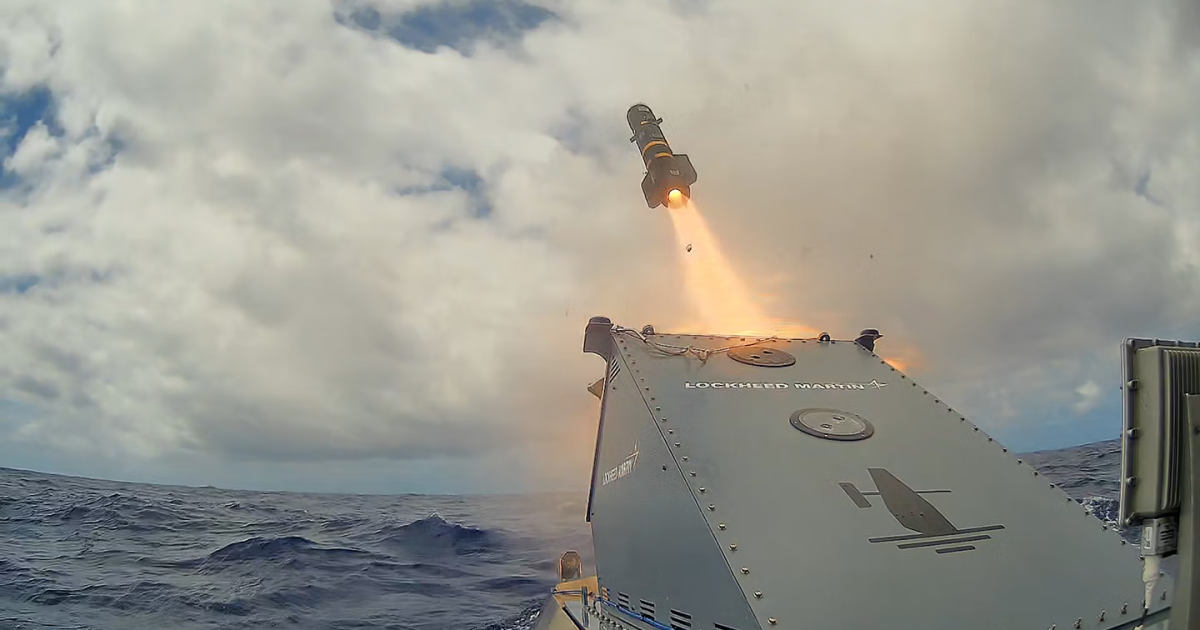
What looks like a sailboard but packs a punch like a warship? Thanks to Saildrone and Lockheed Martin, it's the Saildrone Surveyor Unmanned Surface Vessel (USV), which recently fired two Joint Air-to-Ground Missiles (JAGM) during a naval exercise.Putting missiles on what is essentially a 65-ft (20-m) robotic sailboard might seem as logical as putting a cannon on a duck punt (which has been done), but there is a method to the madness. There are two major trends in the modern military. The first is to integrate land, sea, air, and, eventually, space drones into the armed forces as a major component. The second is to speed up development and production of new systems on a scale that would have seemed incredible even 10 years ago.Part of both efforts is finding ways to turn platforms of all sizes into assets for reconnaissance, electronic warfare, rescue, and strike capabilities, and to do it quickly. The goal is to create a hybrid force, with humans doing the high-level executive and highly-skilled jobs while the drones take on the boring tasks and go into high-risk areas. Saildrone In addition, autonomous vehicles can act as force multipliers, covering larger areas than current forces can. To do this, the drones need to be able to operate in large, connected swarms where each unit can remain on station for months at a time without outside support.Using a rigid sail and an auxiliary diesel engine, the Surveyor can carry a wide variety of payloads and remain at sea for over 180 days, which makes it a strong candidate for developing long-range recon and attack drone fleets.The concept was tested off the coast of Hawaii during Exercise Rim of the Pacific (RIMPAC) 2026 as part of the United States Navy Fleet Experimentation Program (FLEX). During the exercise, the Surveyor was equipped with a Lockheed Martin JAGM Dual Launcher, firing two rounds that targeted a surrogate high-speed surface craft using coordinated sensor data from the USS Theodore Roosevelt (CVN-71) Carrier Strike Group.Along with the missile launches, the Surveyor also detected, classified, and identified a simulated radar threat by teaming up with an MH-60S helicopter."Lockheed Martin and Saildrone are leading the way to leverage the strength of industry to deliver autonomous platforms with containerized capabilities for our national defense," said Paul Lemmo, Vice President and General Manager, Sensors, Effectors and Mission Systems, Lockheed Martin. "We will continue to invest in new capabilities ahead of need to accelerate and de-risk deployment of urgently needed defense technologies."Source: Lockheed Martin
Sail-powered drone fires guided missiles in US Navy live-fire test
Full Article
Original Source
Read the full article at Newatlas →KhanList aggregates and links to publicly available news content. We do not host full articles from third-party sources. Always verify important information with original sources.