
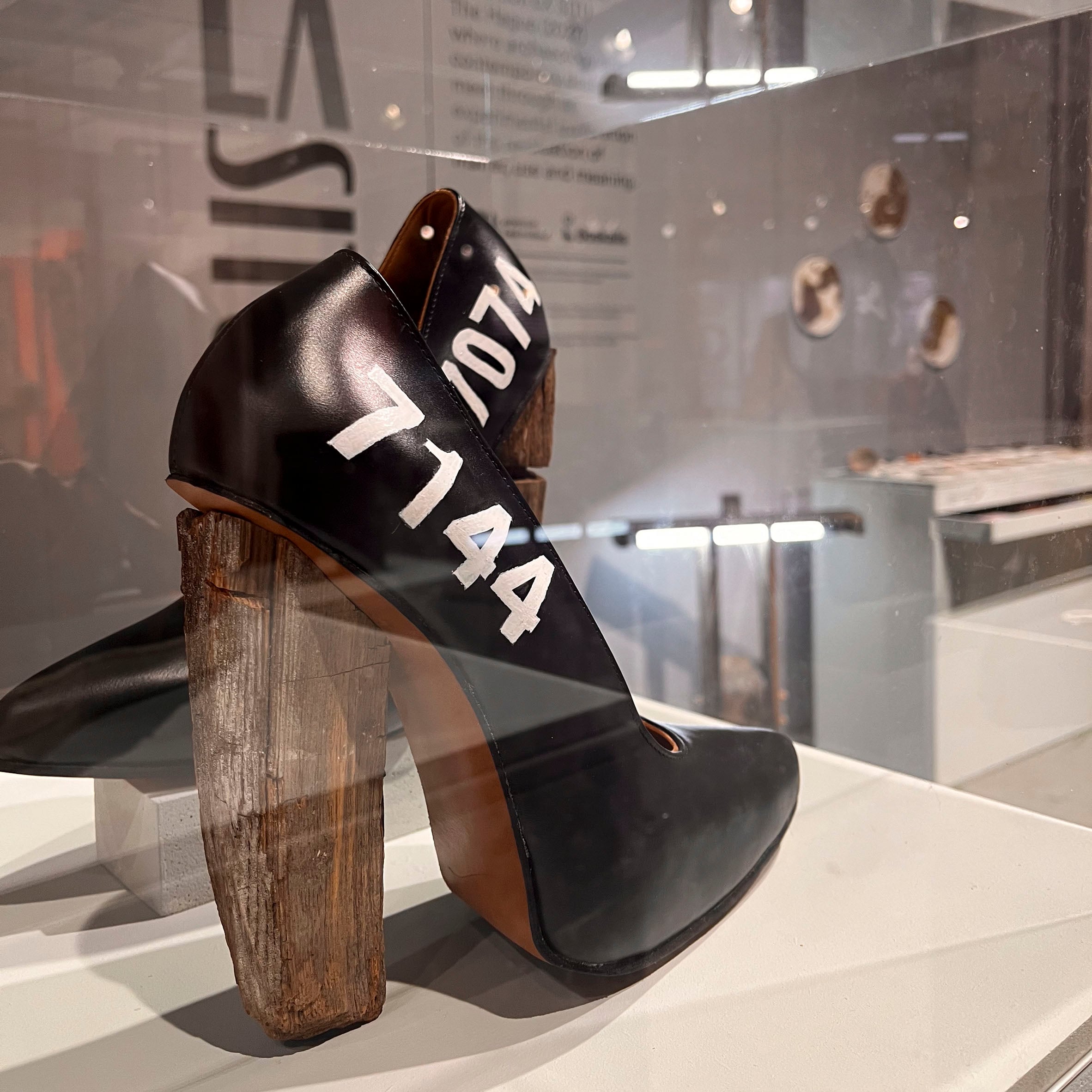
New objects made from mammoth bone, leather from the middle ages and stumps from a road built under Roman Emperor Hadrian feature in the Ex Situ project, set to be exhibited soon in The Hague. Initiated and curated by Dutch designer Marisa Klaster, working in concert with archaeologist René Isarin, the project makes use of materials that many in Isarin’s profession and the broader public might consider off-limits for new designs: the finds from archaeological digs. However, while these finds, such as 40,000-year-old mammoth bone and 14th-century ship wood, sound like they belong in a museum, they are in fact deselected – not chosen for inclusion in any archives. A preview of Ex Situ was shown at Dutch Design Week Deselected finds are duplicates, common in type, poorly preserved or otherwise judged to have limited future research value. “The material that you see here is the lowest of the lowest quality,” said Isarin at a preview of Ex Situ at this year’s Dutch Design Week. “It’s not preserved. It doesn’t belong in a museum. It doesn’t belong in a depot.” In fact, if it is not going to be used for educational purposes or reference collections, deselected archaeological finds are required by Dutch law to be carefully destroyed, as they are in many places around the world, said Isarin and Klaster. Designer Shahar Livne has been working with mammoth bone Although the materials may be of low value to archaeology, the designers both found this something of a waste. With Ex Situ, they aim to explore a new category of use and preservation for these materials, believing artists and designers have the capacity to tell stories of heritage in a different way to museums. With the permission of the province of South Holland, they gave deselected materials to nine Dutch practitioners with expertise in crafts such as ceramics, woodwork and glassmaking. One of the most finished pieces, exhibited in a preview showcase at October’s Dutch Design Week in the Klokgebouw, was by footwear designer and materials researcher Judith Sanders. Footwear designer Judith Sanders worked with wood from a Roman road She crafted the foundation posts from a section of the Roman Limes border road, dated to 125AD and built under the emperor Hadrian, into the heel of a pair of high-heeled shoes. Sanders was intrigued by the notion that they could perform structurally once again – this time bearing the load of just one person. Bold numbers on the sides of the shoe denote where on the dig site the material came from, while a second pair of shoes works leather from the middle ages into a modern-day sneaker silhouette. Another piece is by designer-maker Daan Simons, who worked with 14th-century wood fragments from a ship that was wrecked and then subsequently used in the construction of Rotterdam. Daan Simons made his Remembrance Pots from 600-year-old wood The texture and existing peg holes in the wood are preserved in his Remembrance Pots, which he imagines holding the ashes of a loved one or a keepsake of theirs, compounding the layers of memory in the vessel. Klaster and Isarin started on the path to Ex Situ after meeting accidentally at their timber drying kiln, where she was having some wood dried for a furniture project, and he was having the deselected Roman posts dried in the hope they would find another life. “Intrigued by their blackness”, Klaster asked Isarin if she could have them, and went on to make a series of tall vases. That was five years ago, and they have been discussing the potential intersection of archaeology and design ever since. Klaster says that the Ex Situ designers were supported with information about heritage and the finds they were working with, but that the project naturally inspired some trepidation. “In the work that they have made so far, you see that they have thought it through, and there is respect in what they made,” said Klaster. “But the first cut with a scissor or a bandsaw is, of course, a scary thing.” “[One of the designers] was like, can I really saw that in two? And I said yes, you can. If you have a plan as a designer, yes, it’s yours.” Sanders’ also designed a sneaker-style shoe from Middle Ages leather. Photo by Boudewijn Bollmann That worry will be echoed among some archaeologists, Isarin adds, and he and Klaster’s aim is for the exhibition to promote discussion among the profession. “For archaeologists, this material is in a sense sacred,” said Isarin. “But it’s deselected, so nobody wants it.” He said that while reactions have so far been positive, the issue becomes more thorny if the design were to take place in a commercial context – for instance, if Sanders’ shoes were sold by a fashion brand. In that sense, some archaeologists may see this project as opening a Pandora’s box. Ceramicist Lotte Douwes is experimenting with Roman pottery “As soon as we enter the commercial world, then I think for many archaeologists it will be, even though it’s deselected material, an interesting debate ethically,” said Isarin. “Suppose that all this matter, which has no value at all, that somebody gets rich out of it. That would be a disaster for many archaeologists.” Nevertheless, Klaster and Isarin think it is a debate worth having. Ceramicist Natasja van der Meer is using her materials for glazing research Pieces in the exhibition come from practitioners ranging from glass artist Bernard Heesen, working with 17th- and 18th-century glass, to conceptual material designer Shahar Livne, working with mammoth bone, and ceramicist Lotte Douwes, working with Roman pottery. “We have so much rich material beneath our feet, with amazing stories from 40,000 years up to today,” said Klaster. The exhibition was previewed at Dutch Design Week, alongside the maximalist installation Everything Moist Seems Alive installation by Maison the Faux and Boris Acket and design collective Show Not Show’s Table of Power exhibition. Ex Situ: Matter in Translation will be on at See Lab, The Hague, from 5 February to 7 March 2027, with discussion events as part of its programming. See Dezeen Events Guide for more architecture and design events around the world. Read more
"Sacred" archaeological finds become raw materials for design in Ex Situ exhibition
Full Article
Original Source
Read the full article at Dezeen →KhanList aggregates and links to publicly available news content. We do not host full articles from third-party sources. Always verify important information with original sources.