
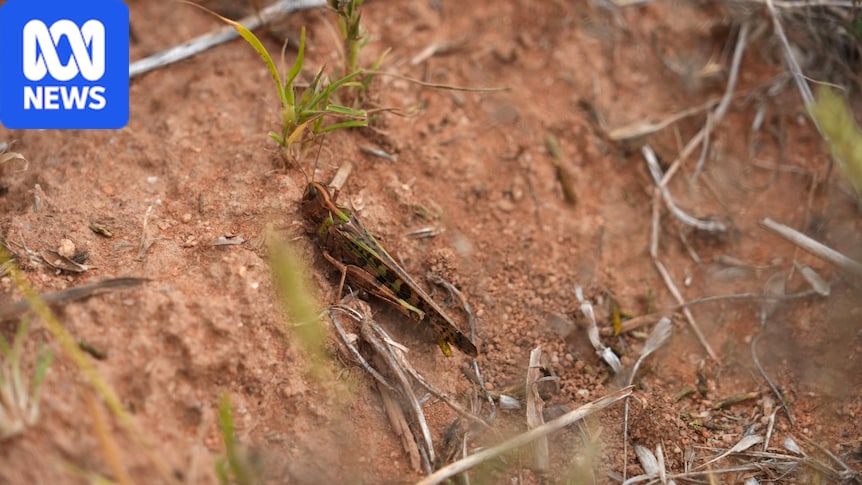
The South Australian government has backflipped on its approach to managing locust outbreaks, announcing it will aerial spray parts of the state it had previously refused.Farmers across the state have been calling for action to control locusts since April, ahead of the grain harvest season, which started in recent weeks in most parts of the state.The Australian Plague Locust Commission (APLC) director announced aerial spraying would commence across seven sites in the Mallee, east of Adelaide, from next week."We see [it] as our last opportunity before locust populations will start to take flight," Bruce Hancocks told the SA Country Hour."We do seek landholders' permission for spraying in particular areas."The decision is a shift from the Department of Primary Industries' (PIRSA) position in September when it said it would spray up to 80,000 hectares in the north of the state by plane, including the Flinders Ranges, but it would not drop chemicals in the Riverland and Mallee regions."The Riverland and Mallee have more intensive primary production and are not suitable for broadacre, government-led aerial spraying, which is the focus of surveillance in the Northern parts of the state", a government spokesperson said at the time.PIRSA said the unsuitability was due to chemicals potentially impacting livestock, crops, waterways and communities, as well as bee poisoning.Locusts swarming at Bugle Hut in the Riverland in 2026. (ABC Riverland: Amelia Walters)'Too late' for aerial spraysThe 2026–27 harvest season is expected to yield a record-breaking crop.Loxton farmer Tom Fielke said he spent thousands of dollars on sprays trying to protect his crop against the pest and said aerial spraying in the area was "too little, too late"."There's just not that many bands of locusts out on the roads or on the ground at the moment," Mr Fielke said.Tom Fielke says it is too late to spray for locusts. (ABC News: Will Hunter/File)He said communication from the government had been lacking, and aerial spraying would have helped weeks ago, when bands of hoppers were on his property.Shadow primary industries minister Nicola Centofanti said the state opposition welcomed the decision, but farmers had requested help for weeks."[About] 178,000 hectares was sprayed out of the Loxton Control Centre [in 2010] and it was done so safely and it was done so successfully," Ms Centofanti said."What has taken so long for the government to make this decision?"Nicola Centofanti says spraying in 2010 was safe and successful. (ABC Riverland: Jackson Byrne/File)Always in the planThe Australian Plague Locust Commission supported PIRSA by surveying the regions with the most locust activity.PIRSA biosecurity executive director Nick Secomb said the commission had identified areas in need of spraying in recent weeks.He said this informed its decision to spray 2,000 hectares between Pinnaroo and areas south of the River Murray.Nick Secomb says PIRSA has only recently identified some areas in need of spraying. (ABC News/File)"Our contingency for this area was always to rely on the plague locust commission to undertake surveillance and [identify] targeted sites that could be arranged for spraying," he said."Up until now, we haven't seen targets that would warrant spraying in that area."Farmers have spent thousands trying to control locusts. (ABC Rural: Petra Oates)Grain Producers SA said the response program should be assessed once completed."There does need to be a review to look at aerial spraying generally when it comes to knocking out locusts and whether the decisions here were correct or not," chief executive Brad Perry said."We need to take every measure that we can, fast."
SA government backflips on locust management approach despite past concerns
Full Article
Original Source
Read the full article at Abc →KhanList aggregates and links to publicly available news content. We do not host full articles from third-party sources. Always verify important information with original sources.