
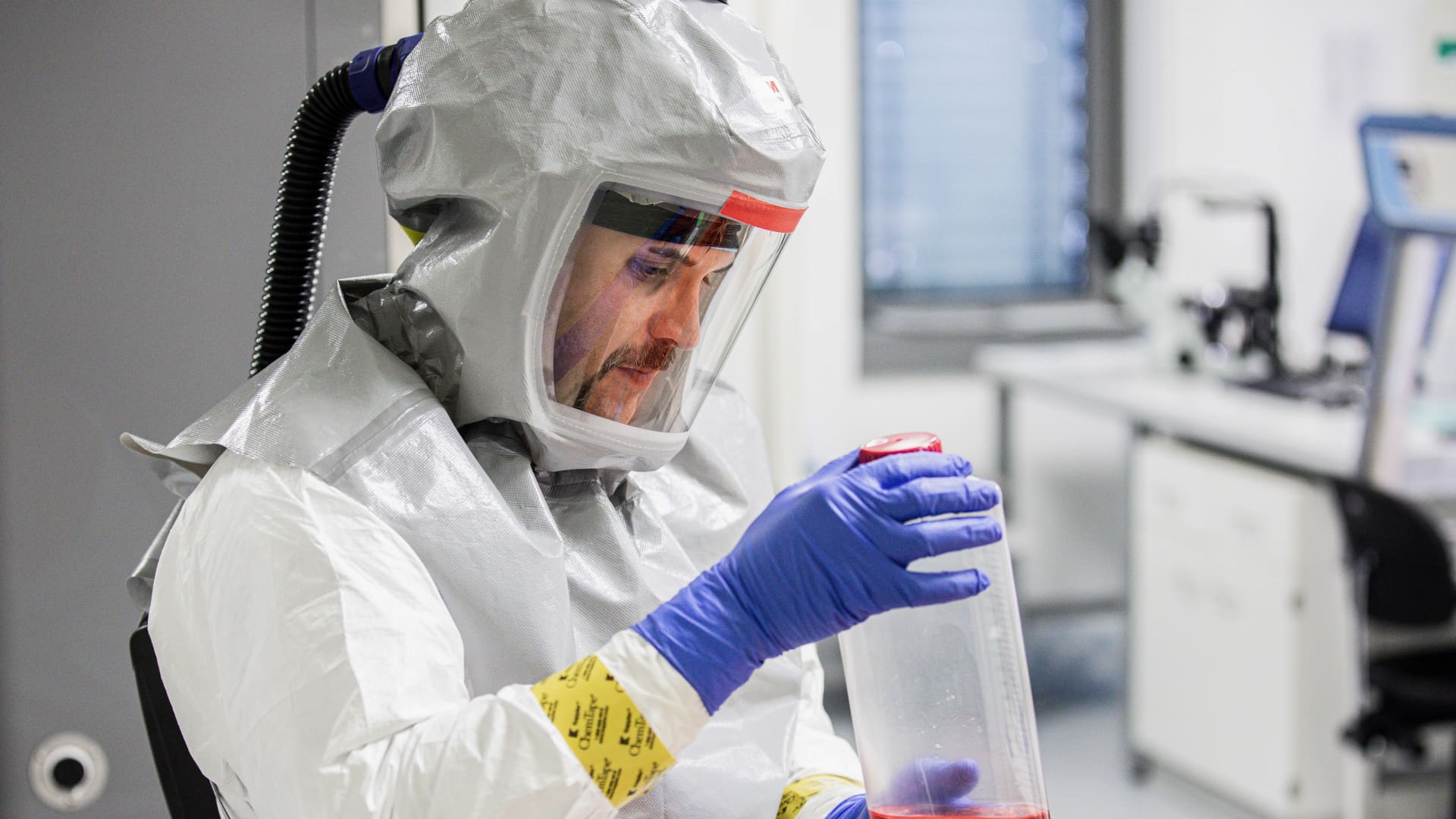
The unexplained death of a lab technician at a Russian research institute handling plague bacteria has raised questions among infectious disease experts, who say the circumstances surrounding the case are unusual and key details remain unanswered.According to local reports, some 200 people have been put under medical observation, or quarantined, in the Siberian area of Irkutsk. Other reports say an incident in the lab dealing with the bacteria preceded the fatality. CNBC has not been able to independently verify these reports.While health authorities around the world say the risk of a wider outbreak appears low, experts told CNBC that the reported circumstances of the death are difficult to reconcile with the stringent safeguards normally used when working with the deadly pathogen.Javier Pizarro-Cerda, head of the Yersinia Research Unit at the Institut Pasteur in Paris, told CNBC he was "very surprised" by the report coming out of Russia, since people working with plague normally take serious protective measures because of the dangers of exposure. "You work with a full body suit. You work with masks. You work with gloves. So even if you break a tube, normally you should be protected," he said. In Russia, there's also a vaccine for plague. However, it doesn't meet the standards expected elsewhere and offers low, transient protection, Pizarro-Cerda added. A fatal diseasePlague is an often fatal disease with very rapid progression. The fatality rate of pneumonic plague is nearly 100% if left untreated, and about 50% if treated. Several experts on the Yersinia pestis bacterium that causes plague told CNBC that isolation and monitoring of anyone who had been in contact with the diseased person is a normal and sensible strategy.As for the origin of the suspected case of pneumonic plague, Yersinia pestis exists naturally in animal reservoirs, especially among rodents, but it is highly unlikely the employee would have contracted the disease elsewhere, according to Pizarro-Cerda.The person would have had to visit a very specific place, been in contact with contaminated people or a sick animal in a wild environment, said Pizarro-Cerda.Reservoirs of Yersinia pestis exist on every continent except Oceania, however, that does not mean human cases occur everywhere those reservoirs exist. Russia's public health watchdog, Rospotrebnadzor, said the situation is under control and that measures have been implemented in response to the case. It also said that "based on the results of extensive testing, no microorganisms associated with the patient's professional activities were detected in the patient's sample."The World Health Organization (WHO) said in a statement to CNBC that the cause of death is still unconfirmed and testing is reportedly underway. All of the patient's contacts have reportedly been identified and are being monitored for illness, and none to date have shown symptoms of illness, the WHO added.Key questions remainIt's not clear why dozens of people would be put under medical observation in the region if there weren't suspicions of plague exposure. According to Pizarro-Cerda, testing for plague is straightforward and quick. "If you perform an autopsy, it should be extremely easy because if it's pulmonary plague, then the lungs of the person should be filled with the bacteria," he said. Given that the death occurred on October 2, if testing had been done, authorities would have already been able to find evidence of plague if it existed.The Russian Health Ministry and Russia's public health watchdog Rospotrebnadzor didn't respond to CNBC's request for further information. A European Centre for Disease Prevention and Control spokesperson said they were aware of the case of pneumonia of unknown origin in eastern Russia that is suspected to be the plague, but cautioned that "that suspicion is not yet confirmed.""The case is in Irkutsk, Siberia, close to the Russian border with Mongolia. There is little travel between Irkutsk and the EU/EEA, particularly at present due to Russia's war against Ukraine," they added. Based on currently available information, there are no reports of additional cases or sustained human-to-human transmission.As opposed to the more widely known form of plague, which affects the lymphatic system and is associated with the Black Death in the 14th century, pneumonic plague can spread from person to person. While less transmissible than, for example, the flu or Covid-19, it's still more of a concern from a disease outbreak perspective."Plague is still endemic in many parts of the world, including western parts of the U.S., [but] there shouldn't be too much concern as the transmission of Yersinia pestis between humans is generally poor," Brendan Wren, professor at the London School of Hygiene & Tropical Medicine, told CNBC.Even so, "any case is alarming, especially under these circumstances," Simon Clarke, associate professor in Cellular Microbiology at the University of Reading, told CNBC. What's needed now to allow scientists to properly assess the situation is "transparency about what this person was working on and why, and what they have died of, and what they've done, where they've done it, in order to try and put a firewall around [their] contacts," he said.The U.S. State Department said they are closely monitoring the situation with the Centers for Disease Control and Prevention but highlighted that many details remain unconfirmed. "We encourage Russian authorities to share accurate information quickly and openly," a spokesperson told CNBC.President Donald Trump told reporters on Monday the U.S. would do what it could to help Russia.The working relationship between Moscow and Washington over the past five to six weeks appears to have improved, and there has been a lot of interaction between officials at different levels, according to Macro Advisory CEO Chris Weafer."In that sense, it doesn't surprise me that Trump would have made this offer to help partly to make sure this does not become another major global event that kills people and disrupts global economy," Weafer told CNBC's "Squawk Box Europe" on Tuesday."But also, it just reflects the fact that there is this good, ongoing, and what appears to be fairly constant dialog between Washington and Moscow right now on a number of issues, not least of which, of course, is about the Ukraine-Russia conflict."
Russian lab worker's suspected plague death leaves some questions unanswered
Full Article
Original Source
Read the full article at Cnbc →KhanList aggregates and links to publicly available news content. We do not host full articles from third-party sources. Always verify important information with original sources.