
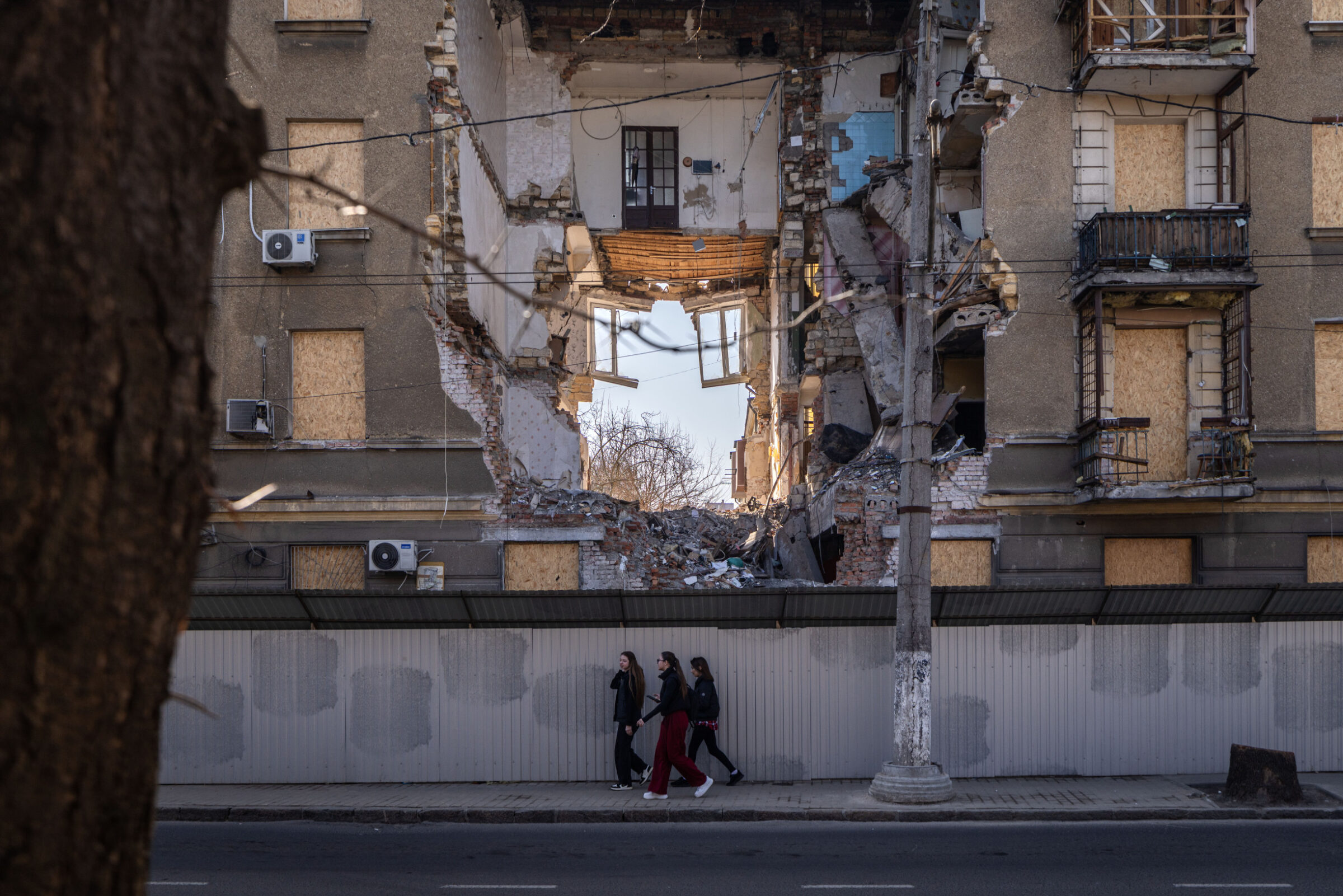
Every day, the Ukraine Battlefield update newsletter offers a clear look at how the war is unfolding on the ground. Subscribe for free here to get the full text delivered to your inbox. A textbook example of how Russian propaganda works. Stalin’s rehabilitation has succeeded in Russia, with almost two-thirds of Russians holding a positive view of him. Colombians succeeded on the Oskil, pushing the Russians back by several km. Sloviansk and Kramatorsk are now officially considered a zone of active combat operations. Maps of the day — Sloviansk-Kramatorsk direction; Dvorichna Videos of the day — how a Russian counter-drone team is armed; two drones attack the same locomotive almost simultaneously. A textbook example of how Russian propaganda works. As you will read later in the section on Russians’ views of the dictator Stalin, Russia is a country notoriously incapable of acknowledging its own mistakes and crimes, and therefore unwilling to draw rational conclusions from them. It spreads the same culture throughout Ukraine’s occupied territories. Their inhabitants are constantly targeted by propaganda, which is not directed solely at current events, but also at the more recent and more distant past. At the same time, it is a direct part of the war, because its aim is to bind the inhabitants of the controlled territories to Russia. Ukrainian children under Russian rule, who will receive new history textbooks this year, are a particular target. Their content reveals how Russian propaganda operates at home and abroad. It does not care at all whether what it proclaims is true or not. Either whatever it claims becomes the truth, or it at least obscures it to the point where its consumers believe that no truth exists. The textbook therefore also contains outright lies — including lies that the parents and grandparents of these children could easily disprove on the basis of their own recent personal experience. Ukraine celebrated Independence Day on Monday (24 August). It officially came into being on that day in 1991, while the confirming referendum took place three months later, on 1 December 1991. The new textbook is called Donbas and Novorossiya and is intended for the fifth to seventh years of primary school — in other words, for the most vulnerable children, who have not yet had the opportunity to acquire enough information to understand that they are being lied to. The website Realna gazeta wrote about it. Ukrainian journalists from the occupied territories contribute to it. It is clearly a pro-Ukrainian outlet, but it is serious and reliable. Its author, Olena Fetisova, for example, confirmed in May that Ukrainian drones caused the tragedy in Starobilsk, in which 21 people — mostly female students — died in a local boarding school. The same journalist has now described a chapter in the textbook entitled In “independent” Ukraine. The quotation marks were indeed used by the book’s authors. They describe Ukrainian nationalists as “Hitler’s henchmen” and claim that the beginning of the Russian invasion was a consequence of the “aggression of the Kyiv regime”. But alongside these traditional Russian themes, the authors also wrote about the 1991 referendum: “Ukrainian nationalists made enormous efforts to bring about the collapse of the USSR. The People’s Movement of Ukraine (Narodnyi Rukh Ukrainy) and other nationalist organisations were generously funded from abroad ... But they did not gain support in Donbas and Novorossiya.” This is precisely the sort of statement that anyone in Russia could easily disprove if they wished to. As Fetisova wrote, “2,957,372 voters took part in the referendum in Donetsk oblast. Of these, 2,481,157, or 83.90 percent, voted for Ukraine’s independence. 12.58 percent voted against, while a further 3.52 percent of ballots were declared invalid. In Luhansk oblast, 1,682,344 voters took part. 83.86 percent of referendum participants voted for independence.” Overall, nearly 29m Ukrainian voters — 90.32 percent — voted for Ukraine’s independence. The information operation targeting children in the occupied territories therefore aims not only to deceive them about the causes of the invasion, but also to convince them that these territories never wanted to belong to Ukraine and are therefore a legitimate part of Russia. Stalin’s rehabilitation has succeeded in Russia, with almost two-thirds of Russians holding a positive view of him. Imagine if 59 percent of Germans held a positive view of Adolf Hitler, and if the German government identified with the legacy of Nazi Germany. The entire world would rightly be horrified by what was happening to Germans and would fear for the future. Of course, this is not the case. Germany is an example of a country that acknowledges the crimes of its past, has learned from them and clearly distances itself from them. In Russia’s case, the situation is exactly the opposite. Not only does the majority of the population hold a positive view of a tyrant responsible for millions of deaths, but Russian president Vladimir Putin’s regime has deliberately encouraged nostalgia for Soviet times and dismantled the remaining institutions that commemorated the crimes of communism. For example, in April 2026, shortly before the anniversary of the Katyn massacre, Russia installed an exhibition at the site of the memorial to its Polish victims entitled Ten Centuries of Polish Russophobia. The massacre of tens of thousands of Polish prisoners was carried out on Stalin’s orders. Events such as this help explain the latest Levada Centre survey, published on Tuesday (25 August). According to it, 59 percent of Russians view Stalin positively (the blue line), 24 percent hold no definite view (green), and only seven percent have a negative attitude towards the greatest murderer in Russian history and one of the greatest murderers in human history. This is even fewer than the number who said they did not know who Stalin was — eight percent. Two percent declined to answer. As the graph shows, the smallest share of Russians viewed him positively in 2012, but even then it was more than a quarter. “More than half of respondents agree that Stalin was a great leader, and this view became dominant in the 2020s,” Levada wrote. Its researchers do not say so, but this is clearly the result of his gradual rehabilitation by Putin’s regime. Colombians succeeded on the Oskil, pushing the Russians back by several km. Surprisingly, Colombian citizens are the largest group of foreign volunteers fighting for the Ukrainian army. At least 7,000 of them have joined the fighting since the start of the war. As we wrote recently, based on a Financial Times article, there are three main groups among them: Soldiers fighting for ideological reasons. Colombians who fought in the country’s civil war, were unable to reintegrate into normal life, and find the pay offered by the Ukrainian army attractive. Members of criminal cartels fighting the army, whose task is to learn how to operate drones so that they can later use them effectively at home. The proportions of these groups are unknown, but it would be a mistake to assume that they do not make a valuable contribution. On Tuesday, both Ukrainian and Russian sources confirmed that it was Colombians who cleared approximately 7.5 square km of territory near the village of Dvorichna, north of Kupiansk. The area is shown in blue on the DeepStateUA map: According to the author of the OSINT account Playfra, they were foreign members of the 23rd Assault Regiment. https://t.co/N7gWHg1ZacForeign volunteers of Ukraine's 23rd Assault Regiment of the Corps "Khartiia" recaptured the blue area southwest of Dvorichna: 2 forests and the northern part of Zapadne, for a total of 7.5 km².At the appropriate time, more will follow.Work loves… pic.twitter.com/fmVQwhBjUI— Playfra (@Playfra0) August 25, 2026 DeepStateUA also released a video of the operation. The good English spoken in it suggests that other members of the unit, which is made up of foreign volunteers, also took part, although the footage shows only men standing in front of a Colombian flag. “Several months of fighting resulted in heavy losses among Colombian mercenaries and the expansion of the ‘grey zone’ by several positions,” Russian outlet Rybar also confirmed, acknowledging the Colombians’ advance. Although it downplayed the change, it took place at one of the critical points on the front. Coincidentally, Ukraine Battlefield Update covered it on Tuesday. The Russian bridgehead on the western bank of the Oskil, north of Kupiansk — where Dvorichna is located — has two potential roles in the Russian command’s plans. The first is clear from the DeepStateUA map above: the Russians have tried to bypass Kupiansk from the north from there, and last year they broke directly into Kupiansk from precisely this area and almost captured it. A map published yesterday by Bohdan Myroshnykov illustrates the second importance of the area for Russia. Dvorichna is a point from which the Russians are trying to create the conditions to cut off the north-eastern tip of Kharkiv oblast. The opposing staging area is Russian-controlled territory around Vovchansk. Ворог продовжує спроби зʼєднати Вовчанськ з Дворічною одним великим плацдармом.Для цього вони ведуть бої за прикордоння, яке переважно нагадує сіру зону.Так, в минулому році певні точки були посилені.Але прориви накшталт того, що сталося в районі Артільного, Дегтярного та… pic.twitter.com/d6rSqaLuXk— Василь Стус (@v_stus) August 24, 2026 Sloviansk and Kramatorsk are now officially considered a zone of active combat operations. The authorities designated both cities as such on 21 August and, according to a post by the 7th Army Corps, which is fighting in the area, this does not mean that the situation in either city has changed, but merely constitutes an “official recognition of the reality both cities experience every day”. The inclusion of Sloviansk and Kramatorsk in the zone of active combat operations did not change the situation on the ground — it merely officially recorded the reality in which the cities live every day. Alongside its brief comment, the corps also published several photographs from both cities. One of them is the lead image of today’s Ukraine Battlefield Update. Here are several examples. They were taken by a member of the 81st Air Assault Brigade. Sloviansk/Kramatorsk. Source: 7th Army Corps, 81st Air Assault Brigade Sloviansk/Kramatorsk. Source: 7th Army Corps, 81st Air Assault Brigade Sloviansk/Kramatorsk. Source: 7th Army Corps, 81st Air Assault Brigade Sloviansk/Kramatorsk. Source: 7th Army Corps, 81st Air Assault Brigade Sloviansk/Kramatorsk. Source: 7th Army Corps, 81st Air Assault Brigade No major developments were reported from this section of the battlefield over the past 24 hours. Only the Russian Telegram channel Slyvochny kapriz, roughly the Russian equivalent of DeepStateUA, reported positional fighting. It made only very minor adjustments to its map north of Rai-Oleksandrivka. Ukrainian channels reported no changes there. They also consider most of the village a grey zone, while the Russians mark it as captured. Videos of the day A mobile Russian army counter-drone team on the back of a lorry. The three soldiers have three triple machine-gun mounts at their disposal. A compilation of attacks on Russian logistics. The most interesting is the very first scene, showing an attack on a moving train. Being a locomotive driver is currently a very dangerous job, as both armies are targeting locomotives. In this case, it becomes clear that two drones attacked the same train at virtually the same time. Just before its own impact, the camera of the second drone captured the explosion caused by the first. What are the losses No update. By Tuesday (25 August), Russia had visibly lost 24,035 pieces of heavy equipment (24,005 on Monday, 17 August). Of these, Ukrainians destroyed 19,005 (18,977), 999 (997) were damaged, 1,193 (1,193) were abandoned by their crews, and the Ukrainian army captured 2,838 (2,838). This includes 4,440 (4,437) tanks, of which 3,346 (3,343) were destroyed in combat. Ukraine lost 12,018 (11,916) pieces of equipment, of which 9,429 (9,333) were destroyed, 697 (695) damaged, 694 (692) abandoned and 1,198 (1,196) captured. This includes 1,456 (1,450) tanks, of which 1,117 (1,111) were destroyed in combat. Note: Neither side regularly reports its own dead or destroyed equipment. Ukraine publishes daily figures for Russian casualties and destroyed equipment, but these cannot be independently verified. This overview uses data from the Oryx project, which has compiled a list of equipment losses documented exclusively by photographs since the start of the war.
Russia is teaching itself and children occupied in Ukraine fake history to justify war (Ukraine Battlefield update, Day 1,644)
Full Article
Original Source
Read the full article at Euobserver →KhanList aggregates and links to publicly available news content. We do not host full articles from third-party sources. Always verify important information with original sources.