
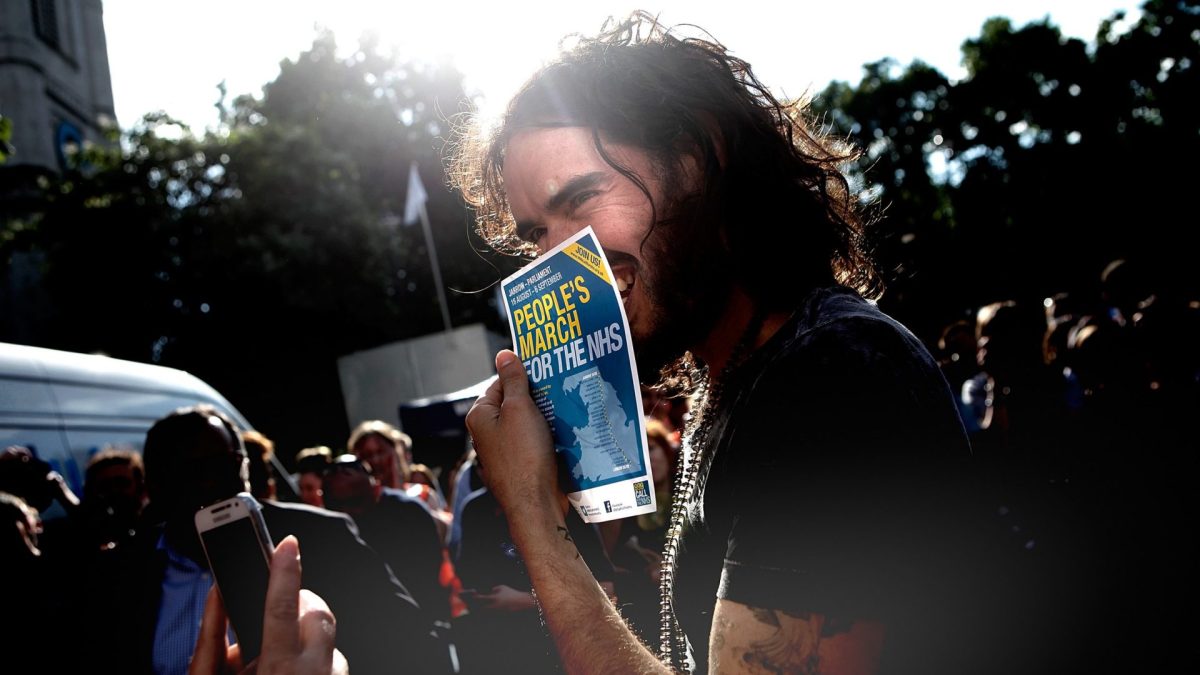
The political implications of Russell Brand aren’t really about sexual assault. That’s a criminal matter, for which he’s now experiencing a richly deserved punishment. The political implications are about how we treat people who are useful to us when we can see that they’re morally reprehensible. They’re about what we put first: our moral standards or our personal advantage. Russell Brand was initially an asset. TV stations wanted to work with him and political movements wanted to be aligned with him. He worked for MTV in 2000 then on Channel 4 in 2004. Afterwards, he became a leadership figure on the left – marching against austerity, going on Newsnight and Question Time, writing radical polemics about the elites. Progressives proved just as enthusiastic about him as TV producers were. He guest edited the New Statesman. Labour leader Ed Miliband appeared on his online show during the 2015 election. It was, at this stage, already clear what kind of man Brand was. We did not know that he was a rapist, but we did know that he belittled women and that he was cruel. We know this because he wrote about it at length. In his excruciatingly titled 2007 memoir My Booky Wook, Brand describes how he brought home a woman for a sexual encounter. At some point events became heated and she slapped him. He responded by bundling her out the front door and spitting in her face. “Yes that’s right, I spat in the face of a beautiful woman,” he wrote. “I was convinced that it was the only course of action and that there’d be no consequences.” All this was written down in black and white, but no-one seemed to care. The book was praised by the Observer (“puts most other celebrity memoirs to shame”), the Telegraph (“the most talented stand-up comedian to emerge in Britain this decade”) and others. In his own accounts of his life, Brand had two main responses to women. Those in positions without authority he treats cruelly. Those with authority – like newsreaders – he attempts to belittle and denigrate. In 2006, when he was doing a Radio 2 show he repeatedly mocked a female newsreader who would come on to do bulletins. “She’s erotic that newsreader,” he said. “I’m going to go in that newsroom one of these days.” When the newsreader complained, he said on air: “We’ve upset her… She’s doing the news, imagine her just in her knickers.” In 2013, Brand appeared on the US current affairs programme MSNBC Morning Joe, where he repeatedly mocked the female presenter by insinuating she was attracted to him. Vulture magazine said: “His uniquely hospitable and downright congenial take down of the anchors led many people to think that they had misjudged Brand not only as a comedian, but as an intelligent and intuitive social critic as well.” His political commentary was riddled with conspiratorial thinking, electoral nihilism and ignorance. He encouraged people not to vote – arguably the stupidest and most counterproductive approach imaginable. He framed the world as a showdown between an imaginary all-powerful elite and the pure virtuous people. He understood nothing about the issues he was discussing. “I say profit is a filthy word,” he told Jeremy Paxman, “because wherever there is a profit there is also a deficit.” This is specious nonsense and yet it made no difference to his leadership position on the left. Progressives allowed Brand to do what he did for the same reason that MTV and Channel 4 did. He was charismatic, famous and desirable. He was an asset. And therefore it was perfectly possible to turn a blind eye to his patent cruelty, to his predatory behaviour, to his moral and intellectual emptiness. Brand then drifted to the right. He embraced Robert F. Kennedy Jr, then Donald Trump. Now it was the turn of the right to make excuses for him. US commentator Tucker Carlson defended him. Public intellectual Jordan B Peterson had him on his YouTube channel. Elon Musk wrote: “I support Russell Brand.” Now, after the trial, Brand is something else. He is a toxic liability. And the same process is taking place in reverse. Instead of trying to claim him, people attempt to distance themselves from him and damage their enemies through association with him. The process of associating with Brand and disassociating from Brand look like opposites, but in fact they are very similar. Instead of a moral judgement and a commitment to root out toxic behaviour, they involve personal, political and commercial calculation. At first people defend him because he’s useful as an ally. And then they attack him because he’s useful as a weapon against their enemies. What’s lacking in either of these cases is a genuine moral judgement, shorn of self-interest. There is a lesson to learn from all this. That lesson is not restricted to MTV, or Channel 4, or the BBC, or the left, or the right. It is that when we see predatory behaviour, cruelty and conspiracy theory, we should call it out, even if it comes from our side – especially if it comes from our side. But that lesson is evidently too demanding for most people to grasp, either in 2015 or 2026.
Russell Brand was always toxic. We just didn’t care when he was on our side
Full Article
Original Source
Read the full article at Inews →KhanList aggregates and links to publicly available news content. We do not host full articles from third-party sources. Always verify important information with original sources.