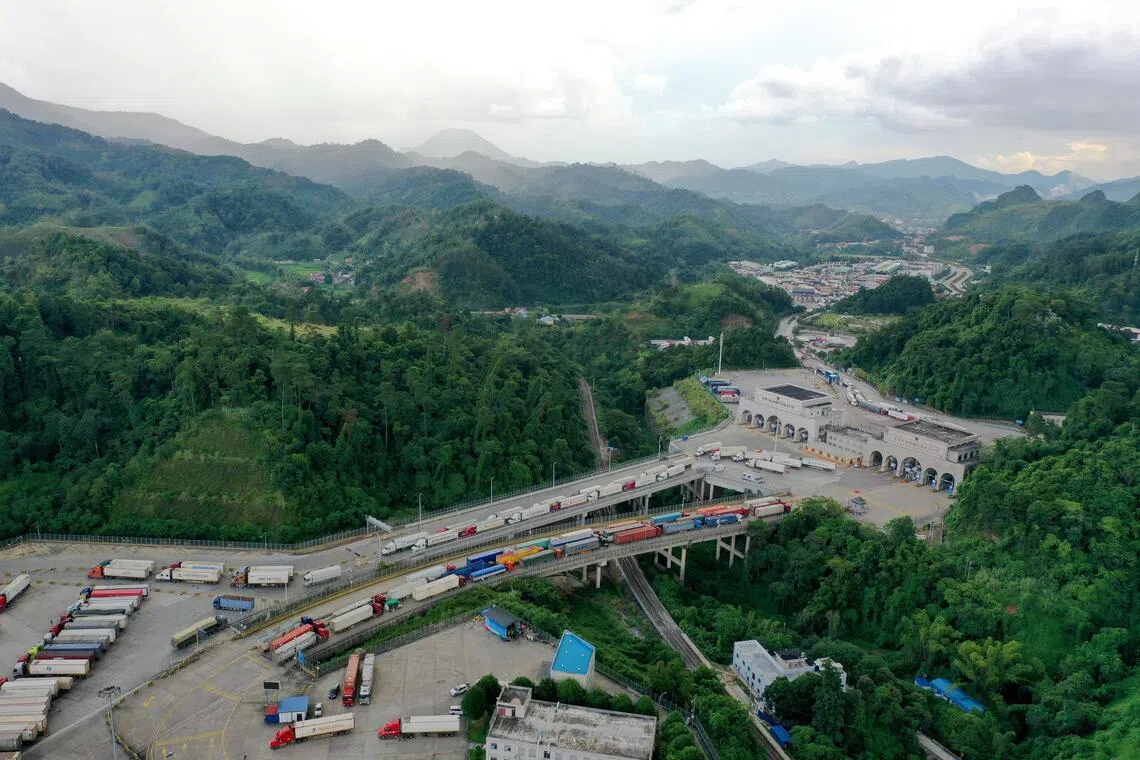
PINGXIANG, China/HAIPHONG, Vietnam – The boxes in Li Anzhang’s warehouse will not be there for long. “There’s a big gap to fill in Vietnam, so we must quickly send these across.”Around him are stacks of cardboard cartons marked with the names of electronics bigwigs Foxconn and Nokia, as well as an array of Apple suppliers.A worker steers huge bundles of aluminium sheets – “for BYD”, Li says – into a waiting truck.The goods tagged “made in China” have travelled from manufacturing powerhouses such as southern Guangdong and eastern Jiangsu, and are now on a brief pit stop in this Chinese frontier town.From there, they will head south across the border before fanning out to northern Vietnam’s factory boom towns, fuelling production lines that are now busier than before.Li Anzhang supervises a warehouse for logistics company Chefuwang in Pingxiang, China, which sends goods to factories in Vietnam. ST PHOTO: JOYCE ZK LIMPingxiang in south-western Guangxi has borne witness to an extension of supply chains from China, hastened by higher American tariffs that prompted Chinese manufacturers to set up factories across the border.The warehouse which Li supervises for logistics company Chefuwang is now 17 times its size in 2021, he said, amid the surge in machinery, components and materials that Vietnam’s industrial base demands.The hive of activity supports a dependence that is running both ways. Just as factories in Vietnam need Chinese parts to keep humming, China’s manufacturers have invested heavily in Vietnam to keep exports strong.The small town, home to a major border crossing and a rail link with Vietnam, is also one reason why production lines down south are booming as they are.With logistics networks making the flow of goods as seamless as possible, “factories in Vietnam (can) become an extension of factories in China”, says Bala Ramasamy, a professor of economics at the China Europe International Business School in Shanghai.Five days a week, Pingxiang native Su Wenpeng drives a heavy-duty freight truck out of Li’s warehouse and begins the familiar journey to a depot in Vietnam.On a recent Wednesday afternoon, he pulled up at the end of a snaking line of trucks waiting to cross the checkpoint known as Friendship Pass, pleased to find the roads not too jammed that day.He figured the journey there would take less than an hour, leaving enough time to drop off the goods in nearby Dong Dang in Vietnam, return with an empty vehicle, and do it all again for a third and final run that day.Su Wenpeng drives freight trucks for logistics company Chefuwang, bringing goods from Pingxiang, China, to a depot in Vietnam across the border. ST PHOTO: JOYCE ZK LIMAn army of truckers like Su has helped drive China’s burgeoning exports to its southern neighbour. Two-way trade with Vietnam through the Friendship Pass reached 305.6 billion yuan (S$58 billion) in the first six months of 2026, up 28.3 per cent from the previous year, official figures show.For the same period, the Ruili checkpoint adjoining Myanmar recorded 34.5 billion yuan, and the Manzhouli railway port next to Russia notched 78.1 billion yuan in trade.China sent US$198.11 billion (S$253.54 billion) in goods to Vietnam in 2025, up 22.4 per cent from the previous year and more than doubling from 2019. The South-east Asian country was China’s largest export destination for intermediate goods in 2023, valued at US$41.2 billion, according to the latest available data from World Integrated Trade Solution, trade software provided by the World Bank.Overland transport networks like those in Pingxiang, more flexible than sea freight, have helped northern Vietnam emerge as an especially attractive option for manufacturers in China looking to diversify their footprint, said Marco Foerster, the Hanoi-based executive director at business consultancy Ascentium.That is because “you can connect your existing south China supply chain with (a) factory in Vietnam within 10 hours”, giving it an edge over other South-east Asian producers, he said.Pingxiang is China’s historic southern gateway. ST PHOTO: JOYCE ZK LIMTrucks parked in Pingxiang, China, a major overland gateway to Vietnam. ST PHOTO: JOYCE ZK LIMVietnam’s lower labour costs have long attracted factory bosses. The minimum monthly wage in Vietnam’s most developed industrial hubs is now 5.3 million dong (S$260), compared with 1,750 yuan to 2,520 yuan in the manufacturing heartland of Guangdong.Goods hauled over the border by Su and others will eventually wind up in places like Bac Ninh, Haiphong or Hanoi, some of Vietnam’s growing manufacturing hubs where padi fields have given way to new roads, buildings and factories with modern infrastructure.Job openings: ‘Urgently needed, attractive salaries’In Tu Son, a satellite city of Bac Ninh north-east of Hanoi, trucks trundle into factories carrying fresh supplies. Outside almost every factory, banners advertise job openings for workers, engineers and accountants: “Urgently needed! Attractive salaries, great medical and social insurance, fully paid one-month probation!”In Haiphong’s Do Son, a 150ha industrial park has sprung up beside an old seaside tourist town, housing roughly 50 companies that are mostly Chinese.G.Tech Technology Vietnam, a subsidiary of Zhuhai-based G.Tech Technology, set up shop there in 2021 after US-China trade tensions prompted the firm to look for an overseas location, said deputy general manager Zhu Qingde.Using machinery and components imported from China, it produces keyboards, mice and other computer peripherals for clients such as Logitech and Asus, but would be happy to use Vietnam-made parts “if we can source them locally in the future”, Zhu said.The firm plans to expand its Vietnam footprint with an extra facility in the works, Zhu said. “Our clients are happy with the move to Vietnam, so eventually we want to shift more production here, perhaps 60 per cent, compared with 40 per cent in China.”G.Tech Technology Vietnam celebrates its fifth anniversary in 2026. ST PHOTO: NGA PHAMG.Tech Technology Vietnam employs 2,000 local workers now, and hopes to increase its workforce to 3,000 by 2027. ST PHOTO: NGA PHAMSteve Bui, chairman of the Vietnam-China Business Council, sums up the sheer scale of the Chinese manufacturing influx thus: “This is no longer a temporary ‘wave’, but has become a ‘tide’.”China is Vietnam’s second-largest foreign investor after Singapore, with investments reaching nearly US$4 billion in 2025 alone. Chinese businesses have 6,386 active investment projects in Vietnam, with a cumulative registered capital of about US$36 billion.Grappling with dependenciesWhile Vietnam’s factory boom has helped to lift its economy, this has also put it squarely in the cross hairs of the United States. Vietnam’s trade surplus with the US has exceeded China’s, and is the largest of America’s trading partners in the first half of 2026, US data showed.The “Liberation Day” tariffs it received in 2025 were on the higher end of the spectrum (46 per cent), though they are no longer in effect. Bloomberg reported in July that US officials inspected China-linked factories in Vietnam, raising concerns it could still put more tariffs on the country.For its part, Hanoi aims to go beyond simply assembling parts and is looking to move up the value chain.Vietnam cannot be allowed to remain just an assembly and processing base, a technological dumping ground for the world, while its domestic firms gain no know-how.Vietnamese leader To Lam in January 2025Bui believes that “in the next five to 10 years, completely separating from Chinese technology is unrealistic because it accounts for 70 per cent to 80 per cent of the supply of components and intermediate machinery for the South-east Asian market”.But reducing dependence is a feasible goal, he said, adding that Vietnamese firms should learn from China to eventually become specialised suppliers in their own right.The challenge is that China’s huge industrial base and workmanship honed over years have made it a key source of materials and affordable components for many manufacturers today.Chinese businesses have invested in more than 6,000 projects in Vietnam, with more than half the capital going to manufacturing facilities. ST PHOTO: NGA PHAMFoerster, the consultant, notes that big players like Apple, which moved to Vietnam years ago, have been trying actively to get more of their Chinese suppliers – and suppliers of these suppliers – to open factories in Vietnam as well.But “even these Tier 2, Tier 3 and Tier 4 suppliers will in the end need to import raw materials (and parts) from China”, he said.Meanwhile, China’s logistics machinery continues to find ways to feed the manufacturing juggernaut now stretching across borders.In Pingxiang, the Friendship Pass checkpoint has in recent years received a series of upgrades to expand capacity and ease congestion. A “smart port” is also being developed for driverless trucks to traverse a section of the border, state media reported.The hauling capacity on a Pingxiang-Vietnam freight train service has also been scaled up, just one piece in a broader rail network that both countries are working to develop further.Back at the warehouse, Li watches over trucks that come by at a steady clip. Boxes are brought in as others are ferried out.“Today, there are so many orders, and we’re really busy,” he said. “Look, this place could be full in the morning, and it’d all be gone by the afternoon.”Borderlands: Stretching from Myanmar and Vietnam in the south to Russia and Kazakhstan in the north, China’s 22,000km border is a mix of opportunities and friction. The Straits Times’ foreign correspondents go on the ground to map China’s complex relationship with those on its periphery. Read more about cross-strait ties, Central Asia and the South China Sea.Additional credit for photos: XinhuaProduced by: Chang May Choon, Albert Wai, Jessica Yeo, Samuel Ruby, Lim Yong
Rumbling trucks, busy border crossing: How China feeds Vietnam’s factory boom
Full Article
Original Source
Read the full article at Straitstimes →KhanList aggregates and links to publicly available news content. We do not host full articles from third-party sources. Always verify important information with original sources.