
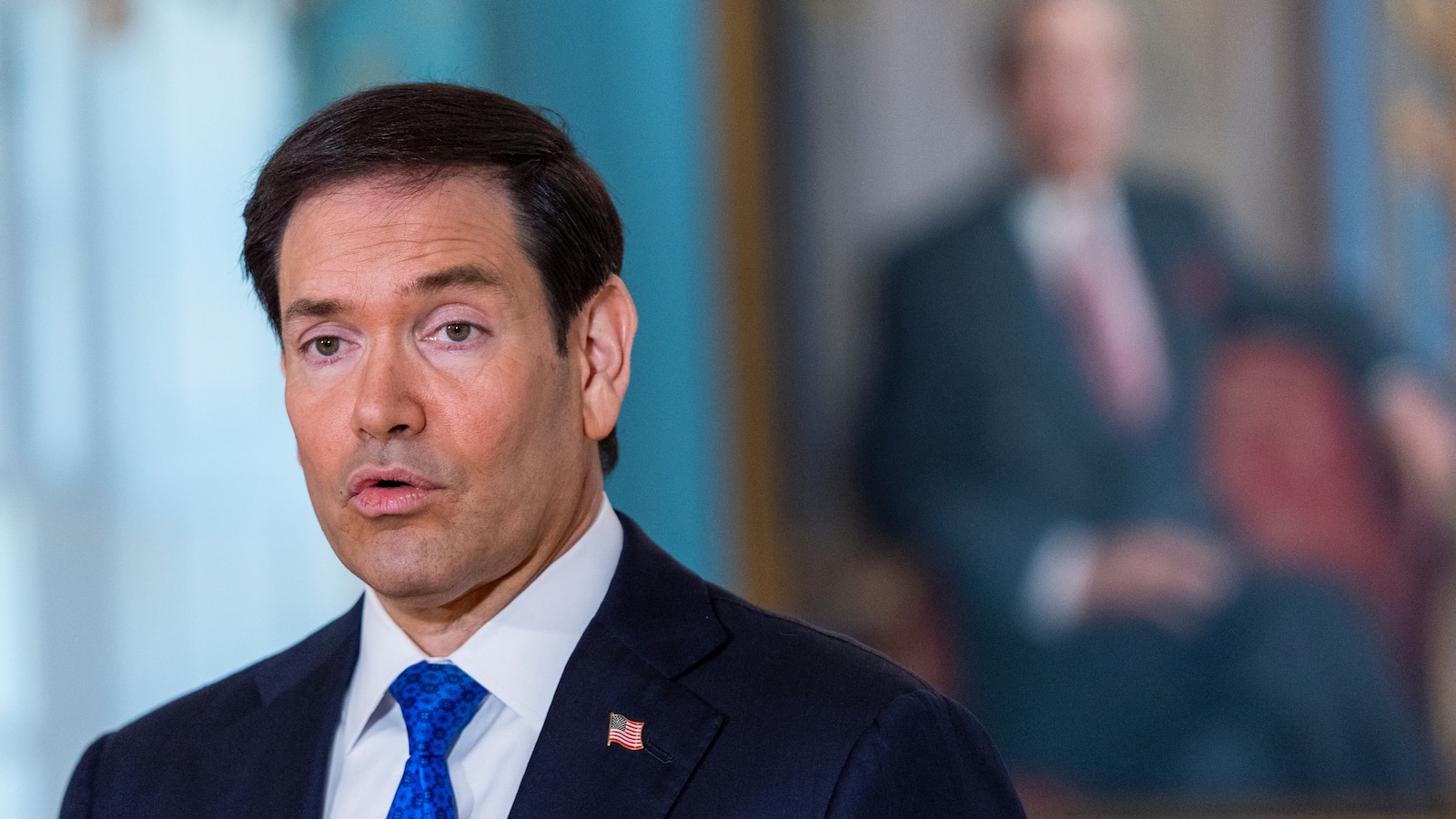
WASHINGTON -- For the 31st time as secretary of state, Marco Rubio has left on a trip abroad, flying to Uzbekistan and later India amid rumblings that America's top diplomat is ignoring pressing matters in favor of politically safer visits and meetings.This tour is intended to promote U.S. economic and security ties with Central and South Asia. But it has only tangential links to the Trump administration’s current main foreign policy dilemmas in the Middle East and with the Russia-Ukraine war.Rubio has been unapologetic about his role as both President Donald Trump’s chief diplomat and national security adviser and has brushed aside suggestions that he is eschewing the most difficult issues in favor of taking on lower-hanging diplomatic fruit with less risk of failure and political damage.“It's an important relationship,” Rubio told reporters Saturday before departing Washington, noting that he selected a time when the Central Asian leaders would be able to meet. “One of the things that suffers is the strategic visits — you’re always visiting someplace where there’s a crisis or there’s a problem, or you’re going because there’s a conference, but there’s countries you'd like to get to because we want to build our relationships with them.”The State Department pushed back on any criticism of Rubio's schedule. It says Rubio's “responsibility is not to generate a public profile around every challenge; it is to help the president develop and execute a strategy that advances American interests. Some of the most consequential diplomatic work takes place outside the public spotlight.”In both roles, Rubio must also "look at these challenges as part of a larger strategic picture,” the department said in a lengthy emailed reply to queries from The Associated Press. “The Iran, Gaza, and the Russia-Ukraine conflicts each demand serious attention, but they cannot be approached in isolation from the president’s broader national security objectives. The right question is not whether the secretary is visible enough on a particular issue.” Rubio is involved in behind-the-scenes discussions on Iran, Lebanon, Gaza, Russia-Ukraine and China, although he has not been the public face of any of them. The Republican president's special envoys such as Steve Witkoff, Jared Kushner and Tom Barrack have taken the lead on those matters.The State Department says there is nothing unusual about this and maintains that Rubio “hasn’t shied away from any issue.”"He’s directly involved and serves as a trusted and capable adviser to the president on what matters most,” the department said. “While he has multiple jobs, he isn’t the White House press secretary and his job isn’t to be in the press 24/7.”Rubio has concentrated on Latin America, particularly Venezuela and Cuba, bolstering ties with a new generation of Trump-friendly conservative leaders and shoring up relations with NATO allies nervous about the administration’s intentions toward Europe, especially in the Arctic.Delegating onerous and particularly time-consuming challenges is not new for secretaries of state. When Hillary Clinton was in office during Democratic President Barack Obama’s first term, she appointed former Sen. George Mitchell, D-Maine, to handle the Israeli-Palestinian file and veteran diplomat Richard Holbrooke to steer the Afghanistan-Pakistan portfolio.Both Clinton and Rubio had made runs for their parties’ respective presidential nominations before becoming secretary of state, and both had and have clear political ambitions for their post-diplomatic careers. Rubio, however, bristles at any discussion of his political intentions. He has refused to discuss speculation about the subject or on the more delicate topic of a rivalry with Vice President JD Vance over who might succeed Trump at the helm of the “Make America Great Again” movement.Popular ReadsRubio’s most recent foreign travels have avoided the world’s main hot spots, although they have focused on areas in which the administration has shown particular interest. Rubio’s aides are quick to point out that the secretary plays a key role in interagency discussions on all national security matters and has been a major behind-the-scenes actor in most, if not all, discussions on the administration’s diplomatic strategy.Since the beginning of this month and before his current travels to Uzbekistan and India, Rubio went to Iceland, Greece and Portugal. Before that, he visited Colombia, Ecuador and Peru.Rubio's schedule "is driven by the president’s foreign policy and national security priorities, not by a desire to focus on some regions at the expense of others,” the State Department said. “Every trip, meeting, and diplomatic engagement has to serve a purpose within that broader strategy. Sometimes that means addressing an immediate crisis; other times, it means building relationships, advancing economic and security partnerships, or addressing emerging challenges before they become more difficult to manage.”Still, some former senior U.S. diplomats have found fault with his travel agenda.“None (of these places) is where American foreign policy is being made,” said Ivo Daalder, U.S. ambassador to NATO under Obama. “The trip fits a pattern. Twenty months into the job, Rubio has largely avoided the capitals, the crises, and the negotiations that define the office.”In a lengthy critique, Daalder wrote that Rubio, as both secretary of state and national security adviser, either has too much on his plate or “has calculated that his future is best served by keeping clear of policies likely to end badly. Iran, Gaza, Ukraine, and China are all candidates.”On negotiations over big topics such as the Middle East, Russia and Ukraine, and China “the Secretary of State is not in the room where they happen,” he said. “For allies, the message of Reykjavik, Athens, and Lisbon is clear. The secretary will come to see you when you are not the problem. When you are, call someone else.”Rubio and his staff take umbrage at such assessments.Rubio’s No. 2, Deputy Secretary of State Christopher Landau, fired back at Daalder, saying it was typical of the turgid thinking of the foreign policy establishment — the one that he, Rubio and Trump are trying to remake.“In this view, a U.S. secretary of state is only ‘supposed’ to travel to NATO capitals because a successful U.S. foreign policy is what makes diplomatic counterparts in Paris, Berlin, and Brussels raise a champagne toast to ‘shared values’ while flinging open their borders, destroying their economies and apologizing for Western civilization,” Landau wrote, denouncing the suggestion that Latin America is not worth the secretary’s time.“This smug approach led not only to predictably catastrophic results in the Western Hemisphere but also in Europe itself, where the combination of moral vanity and strategic incoherence also proved toxic,” Landau said. “But sure: keep holding your academic seminars, writing your unread articles, awarding each other meaningless prizes, and looking down your noses at Donald Trump and Marco Rubio.”
Rubio heads to Central Asia as some wonder if he's keeping the most pressing matters at a distance
Full Article
Original Source
Read the full article at Abcnews →KhanList aggregates and links to publicly available news content. We do not host full articles from third-party sources. Always verify important information with original sources.