
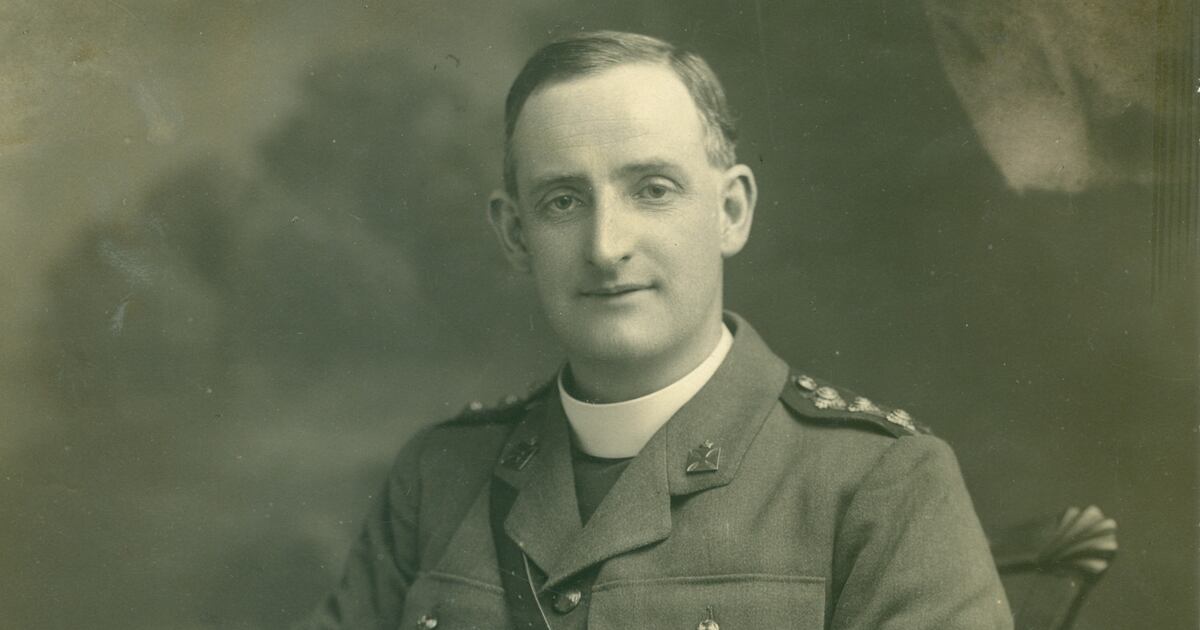
Irish Jesuit priest Fr Willie Doyle died on August 16th, 1917 during the Battle of Paschendaele in Belgium. It was a catastrophic day for the two Irish divisions, the 16th (Irish) Division and the 36th (Ulster) Division assaulting highly fortified German positions on Frezenberg Ridge. About 1,200 men perished that day in a doomed attempt to take the ridge in the mud and rain. Doyle went to the assistance of two officers who were dying – Second Lieutenant Arthur Green from Co Down and Second Lieutenant Charles Marlow, a former captain of the cricket team at King’s Hospital School in Dublin. According to one account, Doyle was anointing one of the men when a shell burst among them. It also killed Pte John Meehan, a winner of the Military Medal, who had taken shelter there. Their bodies were never recovered from the battlefield. READ MOREDeath was not the end of Doyle’s story. In the 1920s, a former Jesuit priest and polymath, Prof Alfred O’Rahilly, published a bestselling biography of Doyle, who came from Dalkey in south Dublin, which was translated into several languages.Readers were told of his intense spirituality, his life of prayer and penance, and his selflessness in the service of others. Thousands testified to his intercession in some aspect of their lives. Many wanted him canonised, but the Jesuits demurred and in the 1930s nothing came of it.The Catholic Church, it is famously said, only moves in centuries. The cause for his canonisation was revived 10 years ago by the Father Willie Doyle Association, founded by Dr Patrick Kenny. [ Irish priest moves closer to sainthood after being declared venerable by Pope LeoOpens in new window ]Doyle’s journey to sainthood moves into another phase with solemn vespers at Mullingar Cathedral on Sunday, which marks the end of the diocesan stage of the process. A memorial stone which includes a blue plaque to Fr Willie Doyle is located on Frezenberg Ridge outside Ieper (also called Ypres) in Belgium. Doyle died here on August 16th, 1917 The cause was opened in 2022 and the Diocese of Meath’s tribunal, which has been tasked with assembling the case for his canonisation, has collected an extraordinary array of material amounting to 11 volumes, or about 4,000 pages in total. The testimony comes from Doyle’s own voluminous writings, theologians and historians. There is also the testimony from those who had a devotion to him both when the original case was opened in the 1920s and later. The internet has made the process of gathering material much easier. “It is extraordinary how extensive the interest and devotion is worldwide,” said Fr John Hogan, the diocesan postural of Doyle’s cause. [ The Great War: ‘The heroic dead of Ireland have every right to the homage of the living’Opens in new window ]Rome will receive two copies of the material. The first will go to the Dicastery of Saints, the second to the Roman postural who will write the positio, the formal document examining Doyle’s life, virtues and reputation for holiness. If the panel of theologians is satisfied that Doyle fulfilled a life of heroic virtue, it will be brought to the Pope for decision. If the Pope approves, Doyle will be made venerable. There are two further steps to sainthood, both requiring a miracle. Doyle will need one miracle to become blessed and a second to become a saint. “Let’s just say that we have some serious favours that are under consideration,” said Hogan of the process of gathering miracles in support of Doyle’s canonisation. It took just 12 years from the opening of the case of Carlo Acutis, the so-called millennial saint, until his canonisation last year. Nearly 5,000 Irishmen died at the Battle of Passchendaele. Among them were 1,200 men who were killed on one terrible day in August 1917. Video Enda O’Dowd/Ronan McGreevy Hogan believes Doyle would make an ideal saint for the modern world. He spent much time in prayer and repentance atoning for the sins of priests. As an Irish Catholic in a British army uniform, he could also serve as a symbol of reconciliation. [ From the archive: An Irishwoman’s Diary on a strange meeting near Ypres in 1915Opens in new window ]His death was mourned by many of those in the 36th (Ulster) Division, with one Orangeman writing in the Glasgow Weekly News: “We couldn’t possibly agree with his religious opinion, but we simply worshipped him for other things. He didn’t know the meaning of fear, and he didn’t know what bigotry was.”
Rome to consider sainthood for Irish Jesuit priest killed in bloody first World War battle
Full Article
Original Source
Read the full article at Irishtimes →KhanList aggregates and links to publicly available news content. We do not host full articles from third-party sources. Always verify important information with original sources.