
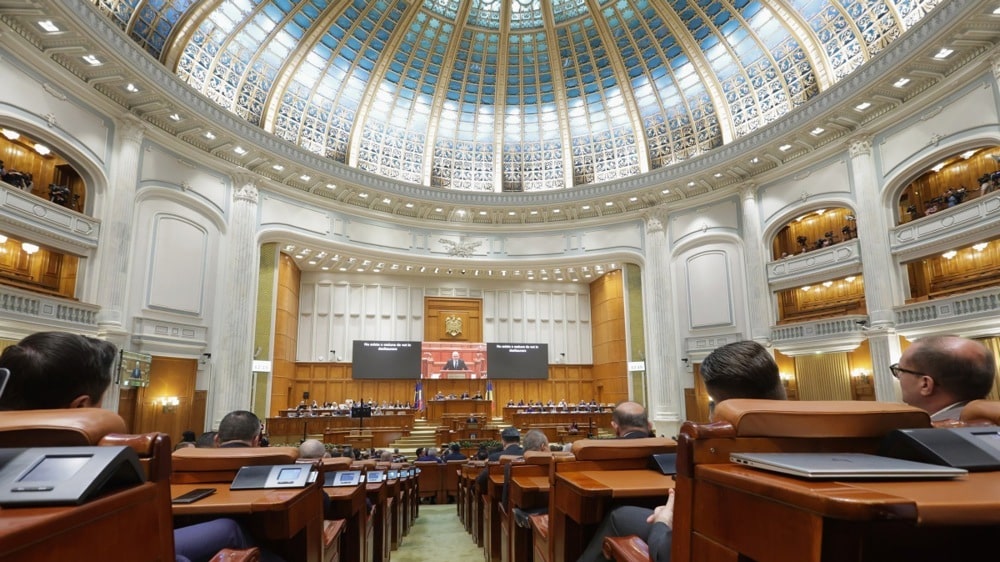
A plenary session of the parliament in Bucharest, Romania, 05 May 2026. Photo: EPA/Robert Ghement. Romania’s parliament on Wednesday overwhelmingly approved a new integrity law intended to strengthen sanctions for abuses by public officials, in order to allow the country access to a 770-million-euro EU-funded National Recovery and Resilience Plan (PNRR). The legislation was also supported by the centre-right National Liberal Party (PNL), which is part of the interim government led by Prime Minister Ilie Bolojan, alongside two smaller centrist parties. “Although we initially opposed the law in its current form, we decided to vote in favour because the country’s interest in meeting the PNRR milestones takes precedence over any other debate,” Bolojan said. He added that the PNL would seek to amend the law in the near future. The law revises Romania’s rules on public officials’ asset and interest declarations, and strengthens the penalties if discrepancies or conflict of interest are determined. It also replaces detailed public wealth declarations with financial-interest forms that disclose less information about officials’ assets and holdings. But it has sparked controversy after the Social Democratic Party (PSD), with support from the far-right Alliance for Unity of Romanians (AUR), introduced a provision stipulating that officials who have been found responsible in conflict-of-interest cases and whose three-year sanction period barring them from public office temporarily has not yet expired, would have their mandates terminated within 30 days of the law entering into force. The amendment has been criticised as being specifically aimed at Dominic Fritz, the mayor of the western city of Timisoara and president of the centrist Save Romania Union (USR), part of the interim government. Fritz, a German national who was first elected mayor in 2020, was found to have been involved in an administrative conflict of interest related to an urban planning document he approved that year. Critics, including USR and PNL members as well as civil society representatives, have argued that the amendment could violate the principle of non-retroactivity and amount to the use of the law against political opponents. The criticism has also been echoed at European level. The centre-right European People’s Party and liberal Renew Europe in the European Parliament groups on Monday asked European Commission President Ursula von der Leyen to withhold the 770 million euros from Romania, citing concerns over the rule of law. The integrity law is part of a broader package of reforms Romania has committed to adopt by the end of August in order to unlock further EU funding under PNRR. European funds are vital to Romania’s strained budget, supporting healthcare, education and infrastructure projects. EU funding is equivalent to around a third of the country’s GDP. The present political crisis stems from Romania’s prolonged political instability. Last June, a coalition comprising the PSD, PNL and two smaller centre-right parties took office, with a primary mandate to stabilise the economy. However, a series of unpopular austerity measures introduced by Ilie Bolojan to curb the deficit placed increasing strain on the coalition. Tensions came to a head in May , when the PSD withdrew its support, deepening the political turmoil. The PSD subsequently allied with the far-right AUR to oust the government. Since then, Bolojan has been in a caretaker position, after two nominations for premier made by President Nicusor Dan were rejected by the main political parties.
Romania Passes Controversial Law on Officials’ Integrity to Access EU Funds
Full Article
Original Source
Read the full article at Balkaninsight →KhanList aggregates and links to publicly available news content. We do not host full articles from third-party sources. Always verify important information with original sources.