
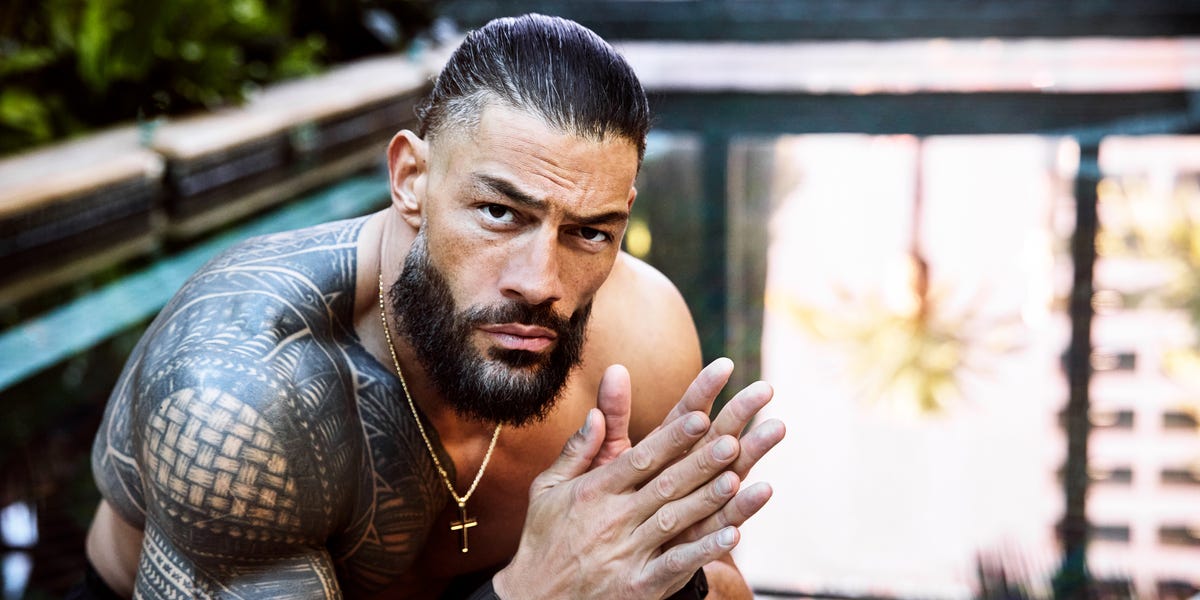
8 min readThis article was featured in MH Flex, our monthly newsletter recommending the one in-depth interview you need to flex your pop culture knowledge. Sign up here to get it first.OVER THE LAST decade, Roman Reigns has established himself as one of WWE’s most iconic superstars. The reigning WWE heavyweight champ stands at 6′3″, weighs in at a chiseled 261 pounds, and generally looks like an IRL superhero—with a comic-style signature finishing move (the Superman punch) in the ring, too.So jacked is Reigns that he says he didn’t even focus on packing on any more muscle for his role as fiery martial artist Akuma in October’s blockbuster film Street Fighter, a colorful, kinetic thrill ride based on the beloved Capcom video game franchise of the same name. And that film, which includes a massive cast of badasses (think: 50 Cent, Jason Momoa, and fellow WWE star Cody Rhodes), might help springboard Reigns to an even bigger career in Hollywood.Yet every so often, when Reigns (real name: Joe Anoi’a) looks in the mirror, he’s just like the rest of us. He notices that his abs aren’t quite as defined as he wants, or that his chest lacks a little pop, or that something’s just a bit off. And yes, it affects him. “We’ve all got a little bit of body dysmorphia, right?” Reigns says. “We’re all fighting this little, you know, critic in our head. I’m in an aesthetic business, and this is what I signed up for, so there’s nobody to blame. But it’s not always perfect.”Not that you’d notice even tiny flaws in Reigns’s physique when you watch WWE Raw and SmackDown, shows in which he regularly appears. Before our interview, he trains at the Las Vegas Raiders’ practice facility in Henderson, starting with mobility drills and finishing with high-rep sets of classic exercises like dumbbell bench presses and biceps curls. At age 41, he doesn’t always lift massive weights (on this day, he doesn’t pick up anything heavier than 70-pound dumbbells), and he doesn’t do the explosive Olympic lifts he did two decades ago, when he was a defensive lineman at Georgia Tech. But that hasn’t stopped him from maintaining his boulder shoulders and chiseled abs (with plenty of raw explosive athleticism still on tap, too).Michael Scott SlosarBut while he makes it look easy, Reigns still has to put in serious work to maintain his physique—and he’s constantly battling his own mental cross talk. The diet portion of things is especially hard, he says, in part because he says he can easily gain weight. “You put a doughnut right there, and I’ll start accumulating water on me. For some reason, I could just look at it and get chubby,” he says. “I come from a big family. We’re big-boned people. We’re watery bros, you know?”He battles to stay strict. “When I’m locked in and I’m dialed, that’s everything,” he says. “If I get out of that, I can be the opposite, where I don’t want to work out and I want to eat the worst stuff. I want to order the food in. Is it 5:00 somewhere? Because I’d like to have a beer, too. It’s one of those things that I have to be very careful about, and I have to constantly remind myself of what we’re doing, what our goals are, and what we’re trying to achieve.”Reigns has never lost sight of those goals, and with Street Fighter due out soon, he just may be poised to leap from superstar to megastar. Could he follow in the footsteps of Dwayne Johnson, Dave Bautista, and John Cena and jump from wrestling ring to film star? In an interview with Men’s Health, he discussed that prospect, as well as the body-image challenges most guys have, and his most in-depth training protocols.Courtesy of Paramount Pictures aIn the upcoming Street Fighter feature film, Reigns plays Akuma, one of the franchise’s most powerful characters.MEN’S HEALTH: You trained like a football player when you starred at Georgia Tech. You’ve trained for the WWE for years. And then you had to learn new training to play Akuma in Street Fighter. Which was the toughest? ROMAN REIGNS: I would have to say the football training was the hardest and the most intense, but I was also my youngest. As I’ve gotten older, training for wrestling in the WWE, it’s not easy at all. But with wisdom you get a little smarter. You learn how to handle things and adjust things.I would definitely say I was much stronger [at Georgia Tech], because I was a bigger human and a younger human at the time. But when you couple the lifting and the conditioning of football, it’s pretty wild.MH: What were the challenges of training to play Akuma?RR: I got lucky because Akuma…his physique is kind of bodybuilderesque. He’s a big brother, so he’s very muscular. That helped me out, to kind of stay in my regimen. But when you add in the martial arts, the fighting disciplines…you have to be able to have your legs in a sumo squat, but then you can pop up on your toes and also hit a unique pose with your arms.There’s so much isometric work in that. There’s so much to that body control, almost like a ballerina type of work. And the footwork was pretty extensive.Michael Scott SlosarMH: Are there any Street Fighter exercises or training principles you still use now? RR: There were a lot of parallels for me to be able to transition. I mean, they’re obviously different things you’re asked to perform, within wrestling and within martial arts. But the physical disciplines are a bit adjacent to each other, where it wasn’t as big of a gap for me to figure out.The fact I’m in professional wrestling helped, but [martial arts] is still its own rite. It really makes you go back and look at all of the great martial artists: Jason Statham, Chuck Norris…all these guys who were able to do all these stunts and movies and and have it be so good.MH: Did training for Street Fighter, with all those poses, make you think about training for longevity differently? It’s not all big muscles, right? RR: The crossover is huge, because we want to look like we can save the world. There’s that fine balance, where you want to look that part. But if that movement, that physicality, that athleticism is not there, it will take people out. [The audience] won’t be able to get lost. There will be no escapism.That’s the most important thing about being well-rounded. You can see when guys have a super strength over here, but then there’s a deficit here. But then they’re good here, but they don’t have all the tools sharpened. It’s important to have both those tools.Mike Zarrilli/GettyReigns—then known as Joe Anoa’i—playing for Georgia Tech in November 2006.WWE/WWE via GettyReigns taking on Big E at the Barclays Center in November 2021.MH: When you started in WWE, Dwayne Johnson and John Cena were the faces of wrestling. Is there anything you’ve learned from them about shifting from ring to screen?RR: Even in their leaned-out stages, they’re still just superhero guys. We all get to a place where we have to adjust. We’ve got to evolve. And we have to change. I hope I can get to a place in my career, like they did, where that’s going to be the next step for me.MH: What have you learned from the way both of them remade their bodies for Hollywood. Both John and Dwayne have lost weight in recent years. RR: [For John], there was a bit of a shift for him where I think he moved into mobility a lot more, and pliability, where he started really stretching. I think it was when he went to China. He spent a good bit of time over there, and I think that’s when he started to change his philosophies on a few things. But John is one of those guys who’s just freakishly strong.Dwayne is huge. People don’t really understand how big DJ is. Even in his leaned-out state, he’s still a big man. I would say me and Dwayne have a little closer mindset on what we like to do in the gym. We’re chasing that pump. We’re trying to create hypertrophy.MH: One thing I noticed in your own workouts: You don’t lift heavy all the time. How do you choose when to go hard and when to pull back? RR: You have to listen to your body if you’re committed to this, and this is an annual thing. Your body is going to send signals when you’re not feeling good.My elbows were really beat up [last] December. So, my training struggled that whole time, and I was coming out of a non-diet phase 2 out of the holidays, so I just couldn’t get to that intensity and locked-in focus. I was just hurting. It’s just one of those things where you have to be intuitive.MH: Do you wear a fitness tracker? For many people, that helps them understand when to pull back and when to go hard.RR: I wouldn’t put all my weight on the actual data or metrics, but it’s gauging day-to-day the consistency of what these numbers are. That’s a way to use them. The main thing I really like to use those for is my sleep.I have a crazy-low pulse. My resting pulse is under 40 [beats per minute]. And sometimes I can get it all the way down to, like, 35, So if I’m over 60, I know something’s going on. But I wouldn’t ride or die on these metrics. I’m the captain.MH: Do you wear a tracker in the ring? RR: For a few of them, I have. I wear a glove, so it does kind of protect it, but still, that thing gets smacked. I abuse this thing, Whoop. It must have good engineering, because I beat this thing up.[My heart rate] is always lower than I expected. Then a crazy brawl breaks out, and it’s like a sprint. I’ve learned over the years how to manage that whole process in the 30 to 40 minutes where I’m out there. I’ve learned how to ride that roller coaster where I can keep my stress levels down the whole time.Michael Scott SlosarMH: You’re 41 right now. Do you ever chase the physique you had when you were in your 30s?RR: I think I’m in my prime physically. I look at my stomach or whatever it may be, that’s a part of that body dysmorphia we’re all struggling with. And it’s one of those deals that I think if you just keep working on it…it’s not done until it’s done.MH: What do you tell yourself on those days you look in the mirror and find flaws in your physique? RR: It’s a marathon. It’s not over. Even if your goal is tomorrow, just extend it. Just keep going. If my look isn’t perfect on Sunday, then I should probably just keep trying to make it a little better. Keep working at it.This interview has been edited for length and clarity.Ebenezer Samuel, C.S.C.S., is the fitness director of Men's Health and a certified trainer with more than 10 years of training experience. He's logged training time with NFL athletes and track athletes and his current training regimen includes weight training, HIIT conditioning, and yoga. Before joining Men's Health, he served as a sports columnist and tech columnist for the New York Daily News.
Roman Reigns Is Ready for His Close-Up
Full Article
Original Source
Read the full article at Menshealth →KhanList aggregates and links to publicly available news content. We do not host full articles from third-party sources. Always verify important information with original sources.