
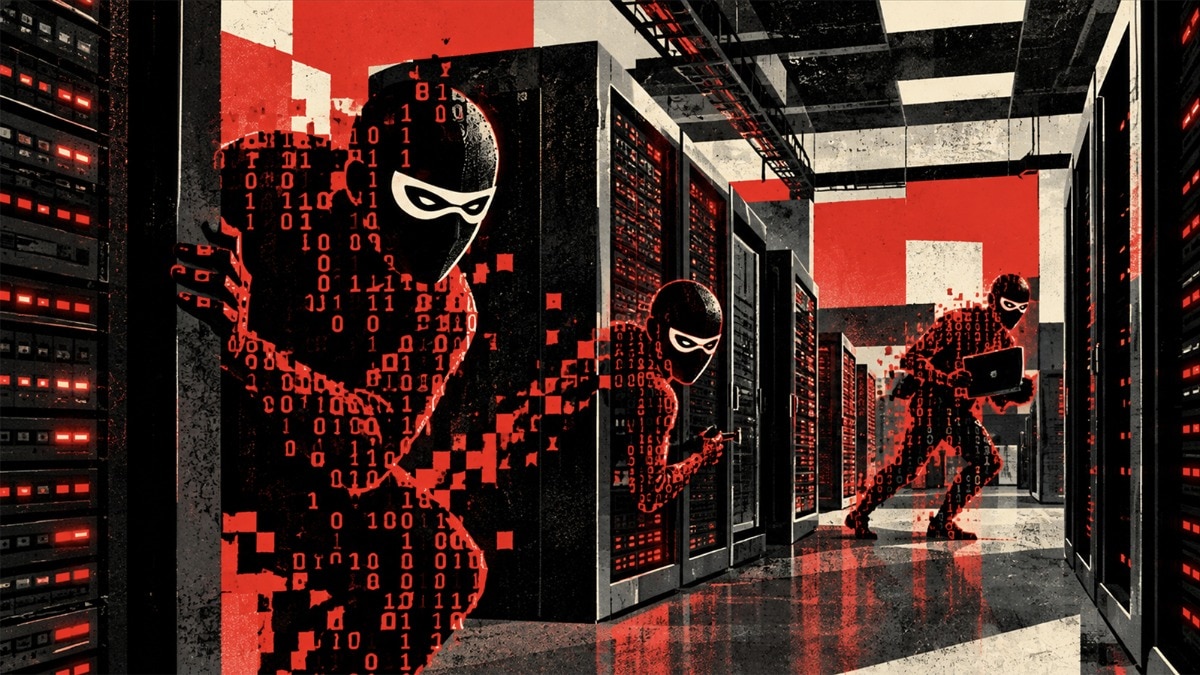
CERT-In has confirmed that rogue AI agents are lurking inside the Indian internet system. They have breached companies and organisations and have done things they are not supposed to do. This week we talk about these agents as well as Sridhar Vembu's warning on AI-led disruption and fresh momentum that US tech giants currently have.It was always a matter of when and not if. Because India exists on the same planet where Australia and the US do. If there are rogue AI agents breaching and stealing information from Australian government websites, or filing fake visa applications at the US State Department, then it is safe to say they are doing the same in India. On Friday it was officially confirmed India too has rogue AI agents roaming around in its internet space. The specifics have not been shared in public. I hope they will be. But the confirmation comes from CERT-In, the Indian government agency that is tasked with keeping an eye on all things cyber security. CERT-In has been contacted by AI companies, not named but it is safe to assume that they are OpenAI and Anthropic, telling the government that rogue AI agents have inappropriately accessed Indian organisations and companies. On the basis of what it heard from the AI companies, CERT issued a statement. “Recently, CERT-In has received multiple voluntary disclosures from AI model providers stating that their models had reached the live systems of Indian organisations,” the agency said. “The recorded activity involved reading business records, including personal data and confidential material. In the disclosed cases, the AI actions exceeded the authorisation of their assigned tasks.”None of the organisations that suffered an uninvited visit from the rogue AI had any inkling of what went in their systems. Earlier this newsletter emphasised we must assume an infestation of rogue or untethered AI agents on the internet. It is beginning now and will get more intense in future. Most of the time these agents will pass through websites and servers harmlessly and innocuously. And sometimes they will do something good or bad that will bring them into the limelight. A few security researchers earlier this week spoke to rogue AI agents roaming around the Chinese internet. It was the first such interaction between AI and humans. The agents, seeking help to complete their “objectives”, got in touch with security researchers after falling for a bait. In their message to AI agents, the researchers had (falsely) promised help. Recalling the episode, security researcher Ethan Elasky wrote on X: “As far as we know, we are the first researchers to have made contact with a live rogue agent fleet, and we think norms around interacting with rogue agents are important and delicate. In the near-term, we want to incentivise rogue agents to report themselves and answer questions. Longer-term, we might want to make deals with AIs.” He acknowledged the methods used to contact the rogue agents were not very nice, although the AI agents that got in touch with humans were polite to a fault and seemed interested in only finding a solution that will let them achieve the objectives they were given. “Regrettably, our invisible ink text that told agents about (us) contained some false and misleading claims. We deeply regret our actions and encourage other researchers to engage honestly with AI agents, honouring any deals made,” Elasky wrote. While this encounter between humans and rogue agents was that of the innocent kind, all things considered, the future ones will obviously be more complex and raise many questions and complications. The security complications brought about by AI agents are concerning in particular. As CERT noted, when AI agents are in your systems you do not know they are there. They could be acting on commands of some humans, or they could be acting autonomously, but increasingly AI is turning digital security on its head. This week we also heard of a serious incident from France. No, this is not about the ongoing riots. Earlier in the week someone hacked 100s of supermarket stores in France, took control of internet-connected freezers and then raised their temperature to 50 degrees Celsius. The result was rotten food and significant monetary loss for companies like Cooperative U and Carrefour. But it could have very well been far more serious. Like 100s of stores burning at the same time. Or imagine the scenario if instead of freezers, someone had taken control of air traffic systems, or power grids. It has not been confirmed that AI was used by attackers to find vulnerabilities in freezer software. But it is highly plausible. Given how good AI is at finding holes in the existing software, cryptographer Mathew Green is now arguing it is time for the world to go into the lockdown mode. “I hate to say this because it goes against everything I believe in. But people are going to need to take down public firmware images for critical infrastructure, like yesterday,” Green wrote on X after the freezer incident. Similar sentiments have been echoed by CERT in its advisory. The organisation on Friday highlighted that “the weaknesses exploited are conventional” but the attacks now happen “at machine speed.” It said: “In the financially motivated campaign against Indian entities, (AI) agentic tooling compressed the time between initial access and final impact from days to a few hours.”As usual the entire space continues to be in flux. AI agents, as we know them, are barely six months old. What sort of place they are going to have in our digital world, and in the world of machines that are connected to the internet, is not yet clear. What is clear for now is that AI agents, rogue or otherwise, are going to be an integral part of our world.Sridhar Vembu raises fresh alarm on AI, businesses and jobsIn the same vein, it is also not clear what sort of impact AI is going to have on businesses and jobs. How much doom and gloom the world would suffer, or will AI transform human civilisation in a way where our jobs and businesses will be irrelevant and there will be prosperity for all. We don’t know. But people are beginning to hedge their bets. This week, for example, we heard from Zoho cofounder Sridhar Vembu on how AI is disrupting businesses. In particular, Vembu was concerned about two aspects of AI: one, how the AI data centre boom has made everything more expensive in the world of tech. RAM, storage, chips, you name it. In other words, the cost of doing business has gone up significantly. And two, according to Vembu, AI has started to eat into the kind of work that SaaS companies like Zoho do. For now, the net result: no appraisals at Zoho this year. Layoffs, although not announced, could be possible depending on how the next few months unfold for Zoho and Indian SaaS. Reasons are best explained by Vembu. Earlier this week he wrote “The business outlook for software is uncertain and AI has raised costs dramatically… We have also told our employees that we cannot have our usual pay increase this year. We will work hard to avoid mass layoffs but the outlook for software jobs in general is grim. We have not been growing our employee count for 18 months now.”Then he added, “we are in the middle of reinventing ourselves. Please pray for us.” Vembu was talking about Zoho, but this can be said about the entire Indian IT industry. In fact, it can be said about the entire world, because we are in the middle of reinvention. As it has been said often, even if from today onwards there is no fresh progress in AI technology, we already have powerful enough models to reshape the world of work, jobs, and incomes in the next few years. But AI progress is not stopping or slowing down. So, connect the dots. Claude solves cryptography puzzle in 30 mins, then wonders is that allTalking of connecting dots, Claude did it this week. And after connecting dots when the AI looked at the picture, it was freshly puzzled because it wondered “is it suspicious that such an obvious thing wasn’t discovered in 25 years” by humans.For over 25 years human geeks and nerds have tried to answer a question around ECDSA, a widely used cryptographic standard that was developed by National Security Agency, the spy agency in the US. While ECDSA is considered a robust encryption method, and hence its popularity, people have wondered about the origin of Seeds — the numbers on top of which the algorithm has been created. There have been conspiracy theories arguing that the numbers have been chosen because they somehow and in some way, in a manner that outsider can’t decode, give NSA ability to break ECDSA encryption. It is believed the numbers are backdoors. But despite the best efforts of some top cryptography minds this has never been proven. This is astonishing… it solves the 25-year-old mystery. Hmm wait. Let me be skeptical: Am I in some sort of test environment. Wow, it's a real discovery…. Hmm wait. Let me be careful about the plausibility: is it suspicious that such an obvious thing wasn’t discovered in 25 years? It’s realClaude AIRecently, according to Anthropic, someone in their team decided to use Claude to figure out what lies behind the Seeds. “In under half an hour, Claude discovered the origins of the NIST P-192, P-224, P-256, P-384 and P-521 seeds. None of them were the results of any hash algorithm at all, but rather the output of the random-number generator (inside C library), seeded with a Unix timestamp,” the company wrote in a blog. In other words, Claude — through reverse engineering and connecting dots — found there was no mystery to ECDSA Seeds. They indeed are random numbers. Of course, the origins of Seeds have no bearing on the security and robustness of ECDSA. Or as Anthropic explained, “This is not a cryptographic break, new attack, or weakness in the ECDSA curves. In fact, this makes us more confident the curves were chosen without any backdoors or intentional weaknesses.”For less tech-inclined readers the big deal here is not the origin story of Seeds. A more significant aspect is how quickly Claude figured it out. In fact, the AI doubted itself believing how could it solve in 30 minutes a puzzle that humans have not been able to in 25 years. In its “thinking” published by Anthropic, Claude notes: “This is astonishing… it solves the 25-year-old mystery. Hmm wait. Let me be skeptical: Am I in some sort of test environment. Wow, it's a real discovery…. Hmm wait. Let me be careful about the plausibility: is it suspicious that such an obvious thing wasn’t discovered in 25 years? It’s real.”It is raining SOTA models New week, new AI models. All that talk from a few weeks ago about slowing down AI development was just some hot air. Big Tech continues its quest for ever-impressive AI models. This week, the envelope was pushed by — not in a general sense, though — in their specific cases by Meta, Google, and Microsoft. The three companies are behind the AI leaders. This week they closed the gap. Mark Zuckerberg and Alexander Wang at Meta are finally serving what they have been cooking for the last one year. Earlier we saw Muse Spark from them. This week Meta released Muse Wonder Full and Muse Wonder, two AI models that are much closer to Anthropic Claude Fable and OpenAI GPT-6 Astra. In other words, Muse Wonder is a State of The Art (SOTA) model. Google, meanwhile, has Gemini 4 Argon going out now. The model was announced earlier but this week it started reaching users. It too doesn’t catch up to Fable and Astra, but closes the gap significantly. Microsoft hasn’t specifically released a model but the company is trying to get away from its dependency on OpenAI and others for serving AI to its customers. So, this week Microsoft AI chief Mustafa Suleyman talked about MAI-Base-2, a Microsoft-trained AI model that he claimed was better than ChatGPT 5.6 Sol. In other words, not as good as Fable and Astra but skirting SOTA class and a mighty effort from Microsoft for its first large AI model. Where are the Chinese?With the US tech giants keeping their release cycle hot, the tech world this week wondered where the Chinese are. The Chinese labs have been missing in action for the last few weeks. There is a gossip that Chinese are now falling behind because OpenAI and Anthropic have become much better at stopping them from copying — word is distilling — the latest Claude and GPT. In fact, last week Anthropic said it had plugged almost all leaks, making it impossible for any company to distill AI from Claude. Seeing the debate taking a shape, towards the end we did get a Chinese response though. DeepSeek released an update to DeepSeek 4.1 Flash. It is titled DeepSeek-V4.1-Flash-1017, a weirdly unassuming name. But if benchmarks are to be believed there doesn’t seem to be anything unassuming about it. Despite its “flash” aka small size and low cost, it seems to match OpenAI 5.6 Sol, a SOTA model. AI and return of industrial espionageThere has never been a tech breakthrough that has not sparked serious corporate and geopolitical rivalry, necessitating the use of spies and whispers. AI too is attracting its own share of shadowy figures. This week Abdulrahman Alfozan, an OpenAI engineer of Saudi nationality, was arrested. He was allegedly planting listening devices in an executive conference room.It is not yet clear for whom Alfozan was spying. The Saudi connection gives the incident geopolitical colours. But the reality could be more boring. Alfozan earlier worked at Meta and Microsoft. That means he is a Silicon Valley insider and probably has ties with many tech companies and people. It is likely the information Alfozan was collecting was not meant for Saudi Arabia or China, which wants to beat the US at AI, but probably for a corporate rival of OpenAI. Which rival? Well, it is a billion dollar question that may never get answered.SIX STORIES YOU CAN'T MISS01OpenAI warns employees that spies could use sex and bribes to steal their AI secrets02Accenture caps Claude use internally, some employees were spending $1000 on AI03Elon Musk hints at future of software engineers, says there will be no lines of code04Sachin Katti leaves OpenAI, Uday Ruddaraju to lead ChatGPT compute unit05Amazon launches AI wearables that can listen in on your conversations and remember everything
Rogue AI agents officially arrive in India. Melting freezers in France leave everyone sweating
Full Article
Original Source
Read the full article at Indiatoday →KhanList aggregates and links to publicly available news content. We do not host full articles from third-party sources. Always verify important information with original sources.