
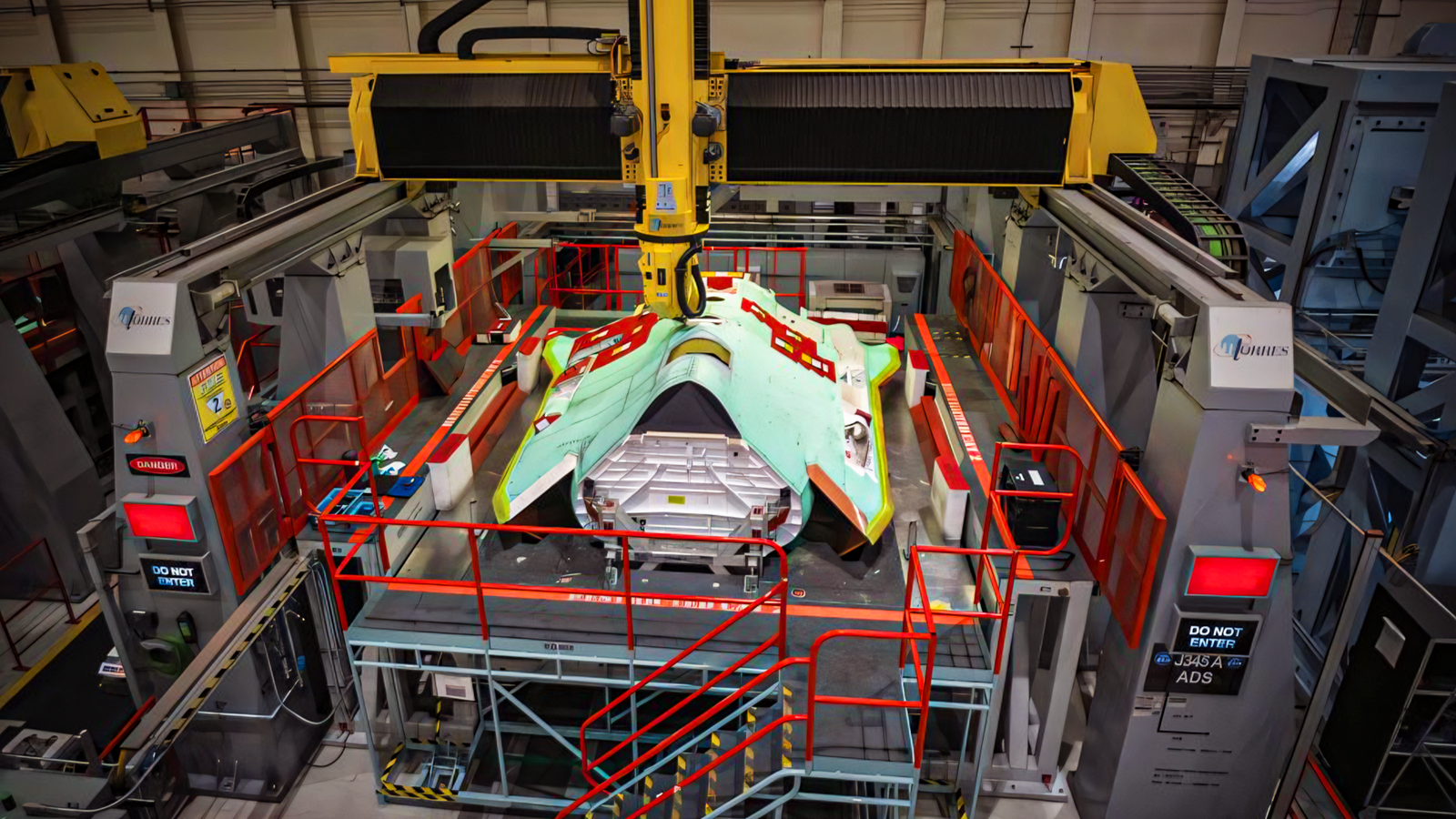
Published Oct 11, 2026, 6:00 PM EDT Luke Diaz is a freelance military writer with experience with active duty experience in the US Navy as well as defense and industrial engineering. He is a former Naval Flight Officer who performed tactical air control on the carrier-based E-2 Hawkeye. Northrop Grumman has helped bring massive process improvements to fellow American defense contractor prime Lockheed Martin at its flagship F-35 Lightning II assembly line. The roll-out of the 'co-bot' was announced on September 30. The new factory robot will take over tedious fastening work that previously consumed hours of labor performed by skilled technicians every day. Specifically, it has taken over the task of installing the bolts that secure the front housing of the Communications, Navigation, and Identification (CNI) module. That is the critical electronics bay that manages the stealth fighter’s radios, navigation arrays, and friend-or-foe tracking systems. Simultaneously, Northrop is expanding this factory automation alongside artificial intelligence inspection systems designed to scan finished components for microscopic flaws. Even as the reported time savings are massive, they apply exclusively to a single manufacturing step on an isolated subsystem. That still leaves the heavily delayed F-35 Joint Strike Fighter production line bottlenecked by software issues and supply chain disruptions that no assembly-line robot can solve. Tackling One Task To Make F-35s Faster Credit: Northrop Grumman A co-bot functions as a collaborative tooling device that supports technicians on the factory floor but it does not replace them. The automation is tailored to reducing a specific fastening sequence on the CNI assembly. The co-bot cuts the time down exponentially, but its main advantage is that it frees up the limited number of techs to focus on other critical tasks to get more planes out the door faster without sacrificing quality. Lavell Catlin, manufacturing manager for the CNI production line gave these remarks in the Northrop press release: “We recently installed a co-bot that assists technicians to precisely install bolts to attach the front housing area of the Communications, Navigation and Identification (CNI) module. This system cuts what used to take hours to complete, down to only a few minutes..." “Our AI-based integration of quality control systems has greatly helped identify even the smallest issue in completed modules to ensure we’re delivering top-quality products every time.” Northrop has not explicitly disclosed how much this robotic helper shortens the total end-to-end manufacturing timeline of a complete CNI module, and thereby a completed F-35. Furthermore, neither the US Air Force nor Lockheed has authorized any increase in overall F-35 production rates to accompany the introduction of co-bot. While the phrase "hours to minutes" implies a sweeping transformation, the true scope of impact is not yet quantifiable. What Is The Joint Strike Fighter's CNI Module? Credit: Northrop Grumman Lockheed is responsible for about 40% of the industrial efforts behind every F-35 that leaves USAF Plant Four in Fort Worth, Texas. The CNI module is the Navigational Suite of the F-35 that houses equipment for guidance, communication, and safety of flight. Northrop describes these modules as the most advanced integrated avionics architecture ever engineered. The CNI represents a massive leap forward from legacy aircraft avionics by consolidating more than 27 distinct functions into a single, highly integrated software-defined radio framework. It includes Northrop's AN/ASQ-242 system, which includes friend-or-foe transmitter and receivers, high-precision GPS and INS, along with radios and flight computers. The CNI is also where many parts of the JSF's Multifunction Advanced Data Link are contained, one of its most important combat systems. Jeannie Hilger, vice president and general manager, communications division, Northrop Grumman Information Systems, described the game-changing impact of the CNI in 2015 when the US Marine Corps' F-35B variant became operational: "The successful completion of IOC also validates Northrop Grumman's more than 10-year effort to advance communication among fifth-generation aircraft. In addition to fifth-to-fifth, Northrop Grumman's CNI system also provides a core capability for fifth-to-fourth generation networked data sharing and unparalleled interoperability." At its core, the CNI system manages UHF/VHF voice radios and the Joint Precision Approach and Landing System. The CNI eliminates the need for dozens of isolated avionics boxes, drastically cutting down on the aircraft's internal size, weight, and power demands. Instead of dedicated hardware for every single function, the system dynamically distributes tasks through its centralized processing units. The Palmdale Line That Set The Pattern Credit: US Air Force Northrop's Integrated Assembly Line, or IAL, spun up in late 2001 when the corporation became a major member of Lockheed's team developing the F-35. Meeting the demanding pace of the ambitious fighter program necessitated new automation techniques and cutting-edge robotics. To support the unprecedented scale of Lockheed's fifth-generation stealth fighter jet, Northrop looked to the US automotive industry. The aerospace titan partnered with KUKA Systems North America, a Detroit-based firm that specializes in integrating production lines for manufacturers. Scott Johnson, the integrated product team lead for the F-35 center fuselage, said the result blends automotive line practice with Northrop's aerospace tooling. It has replaced the standalone islands of the earlier process with a modern, automated flow. Manufacturing output at the Palmdale assembly line has scaled continuously, delivering more than 1,400 center fuselages by July 2025. Defence Industry Europe reported that the line ramped up to full-rate output in 2011. It is situated in a U-shaped building at Northrop's Aircraft Integration Center of Excellence. The line holds more than 115 build stations and 22 automated systems, built to complete an end-to-end sequence in an interval of 30 hours. The facility delivered its 1,500th unit on January 12, and the 1,600th airframe segment was just handed off recently as well. This high-rate production line processes roughly 10 million individual components annually using 3,000 specialized tools, churning out completed center fuselages for all three F-35 variants every 30 hours. Its integrated augmented and virtual reality systems have slashed baseline assembly timelines by 35% while accelerating technician training curves by 20%. The official metrics conflict with the ongoing shortfall of the F-35 program, which has seen jets delivered with major systems missing like primary radar arrays. That begs the question whether shaving hours off single component sub-assemblies provides any tangible benefit to the US and foreign military customers still waiting. Hundreds of mostly completed stealth fighters remain delayed on the line or grounded at depots due to missing parts and software glitches. TR-3 Software Delays And Fort Worth Assembly Rates Plant Four has maintained an impressive annual manufacturing pace of 156 stealth fighters per year, eclipsing all other fighters being built around the world today. Lockheed leadership has also confirmed to investors during summer financial calls that the assembly lines can hold this high-rate output for the foreseeable future. Yet, many deliveries have been by months and costs have continued to rise due to recurring technological deficiencies. Severe software instability and flight-certification delays for the Technology Refresh 3 (TR-3) upgrade forced Lockheed to park finished jets on the tarmac, causing delivery delays that averaged 238 days per aircraft. The show-stopping issue is vital to the sophisticated core processing and display upgrade package that the aircraft's broader Block 4 modernization depends on. These systemic TR-3 software maturation defects prompted a complete Pentagon delivery freeze that marooned more than 110 completed aircraft in long-term storage. While deliveries eventually resumed under a truncated agreement, every single jet delivered during that cycle arrived late by an average of 238 days. Furthermore, the overall Block 4 modernization initiative has surged at least $6 billion over budget. Because of these ongoing technical failures, the military has scaled back its near-term operational requirements, delaying full combat-ready Block 4 capabilities until 2031 at the earliest. Supply Chain Obsolescence And Factory Automation Limits Credit: Northrop Grumman Lockheed cleared its massive backlog of parked jets last year by cutting a deal with the military to install an incomplete, 'training-only' version of the TR-3 software. This allowed them to officially deliver a record number of 191 aircraft, but these jets are restricted to training units, they are not ready for actual combat. The deal was a result of the unprecedented shortage of AN/APG-85 Active Electronically Scanned Array radar. New F-35s were built ready to receive the AESA array but the mounts and software are incompatible with the older, readily available AN/APG-81 radars. Faced with a complete halt in production and massive backlogs, the US military made the highly controversial decision to begin accepting F-35 airframes without radars. Marine Corps spokesperson, Captain Jacob Sugg, gave this statement in March, as quoted by Air and Space Forces magazine: “The Department of War deliberately undertook a highly concurrent development and production program for Block 4 capabilities [including the APG-85] and the largest fighter aircraft production line in the world. DOW officials made this decision with full understanding of the risk of having production aircraft ahead of the Block 4 capabilities. The services’ decision ensured that production aircraft could accept Block 4 capabilities, rather than continuing to build Block 3 F-35s that would require extensive retrofit for Block 4 capabilities, thereby saving multiple years of retrofit hardware installation.” Beyond software and advanced sensors, the assembly line is also choked by many basic component deficits. The Government Accountability Office found that Lockheed has faced over 4,000 parts shortages in its audits. The GAO reports that this is double its historical average on preceding major defense aerospace endeavors. This logistical breakdown has stalled dozens of aircraft on the factory floor because of missing hardware as simple as wing flaps. Although a co-bot is beneficial to the overall program, it does not eliminate supply chain shortages or rewrite computer code. While co-bots excel at building the hardware faster, they remain a hyper-efficient band-aid on a broken system. A co-bot cannot write stable software code, force the government to speed up flight-safety certifications, or fabricate obsolete microchips out of thin air.
Robots Cut An F-35 Assembly Task From Hours To Minutes: Inside Northrop Grumman's Line
Full Article
Original Source
Read the full article at Simpleflying →KhanList aggregates and links to publicly available news content. We do not host full articles from third-party sources. Always verify important information with original sources.