
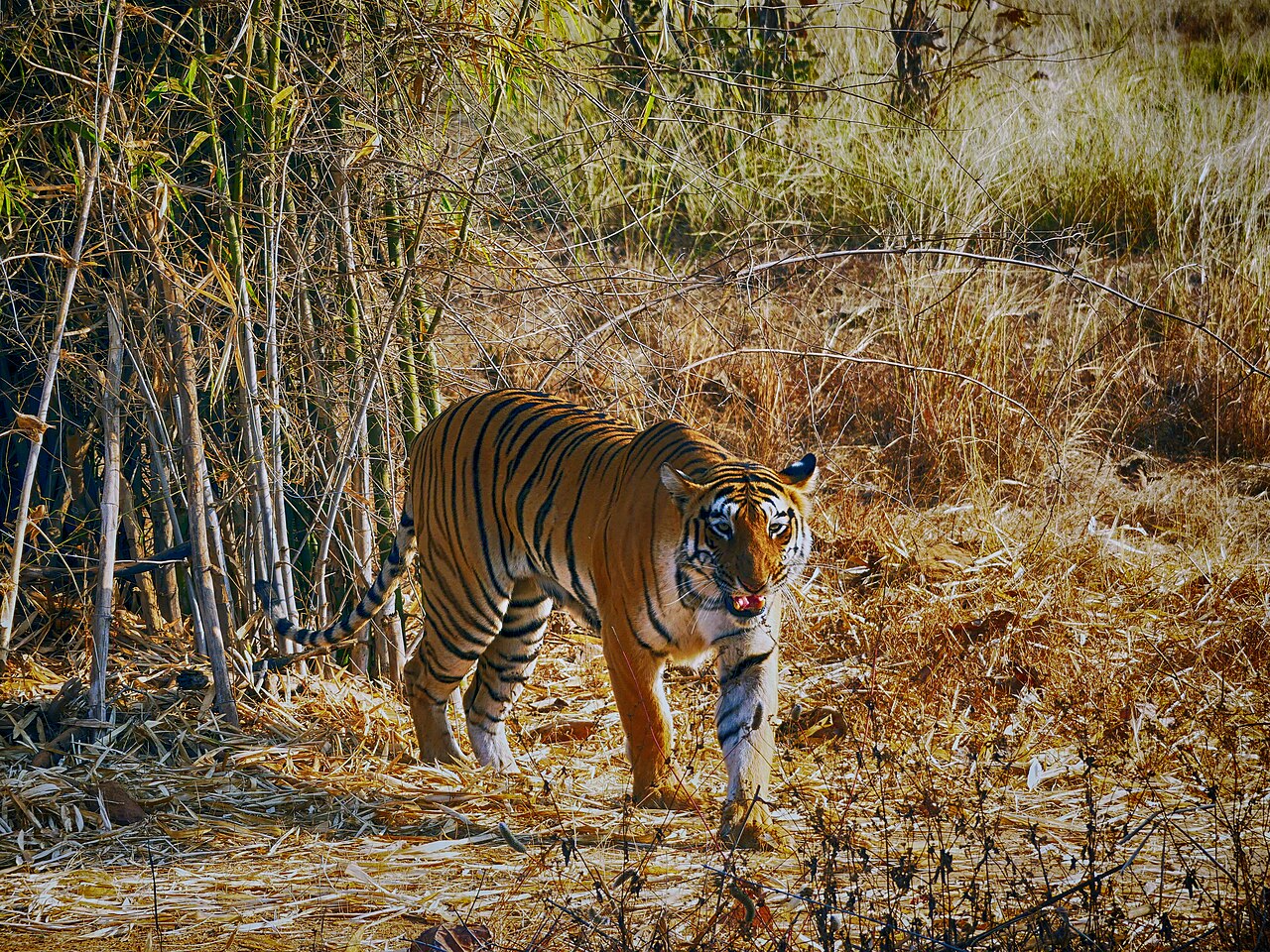
A forested tiger reserve in southern India is home to a thriving population of spotted and sambar deer, nilgai antelopes, and wild pigs — all ideal prey for tigers. Yet the reserve has no resident tigers, reports contributor Nivedhika Krishnan for Mongabay India. Kawal Tiger Reserve in the state of Telangana connects key tiger populations in the reserves of Tadoba-Andhari, in Maharashtra state to the west, and Indravati, in Chhattisgarh state to the east. Since 2015, researchers have confirmed that only 15 tigers entered Kawal from Maharashtra. Of these, only two were females. Lead researcher Imran Siddiqui told Mongabay India that tigers traveling from Maharashtra to Kawal face heavy infrastructure throughout their journey. “The corridor is fragmented by open-cast coal mines, the Ada irrigation project, electrified farm fences, and the main Hyderabad-Nagpur railway line,” Siddiqui said. “National Highway 44 acts as the most formidable barrier of all with its heavy traffic and high fencing. It isn’t just one obstacle — it is a cumulative mosaic of risks that forces dispersing tigers to turn back.” He added that while male tigers dispersing from their birthplace are “bolder risk-takers” and can move long distances through human-dominated landscapes, female tigers are more risk-averse and “require quiet, undisturbed habitat to raise cubs.” “Crossing busy highways, railways, and mines poses a massive perceived threat to females,” Siddiqui said. “That is why males occasionally dodge traffic to reach Kawal, but females turn back. Without females, you simply cannot build a breeding population.” Anish Andheria, president and CEO of the Wildlife Conservation Trust, told Mongabay India that the reserve itself needs a core area free from human settlements, like in India’s other tiger reserves. As of 2023, there were 37 villages and 67 small settlements inside Kawal Tiger Reserve’s core, he said. But keeping people out of the ecosystem is a fraught issue. When Kawal was declared a tiger reserve in 2012, authorities had promised the resident Indigenous communities, the Adivasis, that the change wouldn’t harm their legal rights or survival, said Siddam Bhujang Rao, a local Adivasi leader. “But once the reserve was established, their stance completely shifted.” Families who were relocated from the core reserve, for instance, received little of what was promised to them in the official relocation package for the villages, Rao said. “They promised us land, water, and model villages,” he said. “Instead, families were moved to houses with crumbling plaster, and the agricultural lands were never handed over.” Wildlife managers have also floated the idea of “assisted dispersal,” where wild female tigers from dense populations in states like Maharashtra are airlifted directly into Kawal. But Siddiqui warned that such manual translocations aren’t “a shortcut for fixing broken corridors.” “Bringing tigers from outside will not work,” Rao agreed. “It is a flawed idea, and it should be abandoned.” Read the full story by Nivedhika Krishnan here. Banner image: A tiger in Tadoba-Andhari Tiger Reserve, from where tigers move to Kawal Tiger Reserve but do not live there. Representative image by A.J.T Johnsingh, WWF-India & NCF via Wikimedia Commons (CC BY-SA 4.0). Credits Topics
Roads, infrastructure prevent tigers from settling in Indian tiger reserve
Full Article
Original Source
Read the full article at News →KhanList aggregates and links to publicly available news content. We do not host full articles from third-party sources. Always verify important information with original sources.