
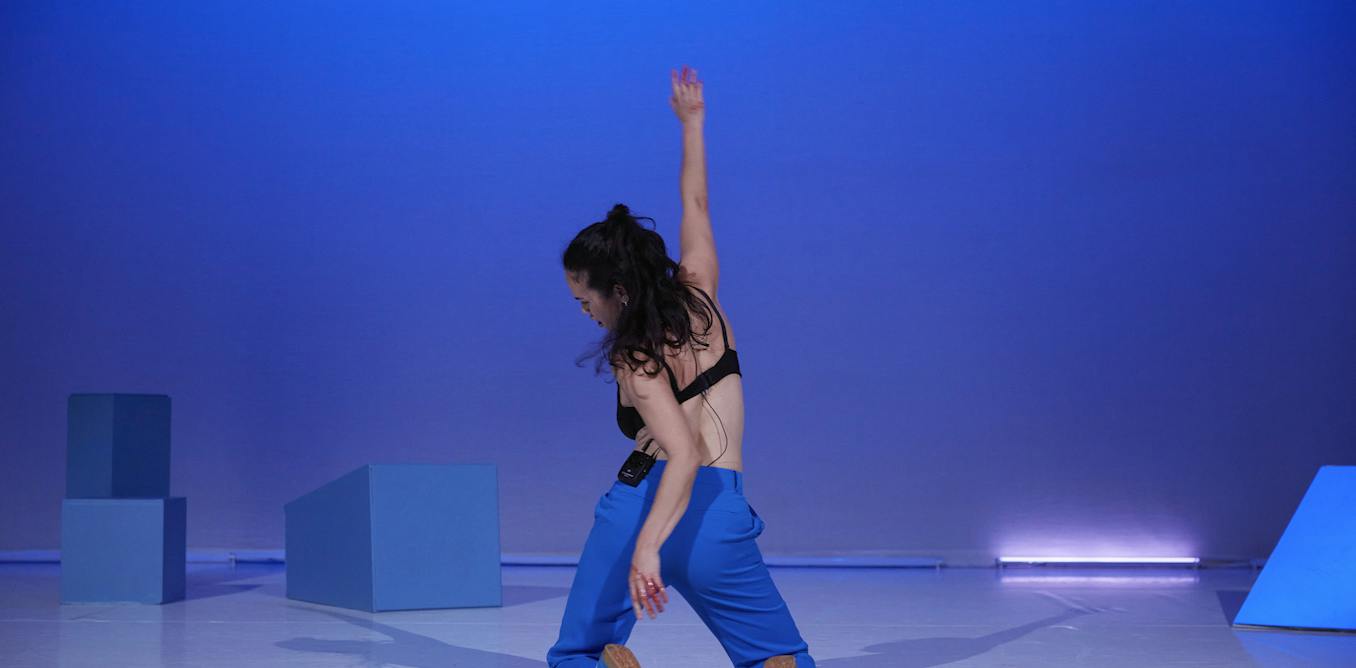
In the beginning, there is a stage: glowing lilac with fluorescent floor lights downstage and upstage, four blue blocks and one silver wedge. A figure appears: an Auslan interpreter, who signs the recorded Acknowledgement of Country. We are on Gadigal land. Another figure appears: Bundjalung (Australia) and Ngāpuhi (Aotearoa New Zealand) dancer and choreographer Amrita Hepi – co-creator and performer of Rinse, making its Sydney Opera House debut after showing at Performance Space in 2022. Hepi regards the audience with a steady gaze. “In the beginning,” she intones, there was emptiness which is not to be confused with nothingness. She starts walking backwards in circles, hinting at the show’s temporality: we are going back to the start but also in spirals. A monologue about beginnings In the beginning, in the beginning, in the beginning – the phrase is repeated approximately 20 times in Rinse. Indeed, Hepi’s hour-long monologue could be described as a litany of starts, commencements and creations. There are profound beginnings: the procreating Māori gods Ranginui, the sky father, and Papatūānuku, the earth mother. There are profane beginnings: for in the beginning was the Word, and the Word was with God, and the Word was delivered by a dancer hoicking up a gummy bear. There are banal beginnings: reminders to preheat the oven before roasting a chicken, delivered in the overly familiar tones of an influencer. There are shocking beginnings, such as when an egg – which may or may not have come before the chicken – is smashed. There are funny beginnings: unlikely meet-cutes, told in a rush and with a touch of vocal fry. And there are ominous beginnings: boats on the horizons and newcomers who try to stop the First Peoples’ dancing. Amrita Hepi in Rinse. Joseph Mayers/Sydney Opera House Wide-ranging choreography Like the script, the choreography ranges across eras, genres and traditions with ease. Hepi’s is a choreography of subtle and multiple traces. Subtle because she often conjures a particular moment or movement with the slightest change in posture or gesture. Multiple because she combines First Nations choreographies with postmodern dance, pop culture and yoga poses. Midway, Hepi conjures various Māori hakas with little more than a huffing breath, a trembling hand and an elastic mouth. It is thrilling to see these movements – so often seen done by a collective of men on television – ripple across the body of a solo woman on stage while she explains “there is watching the haka and there is doing the haka”. Hepi also gestures towards her Aboriginal inheritance: dancing as ceremony, transmission and immersion. In the beginning, “you didn’t buy tickets, you were there, in it”. Now you can buy tickets to see the work of Vicki Van Hout, Dalisa Pigram, Daniel Riley, Jacob Boehme and Stephen Page, among others. A panoply of influences We see – and Hepi narrates – her Western influences, too. She holds an elegant bras bas while telling the story of Beth Dean, a young white American woman who danced the role of “boy initiate” in a ballet titled Corroboree for the young white Queen in 1954. Incredibly, the Australian Ballet resurrected the work in 1994. Recounting this, Hepi swears, explodes off the plinth and lands with a disdainful thump. More positively, there are the influences of Anne Teresa de Keersmaeker’s feet (one flat, one on the toes), Yvonne Rainer’s mouth (saying no) and Pina Bausch’s hair (loose and whipping). Carolee Schneemann’s Interior Scroll is conjured with a slight tug at the groin. These high art influences exist alongside musicals and pop culture. Hepi gives shout-outs to Beyoncé and Jay-Z and the movies Flashdance (1983) and Save the Last Dance (2001). In one section, she wheels a television onstage and sits like a mermaid on a rock to watch the mesmerising finale of Busby Berkeley’s The Gang’s All Here (1943). She admits to dreaming similarly extravagant dreams for this show, then downsizing them to fit “a small arts organisation in Australia”. In another section, she embodies a pop star: music pumping and lights strobing, as she strides the stage and exhorts the crowd to join a call and response. Hepi watches the hallucinatory finale to Busby Berkeley’s The Gang’s All Here. Joseph Mayers/Sydney Opera House A mid-career triumph The irony of a show about beginnings is that an early-career artist could not make it. The reason Rinse works is that it is the product of two accomplished mid-career artists working with wit and economy. Elements of the script reminded me of co-creator Mish Grigor’s previous work with the performance collective Post. In particular, their catalogue of theatrical deaths in Oedipus Schmoedipus, which shocked the Sydney Festival over a decade ago. Rinse – and Hepi’s performance of it – displays the same combination of lightness and precision, invitation and implication. The promise of theatre is that each time we can – and do – begin again. In the briefest of asides, Hepi hints that she is somewhat fatigued with this again-ness, having toured this show internationally for four years. Rinse’s success is a testament to its conceptual and theatrical beauty – but perhaps it is time for this rehearsal of beginnings to conclude. So much has already happened, as Hepi says in the show’s close. But there is also so much more to come – including, hopefully, from this artistic pair. Rinse played at the Sydney Opera House September 10-12. It tours to Portugal later this month.
Rinse: Amrita Hepi’s show about beginnings is a mid-career masterpiece
Full Article
Original Source
Read the full article at Theconversation →KhanList aggregates and links to publicly available news content. We do not host full articles from third-party sources. Always verify important information with original sources.