
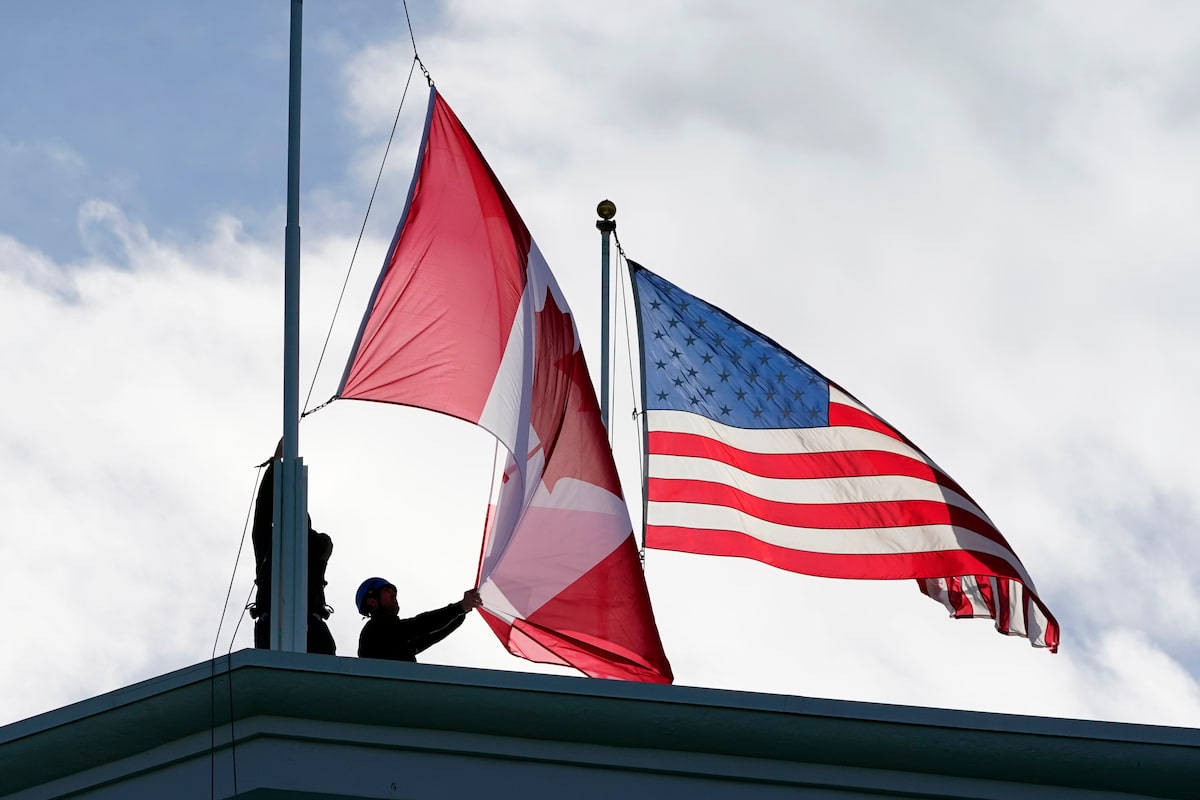
Open this photo in gallery:State park workers install a Canadian flag atop the Peace Arch in Blaine, Wash. The Canada-U.S. fracture has grown deep enough that Democratic political consultants are preparing polling questions to gauge public sentiment on the matter.Elaine Thompson/The Associated PressAt the northern edge of Washington state, the political establishment is contemplating a question no one can remember asking before. Could Canada be an election priority this year?“Historically, this hasn’t been a topic of interest,” says Alicia Rule, a Washington state representative who lives in Blaine, just south of the most important West Coast land border crossings. But after more than a year of sparring between the two countries – with Canadians cancelling travel plans, increasingly hostile rhetoric from the White House and now a surge of punishing tariffs that has upended cross-border trade – that is changing. The U.S. fractures with Canada have grown deep enough that Democratic political consultants are preparing polling questions to gauge public sentiment on the matter, a reflection of how the Canada question could drive ballot decisions during midterm voting later this year.“I’ve been in electoral politics for over 30 years and I’ve never tested anything about the northern border,” said Dean Nielsen, a Seattle-based political messaging strategist who has worked in Democratic politics since the 1992 Bill Clinton campaign.This year, though, “it’s largely about, do voters feel that the candidates need to have an agenda to reach out to our Canadian neighbours and build stronger ties for tourism and trade because of what’s happening? Because ultimately, communities are hurting.”Donald Trump’s battles with Canada form part of his broader bid to extract greater U.S. benefit from its traditional allies, which his administration has pushed to spend more on defence and offer greater economic concessions. Supporters are thrilled.Trump bans imports of some Canadian goods in response to Ottawa’s countertariffsCanada needs to “understand its place,” said Patrick Wolf, the Republican Party youth committeeman in Idaho’s Kootenai County. “In America’s eyes, Canada should be like Mexico, a subservient trade partner.”But Mr. Trump’s attacks on Canada – with tariffs set at levels he has imposed on countries like China, in the midst of continued annexation threats – have also placed Americans in the position of treating their northern neighbours as foes, a posture even some Republicans have found uncomfortable.“I don’t think we look at Canada as a bad neighbour in any capacity whatsoever,” said Scott McCarthy, co-founder of Elevated Impact, a Bismarck, N.D.-based campaign strategy company.“North Dakotans don’t want to penalize Canada or say anything bad about Canada,” he said. “They just want to do business.”Two-thirds of North Dakotans voted for Mr. Trump in 2024 and many remain willing to look past his rhetoric and disruptive actions. “We think of it as his art of the deal, of throwing some stuff around and making it work at the end,” Mr. McCarthy said.But Mr. Trump’s national support has weakened over the course of his second term and his altercations with Canada have proven particularly unpopular. An Ipsos poll released last week found that only a quarter of American respondents support tough measures against Canada, and just one in five want to see additional tariffs on Canadian goods. A mere 4 per cent expect tariffs on Canada to benefit them financially. (Measures like renaming Lake Ontario to Lake America are unpopular even among Republicans.)Open this photo in gallery:People in Toronto look out across Lake Ontario. Donald Trump's effort to rename the lake is unpopular even among Republicans.Keito Newman/The Canadian PressDemocrats spy opportunity. Some of the greatest erosion in support for Mr. Trump has come in northern agricultural states. Among the Republicans who have broken with Mr. Trump is Dan Newhouse. The Congressman from central Washington, who is not running for re-election, has opposed tariffs, citing an economy in his home state that “is closely intertwined with that of our neighbours to the north.”In Idaho, approval of Mr. Trump among registered voters has plummeted 18 points since his inauguration last year, according to Civiqs, a polling firm. In North Dakota, it’s down 10 points; in Montana, 11. In Iowa, it has fallen by 15. “They export wheat, they export livestock. And this whole Trump type of administration is hurting them in their pocketbooks,” said Mr. Nielsen, who founded CN4 Partners. “His war on immigration is hurting them on the labour standpoint.”Tariffs on Canadian goods stand to further raise costs in the U.S., adding to concerns about living costs that Democrats have identified as a core political priority in elections this November that could remake the power balance in Congress.The trade war with Canada is “wrapped up into this affordability crisis that we’re all experiencing,” Mr. Nielsen said. “People are really taking it in the shorts.” Carney focuses on attracting investment and economic growth as U.S. trade war deepensIn more conservative areas, Mr. Trump has nonetheless won credit for pressing Canada, his tactics reviving past moments of animus. American farmers have often felt that agriculture goods travel more easily into the U.S. than into Canada.“It doesn’t always feel like Canada is playing fair and by the rules,” said Pat Finken, who recently retired from a lengthy career as an influential North Dakota political consultant and campaigner. “There are some long-standing issues where we feel a bit impugned,” he said.Resentments also linger after decades of sparring with Manitoba over how to manage floodwaters from a North Dakota waterbody called Devils Lake. “We have a lot of common ancestry and want to be friends – but there is a desire, too, for some level of fairness,” Mr. Finken said.The most assertive of Mr. Trump’s supporters have less concern for niceties. While it makes sense for Canada to be the best trading partner for the U.S., Mr. Trump should extract the most favourable terms for his own country, said Mr. Wolf. He grew up in Duluth, Minn., before moving to Idaho, where he is executive director of the Institute for American Manufacturing & Technology. “There’s a lot of major resentment” for the way past U.S. agreements – including on North American free trade – gutted the American industrial base, he said. He raised concern, too, that Canadian rapprochement with China amounts to welcoming an adversary onto the U.S. doorstep. The American imperative to counter those developments, he said, outweighs international amity.“The general view, outside of hockey, is that Canada is not an equal in terms of size and stature.”Editorial: In a trade war, it must be clear why we fightElsewhere, though, the widening rift with Canada is galvanizing fresh opposition to Mr. Trump.“I don’t see a world in which this works to our advantage in any way,” said Ms. Rule, the Washington state lawmaker. She is a Democrat who previously served on Blaine city council. She hears daily from constituents complaining about changes that have turned the U.S. border with Canada into a barrier. It’s hurting agriculture. It’s hurting the resort business. It’s hurting municipalities that rely on the revenues from those groups. It’s hurting personal relationships.“Of course we care about this,” Ms. Rule said. “This is a primary issue now.”
Rift with Canada shows potential to become a pressing U.S. election issue
Full Article
Original Source
Read the full article at Theglobeandmail →KhanList aggregates and links to publicly available news content. We do not host full articles from third-party sources. Always verify important information with original sources.